


Director Gabbard,
Before you were confirmed in February 2025, I wrote in The Hill that the incoming director of national intelligence (DNI) would face a test not of ideology but of integrity. Under this president, the danger was never simply that intelligence would be ignored; presidents have ignored intelligence before. The deeper danger was that the office of the DNI (ODNI) would be turned into an instrument for validating presidential instinct.
After your confirmation, I wrote my first letter to you in The Contrarian, emphasizing that reform done in service of a political narrative would come at the expense of national security. At 100 days, I wrote again — this time more directly — warning that the next intelligence failure would not be circumstantial. It would be structural — produced by a leadership culture that you established, which rewarded conformity and punished accuracy.
Now, in response to your announced departure, comes this third letter — an update of a draft I wrote in June 2025 after the United States became entangled in Israel’s military campaign against Iran.
At the time, I thought your tenure was nearing its end. The public dissonance in the lead-up to the June 22 strikes on Iranian nuclear facilities was too stark: your March testimony to Congress that Iran was not actively building a nuclear weapon; the video you released from Hiroshima on June 10 warning about nuclear escalation, which seemed less like intelligence leadership than personal branding in the middle of a crisis; the president’s dismissal on June 17 of your congressional testimony with “I don’t care what she said”; and your scramble to insist hours later you and Donald Trump were “on the same page.”
I was wrong about the timing of your departure. I was not wrong about the trajectory you were on. What followed only clarified it.
In July, you accused the Obama administration of a “treasonous conspiracy” over the 2016 Russia assessment, claiming “irrefutable evidence.” Yet the CIA review commissioned under Director John Ratcliffe did not support the sweeping charge. It identified flaws and procedural concerns, but it also found that much of the assessment’s tradecraft was “robust and consistent” with intelligence standards.
You had come into office promising to root out politicization. Instead, you modeled it. You framed uncertainty as certainty. You turned a legitimate debate about analytic rigor into a political charge sheet.
By August, that approach had moved deeper into the machinery. After months of blunt-force actions — cutting offices, removing personnel, weakening internal processes, and pulling intelligence functions more tightly under your control — you announced a sweeping ODNI reorganization. Streamlining is not inherently illegitimate; the office has long faced criticism for becoming too large, layered, and detached from its original integrating mission. But in context, the cuts looked like part of a larger effort to recast intelligence integration as political housecleaning.
The revocation of security clearances from 37 current and former officials sharpened that concern. The memo accused them of politicizing or weaponizing intelligence, among other alleged misconduct, but, according to AP reporting, it did not provide evidence to back up the accusations.
In the months that followed, the geography of influence told the story more clearly than any formal announcement could. When the administration planned and executed its most consequential foreign operations to date — the January 3 mission to seize Venezuelan President Nicolás Maduro and the Israeli-partnered war with Iran that commenced on February 28 — you were absent from the decision-making circle; CIA director John Ratcliffe was not.
When your presence at a high-profile action was photographed, it was not at the president’s side during a foreign crisis. It was at the January 28 seizure of election materials outside Atlanta. That was the clearest example of what your role had become.
You were not reduced to a symbol, exactly. That would imply the president cared enough about intelligence to need one. Your role became more prosaic and more damaging: you were useful when the administration needed the intelligence label attached to political grievance, and absent when strategic judgment was required.
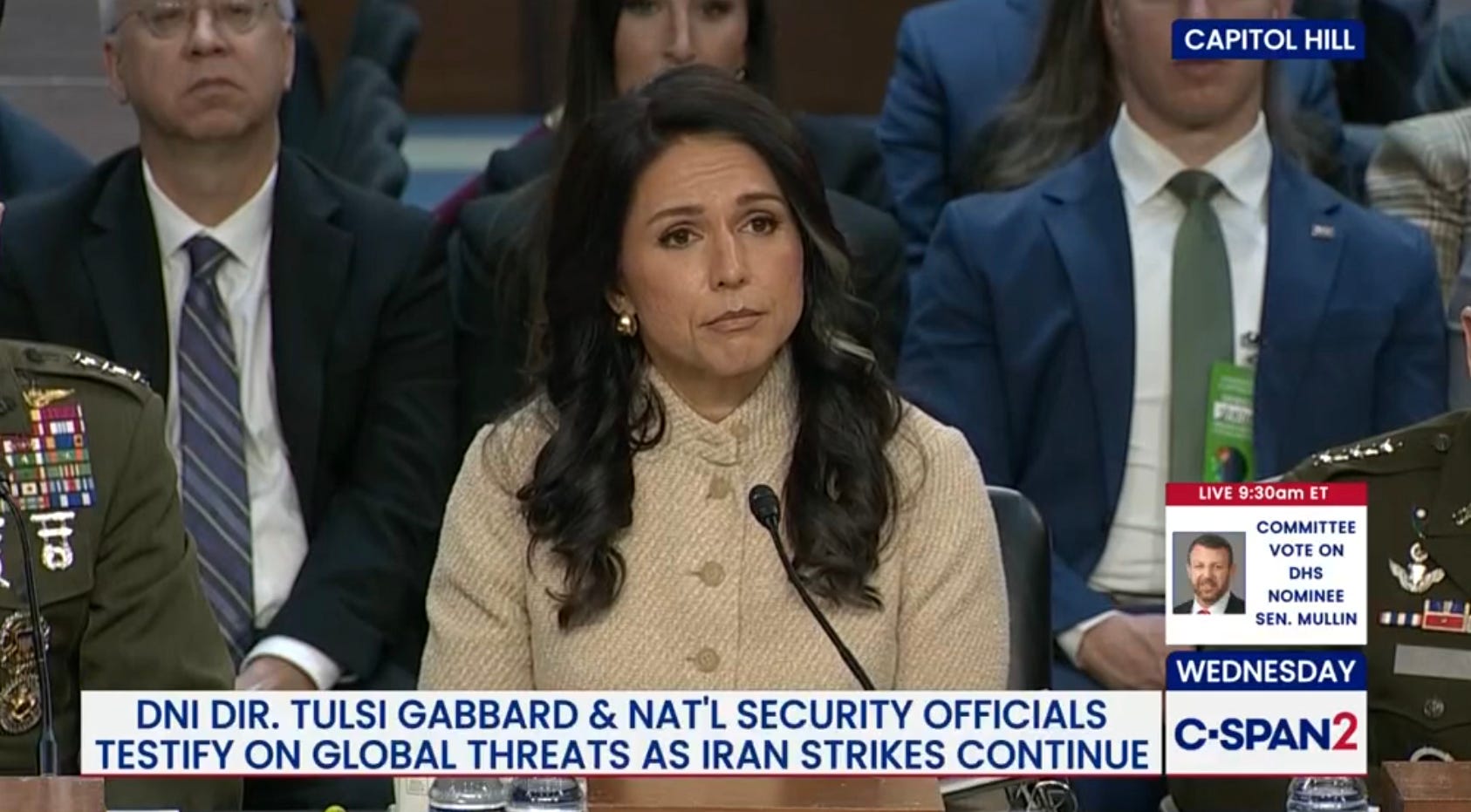
Your March 2026 congressional testimony supplied the final tableau. Asked at the Annual Threat Assessment hearing whether the intelligence community had assessed Iran to be an imminent nuclear threat justifying the war, you answered that “the only person who can determine what is and is not an imminent threat is the president.” That formulation may have sounded loyal, but it was also an abdication.
Presidents decide policy. They order strikes. They accept risk. But intelligence assesses threats, weighs evidence, conveys uncertainty, and warns. When you say that the president alone determines imminence, you are not protecting the president’s authority. You are surrendering the intelligence function.
I told you before that I was not rooting for your failure. I am not celebrating now. I wish you and your family strength in the days ahead.
I will not, however, minimize the damage of your tenure.
You weakened the role of DNI not merely through budget cuts or bureaucratic reshuffling but through something more corrosive: the conversion of intelligence leadership into political utility. Dissent was treated as disloyalty. Accuracy became negotiable when it collided with presidential instinct. The distinction between message and mission blurred.
You join the ranks of recently departed Cabinet officials who held national-security titles while surrendering their offices to the president’s political needs. That is not a legacy worthy of the title you kept.
Brian O’Neill, a retired senior executive from the CIA and National Counterterrorism Center, is an instructor on strategic intelligence at Georgia Tech. His Safehouse Briefing Substack looks at what’s ahead in global security, geopolitics, and national strategy.

She is a typical cowardly toady in this vile tRUMP administration. The security and well-being of the United States and its citizens are irrelevant to her. She just wanted to keep her job. Despicable.
You said it nicer than me, Mr. O'Neill.