


Civil rights icon Dolores Huerta has shared a devastating truth she carried alone for sixty years: that her closest colleague, mentor, boss — and the internationally revered face of the farmworker movement, César Chávez — sexually abused her. As she approaches her 96th birthday, and in the wake of a New York Times investigation revealing that she was not alone — that Chávez also preyed upon other young women, including underage girls — Dolores made the painful, courageous decision that she could no longer keep this secret.
Across Latino, immigrant, labor, civil rights, and farmworker communities — and far beyond — hearts broke and jaws dropped. César Chávez had ascended to the pinnacle of untouchable legend. And from that height, there was a long, painful fall.
There will be many debates about what comes next: what to do with the written history, the plazas, streets, schools, parks, and holidays that bear Chávez’s name; how to reconcile the image so many of us learned with the disturbing portrait described by Dolores and the other survivors. I will leave the deeper historical reckoning to others. But it feels both fitting and just that the holiday bearing his name be revised to Farmworkers Day — El Día del Campesino — and that every boulevard, park, and street honor Dolores Huerta instead.
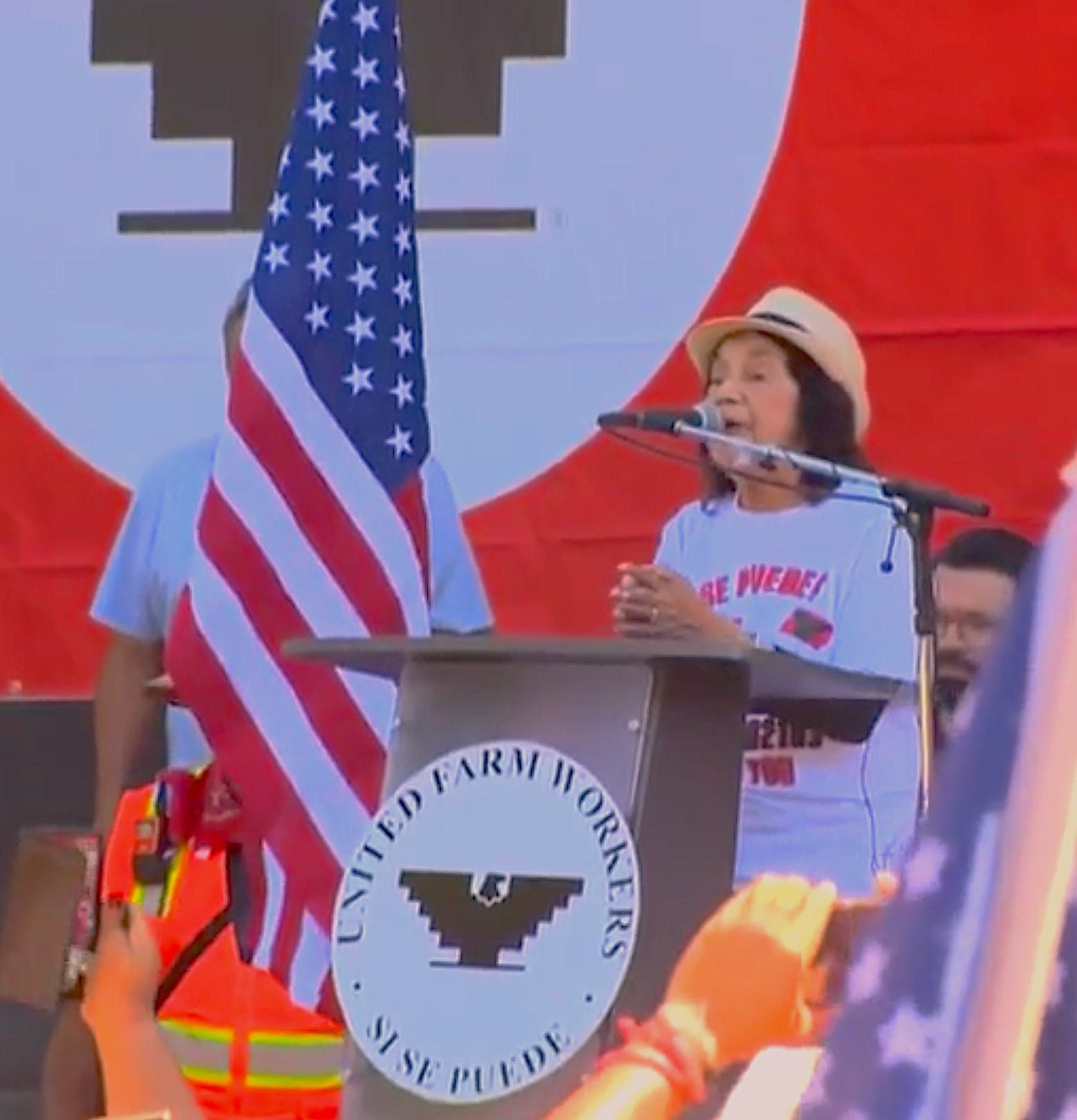
She — and the women who endured in silence for the sake of the movement — are the ones we must uplift now. They are the ones who deserve our reverence, our gratitude, and our protection.
It is almost impossible to fathom the depth of trauma, isolation, fear, and heartbreak Dolores Huerta has carried for six decades — largely alone. To be sexually abused by one’s boss, a man elevated to national hero status, someone widely believed to be incapable of wrongdoing, while he inflicted unspeakable harm behind closed doors — this is a burden few can imagine, but one that way too women still endure today.
And yet, some will still ask the familiar, painful question: Why did she stay silent for so long?
The answer is both simple and devastating. This is what too many women do — especially Latina women. We are raised to be caregivers before anything else; protectors of our families, our children, our communities. We are taught to hold everything together, to sacrifice ourselves, to endure quietly for the greater good. In Dolores’s own words, she stayed silent for her family, her community, and the farmworker movement to which she devoted her life.
Pues ya basta. Enough is enough.
As she has done time and again — often without credit, often without recognition — Dolores Huerta is once more leading us forward. This time, into a new era of truth, transparency, and accountability. Her story, alongside those of the other brave survivors, reflects a tale as old as power itself: a man intoxicated by authority and adulation comes to believe that women are his to control; he uses his power to violate them, silence them, and strip them of dignity so that his secret remains buried.
Let us be absolutely clear: none of these horrific revelations erase the very real gains made in farmworkers’ rights through years of grueling, backbreaking organizing. Those victories belong to an entire movement. Yes, Chávez was a leader — but so much of the unacknowledged credit belongs to Dolores Huerta and to the women who powered that movement from behind the curtain.
The movement was always bigger than one man. And it is certainly stronger than his moral failure.
Dolores Huerta and these women are the movement’s true, unspoken heroes. Dolores organized the boycotts. She coined the immortal words “Sí se puede.” She co-founded the United Farm Workers. She stood beside Robert F. Kennedy in his final days. And yet, history too often reduced her to a “sidekick” — a demeaning and inaccurate label even before we knew the full truth, and now a cruel mockery of the suffering she endured.
And still — despite everything — Dolores persevered. If her silence cost her dearly, it also revealed her extraordinary strength. She never stopped showing up for those whose rights were denied or ignored: farmworkers, immigrants, Latinos, women, and all those pushed to the margins or into the shadows. She marched. She rallied. She organized. She supported leaders who stood with workers. She never abandoned the call to justice.
Now, we owe her.
This moment of truth — for Dolores and for the other survivors — must also be ours. During this Women’s History Month, let us recommit ourselves to unequivocally believing and supporting women who come forward with stories of sexual violence and abuse at the hands of powerful men. Let us refuse to look away, knowing this is still happening every day — in the fields, in homes, in factories — where Latina and immigrant women continue to suffer in silence. It is long past time to hold perpetrators accountable, no matter how powerful they may be.
The name Dolores means pains in Spanish. Let us now transform that pain into purpose.
Let us show Dolores — and every woman who has suffered in silence — that their courage was not in vain. Let us honor them by deepening our commitment to service, by defending workers’ and women’s rights with renewed resolve, and by never backing down in the face of power, cruelty, misogyny, or sexism.
And yes — dare I say it — Sí, se puede! Yes, We Can!

Thank you, Ms Huerta. For some of us our abusers were not iconic, just soulless males. I am sorry you have carried this pain in silence for so long. I stand with you. ❤️
Thank you for speaking out and for all the very hard work over so many years. When will we hold those in the Epstein files accountable?