


The Supreme Court took another major step toward letting Donald Trump act as a king by essentially saying no one can sue to challenge his unconstitutionally demolishing the East Wing of the White House to build his huge ballroom. In coming to this conclusion, the court ignored long-standing precedents as to who has standing to sue in federal court. Strikingly, not even Chief Justice John G. Roberts Jr. could stomach this and joined with the liberal justices in dissent.
Without congressional approval or congressional appropriation of funds, Trump demolished the East Wing of the White House, aiming to build a 90,000-square-foot ballroom. The law is clear that Congress is in charge of federal property and must authorize this change. As the U.S. Court of Appeals for the D.C. Circuit explained: “Congress has not ceded unfettered authority to the Executive Branch to dramatically redesign, reshape, and reconstruct the White House—the People’s House—to fit a particular President’s desires.”
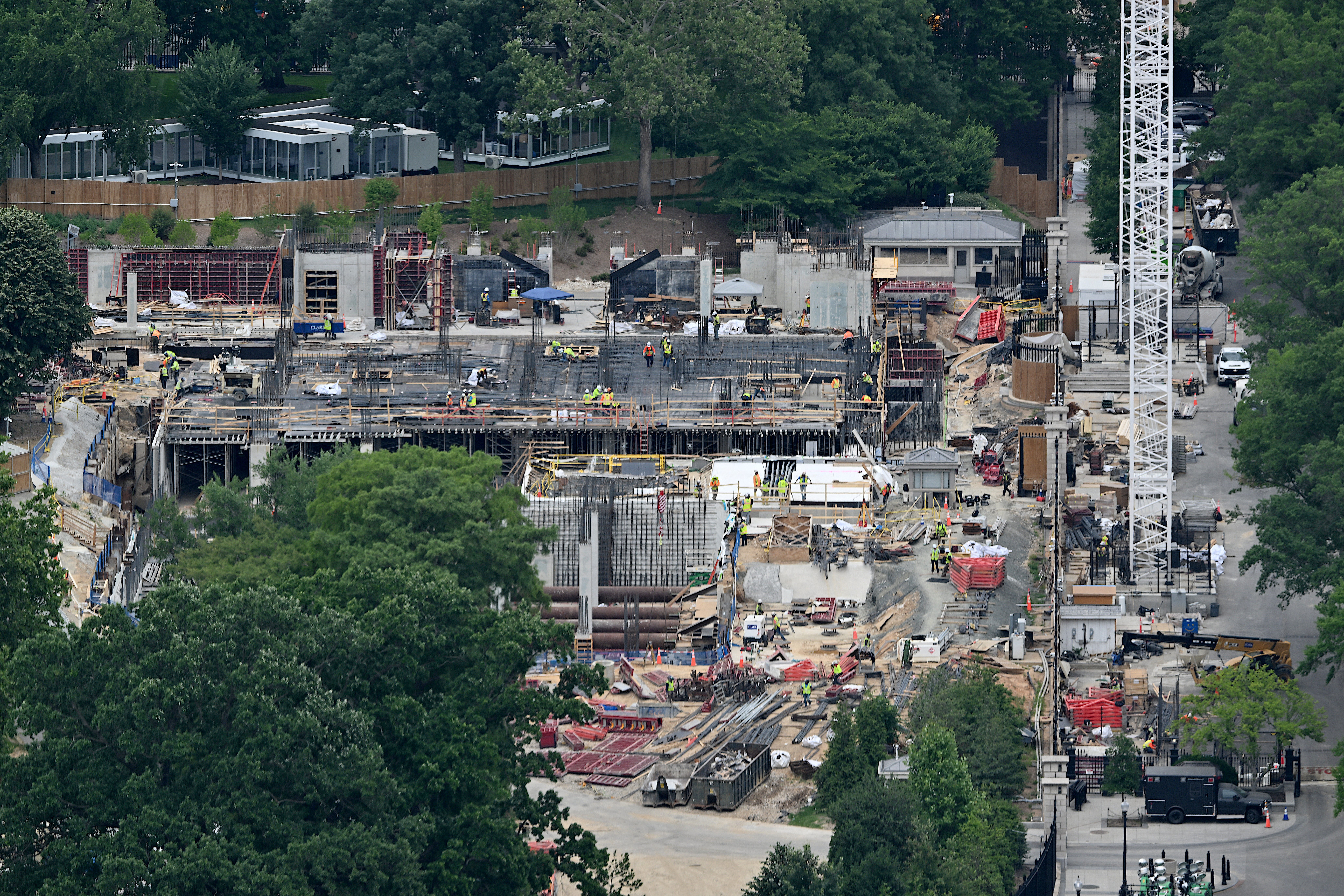
Also, it is estimated that this will cost about $600 million, and though some of the money will be privately raised, there will be significant cost to the federal treasury. Congress, which exclusively holds the power of the purse, has approved no funds for this.
It is stunning that none of the justices argued or even suggested that Trump’s actions are legal. There is no doubt that Trump’s unilateral action violates the Constitution and federal statutes.
The National Trust for Historic Preservation, a congressionally chartered organization that seeks to preserve and promote the United States’ architectural and cultural heritage, brought a lawsuit challenging the demolition of the East Wing and the building of the enormous ballroom. Under well-established legal precedent, an organization must allege, among other things, that one of its members has standing to sue.
Standing requires that an individual has personally suffered an injury. The complaint in the case identified Alison Hoagland, an architectural historian and professor emerita in historic preservation. In her declaration, she said that she has been a member of the National Trust for over 40 years, and is currently a trustee, and serves on its executive committee. She said that she routinely walks in front of the White House and in Lafayette Square directly across from the White House, and she “intend[s] to continue” doing so. She said that the demolition of the East Wing and the construction of the ballroom will substantially change for the worse the aesthetics of that area.
The federal district court concluded that this was sufficient for the National Trust to have standing to sue and found that the demolition and construction of the East Wing was illegal and unconstitutional. Judge Richard Leon, widely regarded as conservative, ruled that the construction of an underground bunker, which Trump said is needed for national security, could continue. But the above-ground demolition and construction had to stop until there was congressional approval.
The appeals court agreed. It pointed out that the Supreme Court many times had said that claims of aesthetic injury are harms sufficient to allow standing to sue. For example, it pointed to Friends of the Earth v. Laidlaw (2000), in which the court held that individuals who lived within driving distance of a river and who fished in it and picnicked along its banks had standing to challenge water pollution. The appeals court in this case said that under the Trump administration’s “cramped standing theory . . . no one [would be] injured by a decision to raze the Statue of Liberty, to obscure the names on the Vietnam War Memorial, or to install a political billboard atop Mount Rushmore.”
Astoundingly, that is exactly the implications of what the Supreme Court ruled on Monday in National Park Service v. National Trust for Historic Preservation of the United States. It was a 5-4 decision, with the majority comprised of Justices Clarence Thomas, Samuel A. Alito, Neil Gorsuch, Brett Kavanaugh, and Amy Coney Barrett. The court concluded that no one was injured by the president’s demolition and construction and said “we have repeatedly held that mere offense, disagreement, or distaste does not qualify as a concrete or particularized injury under Article III.”
But this conclusion ignores the plaintiff’s complaint and the law. The plaintiff did not allege a claim based on “offense, disagreement, or distaste.” Rather, the plaintiff alleges an aesthetic injury and, as Roberts pointed out in dissent, “[o]ur precedents . . . have noted that an injury to a plaintiff’s mere esthetic interests can qualify as concrete and particularized” and therefore sufficient for standing.
Roberts — joined by Justices Sonia Sotomayor, Elena Kagan, and Ketanji Brown Jackson — explained that “Hoagland’s injury suffices for standing. A historic preservations such as Hoagland can be aesthetically injured in a concrete, particularized way by a transformation of a historic building that she frequently enjoys, just as an environmentalist can sustain a concrete, particularized aesthetic injury from the extinction of a particular animal or the transformation of a particular forest or river that he regularly enjoys.”
The effect of the Supreme Court’s decision is that no one will have standing to sue to challenge the president’s actions in destroying the East Wing and building a giant ballroom even though this is violating the Constitution and federal laws. Rather than performing its essential function of being a check on illegal actions by the president, the Supreme Court has empowered him to ignore the law and to nullify Congress’s powers under the Constitution.
It is frightening to see the five conservative justices twist the facts and ignore the law to allow Trump to do something that is clearly illegal and unconstitutional. Whether the ballroom is built is far less important than the court undermining the rule of law in this way.
Erwin Chemerinsky is dean and Jesse H. Choper Distinguished Professor of Law at the University of California Berkeley School of Law.

Can you imagine the noise that would come from the right if a Democratic president even thought about half the stuff Trump is doing?
“Congress has not ceded unfettered authority to the Executive Branch to dramatically redesign, reshape, and reconstruct the White House—the People’s House—to fit a particular President’s desires.”
The hell they haven't--at least the majority who happen to be Republicans!
This decision is so obviously biased in trump's favor, it makes me wonder, once again, who among the Supreme justices are in the Epstein files and what other bribes have brought the majority to heel.