


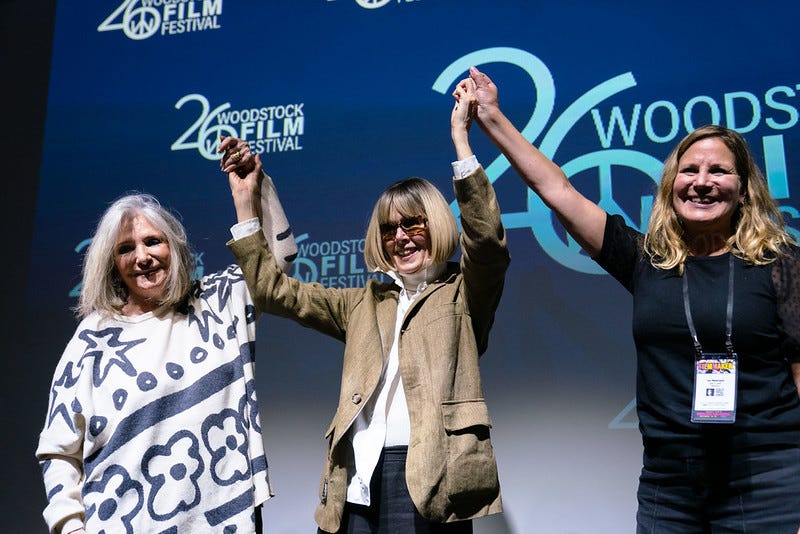
Ask E. Jean is a poignant documentary about E. Jean Carroll, the magazine writer who successfully sued Donald Trump for defamation and sexual abuse and has arguably done more to hold the president accountable than Congress, the Supreme Court, or most elected Democrats.
Directed by Ivy Meeropol, the film is an intimate, surprisingly funny portrait of a woman who has lived several lifetimes in her 81 years on the planet. Ask E. Jean recounts how Carroll, a college cheerleading champion and former Montana housewife, moved to New York in the ‘80s to pursue a writing career. She became an acclaimed contributor to outlets like Playboy, Esquire, and Elle, where she penned a witty advice column for more than 25 years, and hobnobbed at Elaine’s. She also hosted a cable talk show and was even briefly employed as a writer at Saturday Night Live.
In 2019, Carroll embarked on a new chapter as Trump’s most formidable legal adversary when she publicly accused him of raping her in a dressing room at Bergdorf Goodman decades earlier. Thanks to Carroll’s perseverance, Trump was ultimately found liable for sexual abuse and defamation, and ordered to pay a combined $88 million in damages—facts that all too often get drowned out by the president’s seemingly non-stop attacks on American democracy.
“The reason we made this movie is because people in this country do not know that Donald Trump has been held liable for sexual assault,” said Carroll at a sold-out screening at the Woodstock Film Festival last week, where she was joined by Meeropol and executive producer Sheila Nevins. “My next-door neighbor has no idea what Donald Trump did because their Facebook feed is different. So if this movie could be seen by people, it might make a difference. That’s why we’re working day and night to get this movie out.”
The filmmakers have their work cut out for them: as of now, Ask E. Jean, which debuted to positive reviews at the Telluride Film Festival in August, does not have a deal for theatrical distribution or a streaming release.
“No network particularly wants it. Maybe we’ll have a small theatrical release,” said Nevins, who supervised the production of more than 1,000 non-fiction films during her legendary run at HBO. “That’s another thing about this—films are hidden away because people are afraid to show them.”
Nevins also said that some of the film’s backers, fearful of the current political environment, have asked to have their names removed from the project. “I will not tell you who those people are, but they have money,” she said.
Meeropol also knows plenty about politically fraught filmmaking: her debut film, Heir to an Execution, looked at the lives of her grandparents, Julius and Ethel Rosenberg, who were convicted for spying and executed in 1953. Ask E. Jean was largely made in secret. “No one really knew about this film, except for the many people I tried to sell it to early on,” she said.
Ask E. Jean does not paint Carroll as a victim, but rather as a larger-than-life personality whose indomitable spirit served her well both as a trailblazing writer and as one of Trump’s greatest adversaries. Her sharp sense of humor and eccentricity shine through as she recalls some of her wild journalistic adventures, like camping with Fran Lebowitz and making out with William Hurt in a park. The end result is a documentary that’s as moving as it is entertaining.
“Ivy pulled off the impossible because she made a funny movie about sexual assault,” Carroll said Thursday at a post-screening Q&A. “She gives away the secret on how to beat Donald Trump.”
Meeropol draws from a wide array of material, including clips from the talk show Carroll was hosting when Trump allegedly assaulted her (also called Ask E. Jean) and, most powerfully, from the video depositions she gave in both Trump trials. She calmly responds to intrusive questions from Trump’s attorney, Alina Habba, who asks about everything from what Carroll was wearing on the day of the alleged rape to whether she had ever taken acting classes.
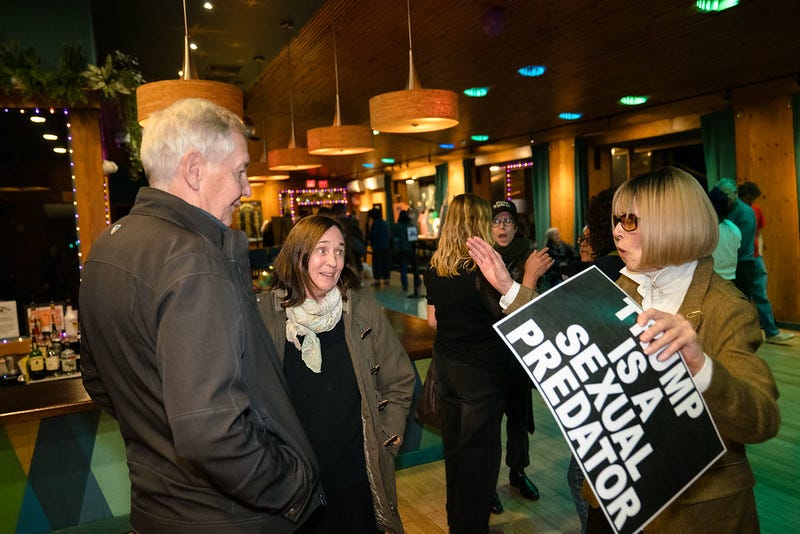
Carroll describes with vividly harrowing detail the encounter with Trump, which though “very brief,” has cast a long shadow over her life. She says she hasn’t had any lasting romantic relationships since that day at Bergdorf’s. The film also includes a portion of Trump’s video deposition in which he mistakenly identifies Carroll as his ex-wife, Marla Maples, in a photograph shortly after he dismisses her as “not my type.”
Though obviously sympathetic to Carroll, Ask E. Jean avoids hagiography. The film is clear-eyed about her evolution on matters of sexual abuse and harassment. We learn that she got a major break from none other than Roger Ailes and, in a clip from the ‘90s, we see her attack Anita Hill and Paula Jones for supposedly being “wimps.”
But the fact that she was so skeptical of accusers also explains her reluctance to come forward about Trump: she knew exactly the kind of judgment she could expect to receive because she had once doled it out. As Carroll says in the video deposition:
“Women who have been raped are looked at in this society as less, are looked at as spoiled goods, are looked at as rather dumb to let themselves get attacked.”
Carroll is also keenly aware of how she will be perceived as an older woman accusing a rich, powerful man of rape. So before going to trial, she asks her hairstylist to recreate the sharp bob she sported in the ‘90s. Otherwise, she wonders, “Who is going to believe that an 80-year-old woman is fuckable?”
The future of Ask E. Jean is far from certain. On the one hand, the project seems like it would be an obvious “get” for any studio or streamer, given the intense interest in Carroll’s case (and the fact that her books are reliable bestsellers). Yet given the cowardice that has gripped much of Hollywood, it seems entirely plausible that the film won’t reach a wide audience—even as an Amazon documentary about Melania Trump and directed by alleged sexual predator Brett Ratner, heads to theaters in January.
On Thursday, Carroll made it clear that, unlike the tech oligarchs increasingly in charge of the entertainment industry, she wasn’t going to be cowed by Trump. “People ask, ‘Are you frightened?’ I say, ‘Don’t think about me,’” she said. Instead, Carroll encouraged people to take action: “We’re going to have to leave our houses, get off our phones, and take to the streets.”
Meredith Blake is the culture columnist for The Contrarian
I’d take exception to the following: “ Meeropol draws from a wide array of material, including clips from the talk show Carroll was hosting when Trump allegedly assaulted her (also called Ask E. Jean) and, most powerfully, from the video depositions she gave in both Trump trials.” It says Trump ALLEGEDLY assaulted her. He was found legally liable for sexual assault against Carroll. There is no longer anything alleged about it. He did it. He is legally a sexual predator. His enablers repeatedly use language that obscures the truth and then journalists repeat it and the lies are reinforced. The truth matters. Just as with the Epstein case, the victims weren’t “underaged women”. That’s an oxymoron. They were children. And Trump’s crime against Carroll is no longer alleged. It’s fact. Or am I wrong?
E. Jean Carroll, you are a true hero. Thank you for your tremendous courage.