


I’m not much of a soccer fan, and unlike many Americans, I haven’t been swept up by World Cup fever. But it’s been impossible to avoid catching glimpses — at restaurants and bars, visiting friends and family, scrolling social media.
Almost any time I glance at a screen, there’s a certain ad lining the sides of fields across North America: ARAMCO.
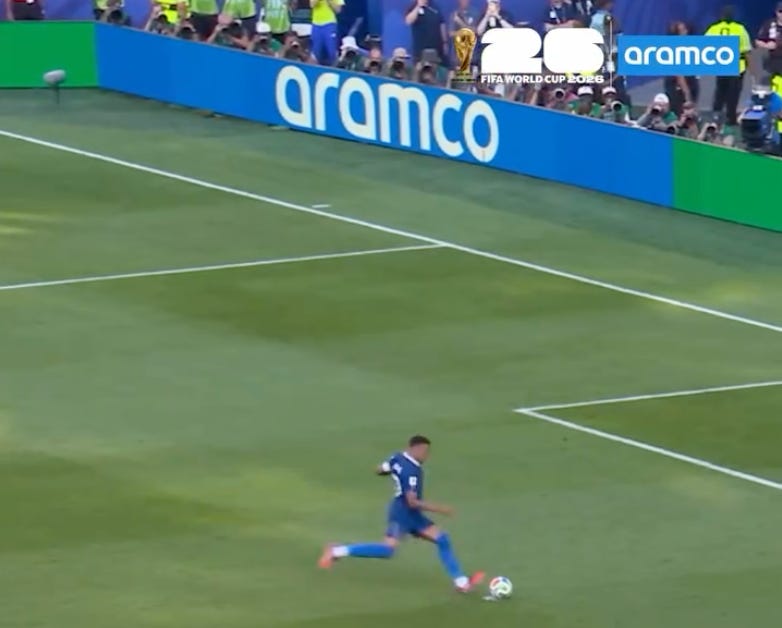
That would be Saudi Aramco, the oil giant owned by the Saudi Arabian government. In 2024, the company inked a four-year sponsorship deal with FIFA, estimated to cost $400 million. For Crown Prince Mohammed bin Salman, the country’s de facto leader, plastering the World Cup with ads is part of a longstanding strategy to improve Saudi Arabia’s image, attract tourists, and diversify its economy, while maintaining its status as a leading oil exporter — even as the climate crisis worsens.
So far, the strategy appears to be working — with help from President Trump.
“Whether through Aramco or other state bodies, the influence the Saudis are trying to exert is pretty significant,” said Nicholas McGeehan, director of London-based human rights nonprofit FairSquare, which last month released a thorough report on Aramco’s relationship with FIFA.
“Aramco is a supervillain,” McGeehan said.
It’s been a decade since bin Salman unveiled Vision 2030, a master plan to modernize the kingdom’s economy and bring more women into the workforce. Experts say the crown prince wants Saudis to live healthier, more fulfilled lives. He also wants international tourists to stop seeing Saudi Arabia as a human rights abuser that kills journalists, and instead view it as a hot vacation spot with world-class resorts, comedy, and sports, including the 2034 World Cup.
That’s where those FIFA ads come in handy.
“The World Cup has an audience that is larger than anything comparable. The world is watching,” said Kristian Coates Ulrichsen, a Middle East fellow at Rice University’s Baker Institute for Public Policy.
It’s not that U.S. viewers are seeing Aramco ads and deciding they no longer care that in 2018, Saudi agents killed and dismembered Washington Post columnist Jamal Khashoggi — a murder the CIA concluded was ordered by bin Salman.
Like all sponsored content, the effects are more subtle.
“The objective is not necessarily reaching an individual. It’s a subliminal association of Saudi with FIFA, Saudi with the World Cup,” Ulrichsen said.
In the immediate wake of Khashoggi’s high-profile slaughter, the idea of Saudi Arabia hosting a World Cup would have been “unthinkable,” Ulrichsen said. But by the time FIFA chose the Gulf nation to host the 2034 tournament, the decision felt “inevitable.”
FIFA is far from the kingdom’s only tool for buying good vibes.
Saudi Arabia’s Public Investment Fund bought England’s Newcastle United Football Club for £305 million and helped establish LIV Golf, a competitor to the PGA Tour. The kingdom hosts the Esports World Cup, offering tens of millions of dollars in prize money. Saudi Arabian soccer club Al-Nassr FC is paying Cristiano Ronaldo a record salary to play for them. Saudi Aramco serves as a “premier partner” of the International Cricket Council and the “title partner” of Aston Martin’s Formula One team.
The Saudis have also spent lavishly on comedy, music, and film festivals featuring the likes of Cardi B, Pete Davidson, and Dakota Johnson. The events have revved up locals and signaled to well-heeled Westerners that the nation is worth visiting.
Saudi Arabia is growing its footprint in Hollywood, too. The Saudi Public Investment Fund is contributing roughly $10 billion toward the Ellison family’s proposed takeover of Warner Bros. Discovery, which would help billionaire Trump ally Larry Ellison take control of CNN — and make the Saudi government a sizable minority owner of one of America’s biggest movie studios.
The Public Investment Fund is also awaiting Trump administration approval for its $55 billion purchase of video game developer Electronic Arts — not that approval is in doubt. Trump’s son-in-law, Jared Kushner, is involved in the deal.
The Saudi royal family began cultivating Trump and his family early on; in May 2017, the first-term president met with bin Salman’s father, King Salman, in Riyadh, leading to the viral photo of Trump and the king placing their hands on a mysterious glowing orb. The Saudis quickly won Trump’s favor by committing to buy $350 billion worth of U.S. weapons. During a recent White House visit, bin Salman upped the stakes, telling Trump that Saudi Arabia would invest nearly $1 trillion in the United States.
Unsurprisingly, the Trump family has benefited directly: the Saudi Public Investment Fund allocated $2 billion to Kushner’s investment firm, Affinity Partners, in 2021.
“It’s about more than a commercial return on investment,” Ulrichsen said. “It’s about proximity. Trying to make sure that U.S. and Saudi interests are intertwined.”
At times, the strategy has paid dividends. Trump has taken to defending bin Salman over Khashoggi’s death, at one point stating simply, “Things happen.”
Still, it’s not clear whether the American public will be charmed quite so easily.
“A lot of people carry around very negative stereotypes of the country,” said Michael Ratney, who served as U.S. ambassador to Saudi Arabia under President Biden. “The Saudis understand that attracting tourists is a slow process.”
Ratney suspects bin Salman cares less about public relations and more about making sound financial investments that diversify the nation’s economy. Ratney also pointed to the domestic benefits of opening Saudi society to modern sport and entertainment options — a happier, more physically active populace that’s less prone to diabetes and obesity, and less likely to gravitate toward extremism.
“I don’t doubt that part of [the economy strategy] is getting the Saudi name out there internationally. But I don’t think that’s the main goal,” Ratney said.
At this year’s World Cup, though, name recognition is very much Aramco’s goal. And as fossil-fueled heat waves batter the U.S. and Europe, activists are outraged — not just by Aramco’s partnership with FIFA, but by a longstanding Qatar Airways sponsorship.
“These oil states see football as a way to build their soft power, build international legitimacy,” said Peter Crisp, a campaigner with the European advocacy group Fossil Free Football.
Crisp also slammed FIFA for its role in wrecking the climate.
“There’s an incentive for everyone to be chasing more and more money,” he said.
Under FIFA President Gianni Infantino — who has cultivated close relationships with bin Salman and Trump — the soccer federation has accepted Aramco’s money even as extreme heat increasingly threatens players and fans. For the first time, FIFA required three-minute hydration breaks during every World Cup game this summer.
The tournament’s “iconic moments are always in June and July, but that tradition is running into the brick wall of climate change,” Crisp said.
Heat already kills more people than floods, hurricanes and wildfires combined — and the planet continues getting warmer. With that reality in mind, climate activists and many European athletes have called for an end to fossil fuel advertising in sports.
A similar movement is emerging in the U.S., with climate activists protesting Aramco and other fossil fuel sponsors at World Cup venues. Major League Baseball player Brent Suter recently became the first American pro athlete to speak out against oil industry advertising.
Alas, the campaigns have yet to claim any U.S. victories. With deep-pocketed foes like the Saudis — and their brazenly corrupt, fossil-friendly allies in the White House — that’s hardly a surprise.
Aramco reported $105 billion in net income last year. Saudi Arabia boasts the world’s second-largest proven oil reserves, after Venezuela, and Aramco currently spews more climate pollution than any other company on Earth. Saudi Arabia has been perhaps the biggest barrier to progress at international climate negotiations.
Indeed, for all their talk of diversification, the Saudis plan to pump oil for a long time. Bin Salman’s half-brother Prince Abdulaziz bin Salman, who is also the Saudi energy minister, has reportedly said that his country intends to be the “last man standing.”
“Every molecule of hydrocarbon will come out,” he said.
If that’s the goal, it’s no wonder bin Salman wants soccer fans to start getting familiar with Aramco. You can’t pump gas from an Aramco station in the U.S. today. But if the Saudis get their way, someday you may have no choice.
Sammy Roth is an environmental storyteller and former Los Angeles Times columnist focused on the intersection of climate and culture. He writes the newsletter Climate-Colored Goggles.

If I am informed correctly, Aramci used tto stand for Arab-American Oil Co, and was initially formed as a joint venture between Saudi Arabia and Standard Oil of the US. So, here is anothher example of US interests having been ruthlessly followed in the past.
As to the present, it makes perfectly good sense that Saudi-Arabia, through MBS, our orange convicted felon and Infantino, the three leaders in world corruption are joined in this endeavor.
I used to think no one could beat Sepp Blatter in the field of corruption, but Infantino beats them all and with the help of Saudi money, he has the entire FIFA organization in his pocket.
When I worked in AL Jubail, Saudi Arabia we used to call the Aramco compound in Dhahran "the 51st state" You had to know someone on the inside and pass through two security checkpoints to get in, but once inside it was like any American town. Women dressed in regular clothes rather than being covered head to foot. You could actually talk and openly socialize with women without being harassed by the mutawa or arrested by the Saudi morality police. Women even drove cars within the compound which stretched for miles. Even alcohol was available.