


Our Founding Fathers made freedom of the press a core part of the First Amendment because they understood something essential: democracy cannot survive if powerful people get to decide what the public is allowed to know. They understood our success as a nation depended on an independent press that was free to investigate wrongdoing and challenge those in power.
The Paramount–Warner Bros. Discovery merger, if approved, would put these already endangered practices on life support. It would make news organizations more likely to soften, delay, or abandon stories that could draw retaliation from regulators, corporate partners, or political leaders — which means the public sees less of what those in power are actually doing.
I left legacy media in 2025 not because of any specific on-air incident, but because the erosion of journalistic freedom was already impossible to miss. The broader corporate environment was becoming increasingly cautious about what could be said and how in the wake of Trump’s return to power. I believed democracy was under extraordinary strain and free speech would be one of the most important tools for defending it.
The Trump administration wasted no time proving that caution was justified. Federal Communications Commission Chair Brendan Carr sent threatening letters to NBC, ABC, CBS, and their parent companies seeking disclosures about their DEI policies and programming within weeks of Trump’s return to office.
The message was painfully clear: either bend the knee or face regulatory consequences. And the networks … capitulated. Corporate leadership becomes risk-averse under that pressure in ways that are invisible to the public but felt immediately by journalists.
At CBS, after the Ellisons installed Bari Weiss as the network’s editorial leader, they have steered the network toward a more conservative editorial line since pressure started to be exerted. “60 Minutes” — one of the gold standards of American investigative journalism — temporarily shelved a segment on the CECOT detention facility in El Salvador, where the Trump Administration has been illegally deporting migrants.
This is already an existential threat to American journalism. This merger will make that political and corporate pressure even harder to resist. When fewer companies control the media, there are fewer independent newsrooms where journalists can push back.
News divisions that once operated with real independence become part of larger corporations that must weigh not just whether a story is true or important but whether it creates risk — from regulators, business partners, or political leaders. Over time, that calculation narrows what stories are pursued at all.
Maybe no executive ever says the quiet part out loud. Maybe there’s no smoking gun email that says, “Kill the story.” Human beings are more subtle than that. Careers are made and destroyed through suggestion, through silence, through many raised eyebrows.
The result is that journalists start asking themselves questions they should never have to ask: Can I report aggressively on this company if our parent corporation has a business relationship with it? Can I criticize this politician if the CEO wants access to the White House? Can I pursue this story if it upsets the shareholders?
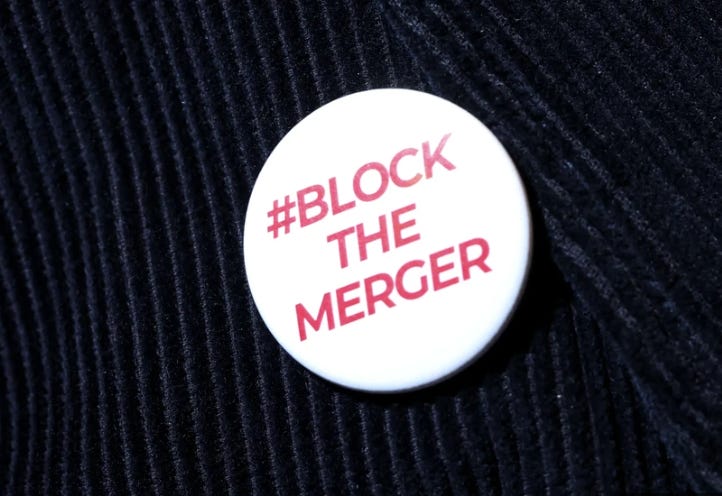
We already have a real-world example of Paramount and the Ellisons’ willingness to attack journalists who criticize them. On Tuesday, Paramount pulled all of its advertising from The Ankler because its editorial director and chief columnist, Richard Rushfield, supported the BlockTheMerger campaign. We will see more of this if the merger goes through.
The Supreme Court recognized this threat generations ago. In Associated Press v. United States (1945), it ruled that a free press cannot survive if private concentrations of power achieve the same suppressive effect as government censorship.
We are seeing this dynamic play out today. The federal government is using regulatory leverage — FCC license threats, merger approval authority, and multi-million dollar legal settlements — to steer media companies toward owners it views as more aligned and away from editorial voices it does not. When the government shapes who owns the press and the press shapes what the public knows, the First Amendment has not been violated in form. It has been gutted, in fact.
That is why Congress cannot treat this merger as just another media deal. It has an opportunity — and I would argue, the obligation — to ensure that the Paramount–Warner Bros. Discovery merger does not proceed without robust and enforceable conditions that defend the independence of journalists who serve the American people every day.
Our nation is facing a potentially catastrophic era of authoritarianism. Journalists have to be free to meet this moment. This is no time to bow down to a tyrant. Don’t give in to the lies. Don’t give in to the fear. Hold on to the truth.
Katie, thank you for your righteous fight, together with Norm.
"... they have steered the network toward a more conservative editorial line..."
Okay, it's a pet peeve, but please don't call them "conservatives." There's nothing conservative about anarcho-fascism.
In truth, we are now the conservatives, defending traditional American values of liberty, justice, and equal protection under the law.