


The Roberts Court heard oral arguments this month in Louisiana v. Callais, which could mean the final blow to the Voting Rights Act – by some estimates eliminating a dozen or more congressional districts that have ensured that minority communities have a voice in Congress. And whether it’s the mainstream media or centrist or progressive publications, the headline about this has been some version of “Supreme Court Appears Poised to Weaken Voting Rights Act.”
The problem with that headline? If the Voting Rights Act is undone, it won’t be at the hand of “the Supreme Court,” an independent institution that’s just calling balls and strikes. As I wrote several months ago: “When we say ‘the Supreme Court did X,’ even if we loudly object to X on the ‘merits,’ we give X unwarranted legitimacy by naming the hijacked institution rather than the hijackers.” The more accurate headline would be Republican Justices Appear Poised to Entrench Republican House Control.
To be clear, the harms are much larger than the purely partisan stakes. As I’ve written here, in other contexts naming the Roberts Court as “Republican” is too narrow a frame; the six justices to which that label refers are not merely partisan hacks but agents for those who elevated them to the Court. It’s especially problematic when those who do label the majority as “Republican” justices feel compelled to label the other three “Democratic justices,” because it suggests a symmetry that simply doesn’t exist.
But when legal and media elites don’t name those partisan stakes, and when even progressive critics keep referring to the Roberts Court’s legal Calvinball as “Supreme Court” rulings, they are losing the plot and conditioning all of us to accept what we never would otherwise.
Dayenu
The Passover Seder includes singing “Dayenu,” which means “It would have been enough for us.” Here, I wonder why none of the following has “been enough” to deter “objective” news organizations and liberal commentators from continuing to confer institutional legitimacy on the nakedly agenda-driven project that is the Roberts Court.
In the spirit of Dayenu …
It should have been enough that Republican Supreme Court majorities have repeatedly intervened to ensure their party’s nominee reaches the White House, first with Bush v. Gore in 2000, then last year withTrump v. US (delayed ruling to prevent Trump from standing trial for crimes we all witnessed on TV, and then reversed the unanimous decision of the appeals court to give him broad immunity), and then Trump v. Anderson (reversed the effect of the insurrection clause of the 14th Amendment—from requiring a two thirds vote by Congress in order to allow an insurrectionist to serve, to requiring prior legislation to prevent an insurrectionist from serving)
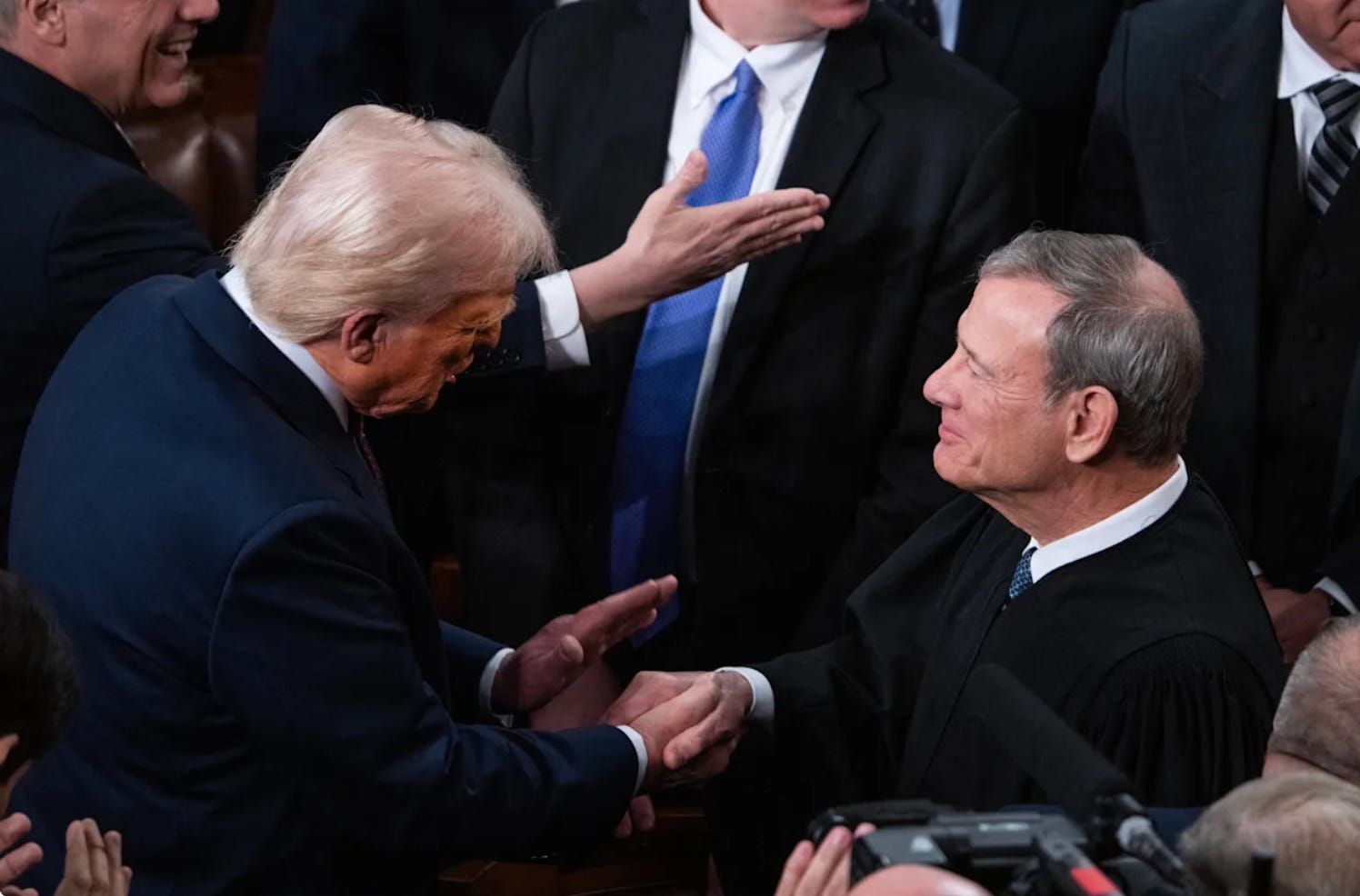
It should have been enough that no other Supreme Court majority has included as many party apparatchiks. Three assisted Bush’s legal team in 2000 (Roberts, Kavanaugh and Barrett1); five have served in Republican Administrations (Thomas, Alito, Roberts, Gorsuch and Kavanaugh2); and one cut his teeth in the Ken Starr investigation of Bill Clinton (Kavanaugh3).
It should have been enough that Republican presidents since George W. Bush have vetted justices not through the non-partisan American Bar Association (ABA), but the billionaire-backed Federalist Society, whose sponsors are the funding and mobilization base of the Republican Party.
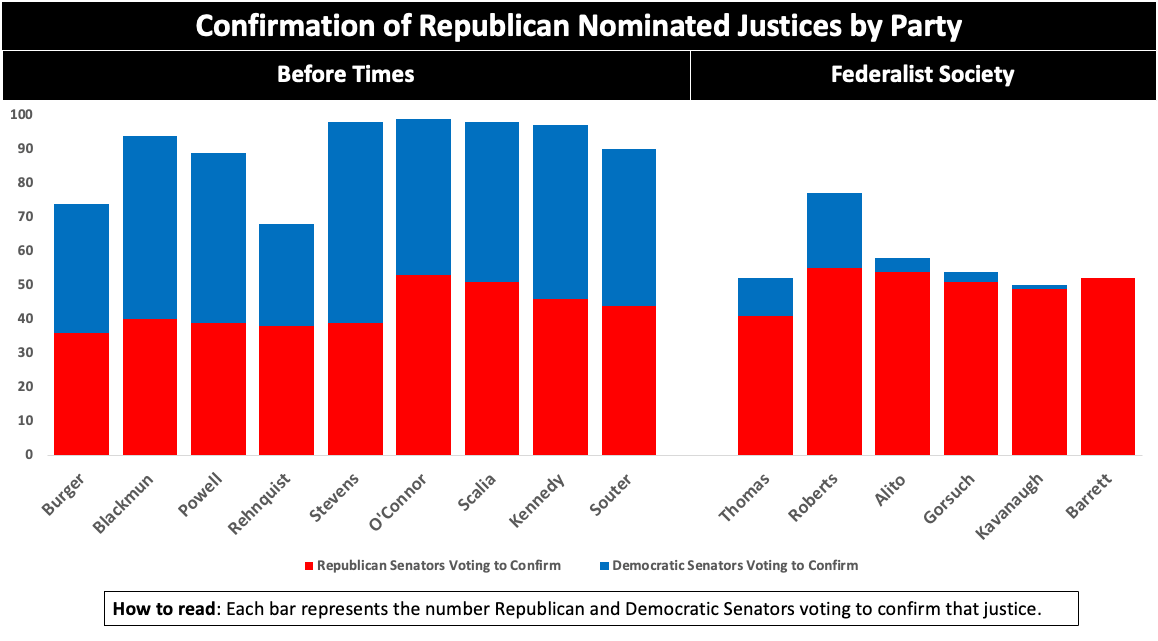
It should have been enough that no other Supreme Court majority has consisted of justices confirmed on such a purely partisan basis.4 The left panel shows the partisan support for the nine justices nominated since the Voting Rights Act by Republican presidents, and the panel on the right the six nominated beginning with Clarence Thomas (the current Republican majority on the Court).
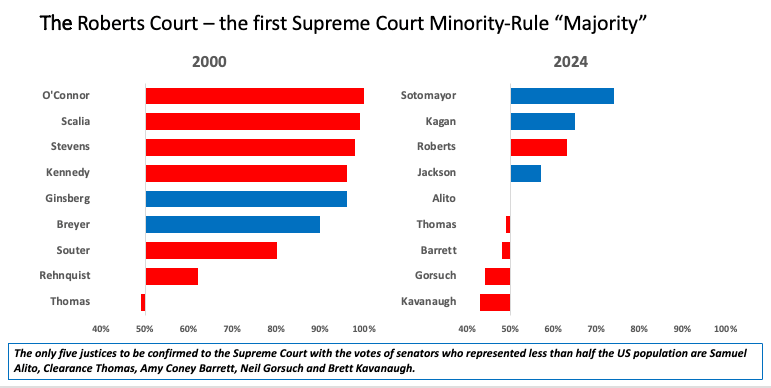
It should have been enough that no other Supreme Court majority in American history has less of a claim to democratic legitimacy. Five of the six justices were nominated by presidents who did not win the popular vote, and five of the six were confirmed by senators representing less than half of the US population (this chart compares the Bush v. Gore Court to the present one).
It should have been enough that two of the justices who were sympathetic to Trump’s efforts to reverse the outcome of the 2020 election did not recuse themselves in Trump related cases, nor did Roberts do anything to address that.
It should have been enough that every Roberts Court case that has changed election law to help Republicans has been decided without a single vote from the justices appointed by Democratic presidents. While the Warren Court also made significant election law changes, they were not just pro-democracy but were also decided by bipartisan supermajorities.
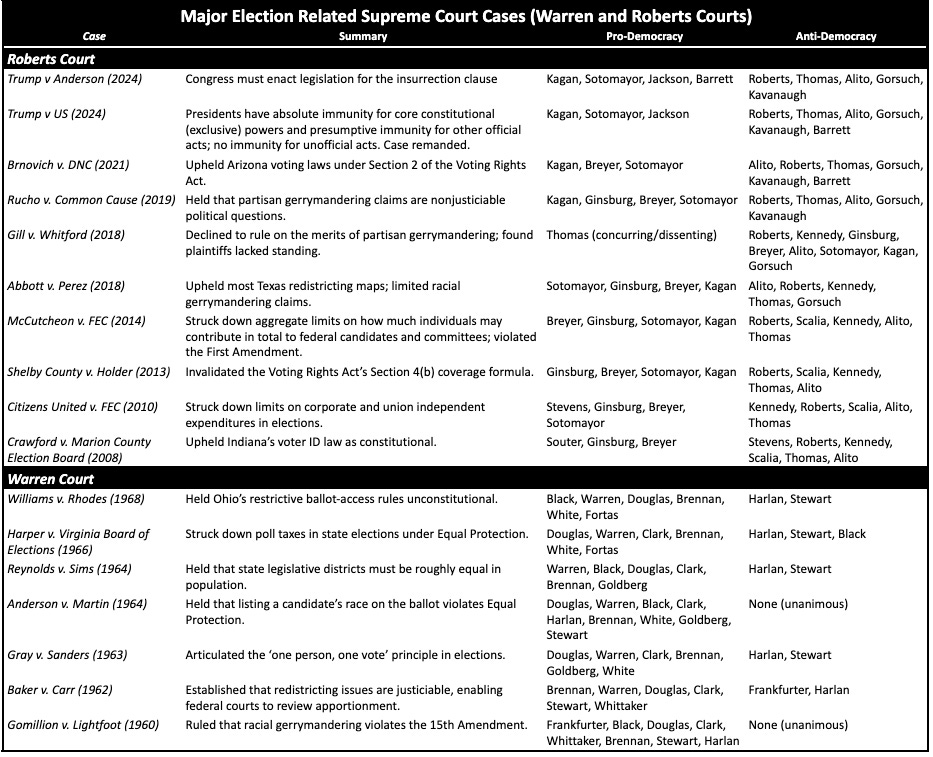
It should have been enough that conservative jurists regularly called out the Roberts Court for creating new law, including J. Michael Luttig and Richard Posner, who blasted the Shelby decision by pointing out that there was “no such principle as … equal sovereignty.”
It should have been enough that fellow Supreme Court justices’ blunt dissents called Roberts out for making things up, including Justices Stevens, “They changed the case to give themselves an opportunity to change the law”(Citizens United); Sotomayor, “Today’s decision … makes a mockery of the principle … that no man is above the law.” (Trump v US); Kagan, “(What is tragic here is that the Court has (yet again) rewritten...” (Brnovich) and many others.
And yet, all of that is still not enough for today’s legal establishment to name the Roberts Court for what it is: judicial tyranny on behalf of organized wealth and a mobilized theocracy.
This failure amounts to …
Obeying in Advance
The law-school deans, the “senior analysts,” the columnists, and the network of former clerks who dominate legal discourse insist that we are witnessing a rough patch, rather than a constitutional collapse. For the last twenty years they have met every Roberts Court usurpation of our freedoms and democratic agency with jurisprudential critique instead of a call to arms. By doing this, they have been complicit, however unwittingly, in allowing the MAGA regime to rise and thrive.
A key reason they have done this was that liberal reverence for the Court curdled into obedience to it.5 Brown v. Board of Education became the founding myth of modern liberal legalism—the story of nine wise justices, and courageous, whip smart lawyers, stepping in where congressional democracy had failed, even though Brown II would blunt its effects. But it was movement politics, not judicial grace, that produced the Civil Rights Act and the Voting Rights Act—the statutes that finally made the Constitution real for tens of millions of Americans.
Yet each time Roberts’s majority chopped away at those gains, from Shelby County to Brnovich, the liberal legal establishment minimized the damage, reassuring us that “the system would hold.” Many ruled out any response that might (in their minds) jeopardize future litigation. Thus, the establishment allowed the political muscle of the civil-rights coalition to atrophy. It left us with no strategy for what to do when the Court simply rules against democracy itself.
Yes, it is good that people are finally mobilizing against Trump’s open promise of dictatorship. But the unsettling truth is that while so many have rallied to stop a would-be king, almost no one has, or is, to stop the kingmaker.6 Trump continuously says the quiet part out loud; just as Roberts did, with a smirk, in 2009:
“If the public doesn’t like what we’re doing, it’s more or less just too bad.”
None of us are ready to concede our democracy to Trump’s authoritarian ambitions yet have ot even noticed the extent to which we have to Roberts’s. That is what “obeying in advance” looks like.
We have no hope of speaking truth to power, if we can’t bring ourselves to speak truth to each other. If you doubt the stakes of language, try a simple swap: replace “the Supreme Court” with “the Roberts Court” in your favorite explainer or podcast. Watch how the haze of institutional legitimacy subtly lifts.
Especially in the wake of the immunity ruling, the criticism by the legal establishment has become harsher and edgier. Yet much of it still fails to recognize that the “Court” per se is not the problem; the interests that have captured it are.
James Baldwin famously said, “Not everything that is faced can be changed, but nothing can be changed until it is faced.” If/when the Roberts Court kills the Voting Rights Act in Callais, it won’t be due to poor legal reasoning, Roberts’s principled opposition to considerations of race, or even the advancement of the Republican cause. It will be due to the institutional mobilization of white Christian nationalism—the movement that has never relinquished its conviction that “real Americans” can only look like its followers. It is not a theory of law but a campaign of restoration, enforced through robes instead of rifles. So as you look to those who claim to guide you through this state of exception, ask yourself: are they preparing me to confront what must be changed—or training me to accept it?
The way out starts with clarity. Stop conferring symmetry where there is none. Stop calling capture “jurisprudence.” Stop laundering tyranny as “the Supreme Court decisions.” Name shadowcasters, not the shadows. Then act as if the government belongs to the people who live under it—because if we don’t, it never will.
For more on their roles, see Graves, Without Precedent, and Toobin, Too Close to Call.
Their roles in Republican administrations:
Clarence Thomas: Assistant Secretary for Civil Rights, U.S. Department of Education (1981–1982); Chairman, U.S. Equal Employment Opportunity Commission (EEOC) (1982–1990)
Samuel Alito: Assistant to the Solicitor General (1981–1985); Deputy Assistant Attorney General, Office of Legal Counsel (1985–1987); U.S. Attorney for the District of New Jersey (1987–1990)
John Roberts: Special Assistant to the Attorney General (1981–1982); Associate Counsel to the President (1982–1986; Principal Deputy Solicitor General (1989–1993)
Neil Gorsuch: Principal Deputy Associate Attorney General, U.S. Department of Justice
Brett Kavanaugh: Attorney, Office of the Solicitor General (1989–1990); Associate Counsel in the Office of Independent Counsel (Kenneth Starr) (1994–1998); Associate Counsel to the President (2001–2003); Assistant to the President and Staff Secretary (2003–2006)
See, for example, Jeffrey Toobin, “Brett Kavanaugh’s Path to the Supreme Court Runs Through the Starr Investigation,” The New Yorker, July 10, 2018; Paul Blumenthal, “All The Lies Brett Kavanaugh Told,” HuffPost October 1, 2018; and David Lurie, “How Kavanaugh Likely Violated DOJ Policies While Working for Ken Starr” September 23, 2018, Slate Magazine.
For example, in the last term of the Rehnquist court the majority justices had an average of 77% approval votes from Democratic senators in their initial confirmation votes, with the lone justice not earning a “Yea” from the majority of Democrats being Clarence Thomas (he received just 19%). The majority justices on the current Roberts court have an average confirmation approval from Democrats of just 15%. A court with this low of approval from the opposing party is a historical anomaly, and there has never been a court majority - be it Democrat or Republican - composed of justices lacking support from the majority of the opposition party. Even as recently as 2016, the justices in the majority had an average of 56% approval from Democratic senators, and the justices in the last Democratic majority (on the Warren Court) had an average approval from Republican Senators of 80%.
This is known as “judicial supremacy” in contrast to “popular constitutionalism, which I elaborate on in “The Courts Will Not Save Us,” and are further developed in Larry Kramer’s The People Themselves and The Anti-Oligarchy Constitution by Joseph Fishkin and William Forbath.
This is known as “judicial supremacy” in contrast to “popular constitutionalism, which I elaborate on in “The Courts Will Not Save Us,” and are further developed in Larry Kramer’s The People Themselves and The Anti-Oligarchy Constitution by Joseph Fishkin and William Forbath

I call them six Christian Nationalists because every time there's a "Religious Freedom" case before them, the six place their religious beliefs above the Constitution. There's never been a "Religious Freedom" case where the six voted for freedom from religion nor individual rights trump the rights of those who have religious beliefs (especially Christian religious beliefs).
With the full support of the six Christian Nationalists on the Supreme Court and GOP Congressional members the Felon is making the United States an authoritarian theocracy, with the Felon as leader and the American oligarchs running the Country (Putin's Russia).
WOW!! What a POWERFUL piece!!! It should be required reading for every journalist and legal correspondent!! It's been such a calculated campaign by Republicans/Christian Nationalists, and it is not over, with oligarchs (in their craven self-interest), now purchasing social media outlets, and major networks in one merger after another. The rich keep getting richer, and are entrenching their power through every means possible, especially lying, propaganda and disinformation.