


“The pleasure of the table belongs to all ages, to all conditions, to all countries, and to every day; it can be associated with all other pleasures, and remains the last to console us for their loss.” — Brillat-Savarin, Physiologie du Goût, 1825/1838
I’m obsessed with the history of food. It’s my passion as well as my work (I won’t use the word job, which often has negative undertones). When I’m weighed down by the plight of the world, I know an hour or more with my head in my books researching a recipe, an ingredient, or a culinary tradition will relieve me of all stress, anxiety, and fear. I completely forget about the present world as I submerge myself in the past.
The history of food — what we cook, what we eat — is a reflection of our own larger history. Food is an expression of our culture, a mirror of our society. As Brillat-Savarin so astutely put it: “Tell me what you eat, and I’ll tell you who you are.” You might not see this in the foods you prepare every day, but think of dishes prepared for holidays or the foods traditional to the region or country in which you live. But the simple foods we make in our homes on any regular day that have been around for a long time, passed down from generation to generation, also have a sense and a meaning. The food we serve and eat, it all tells a story of who we are.
And so, when we share food with others, we are sharing our culture in a way that fosters insight and understanding, creating a bridge between different worlds. When we travel — whether to a neighborhood restaurant or a foreign country — and explore the culinary delights offered, we might not fully grasp every nuance or the symbolism with which every dish is infused, but that is where discovery begins. It breaks down barriers, cultivating connection and revealing just how much we have in common.
“Meals, as we understand the word, began at the second stage of the history of humanity. That is to say as soon as we ceased to live on fruits alone. The preparation and distribution of food made the union of the family a necessity, at least once a day.” — Brillat-Savarin
Food also brings us together. Family or community, we gather around the table and communicate. Think of the political and diplomatic alliances forged and strengthened over a meal. The table is neutral ground — as Jane Austen put it in Pride and Prejudice: “for though they could not all talk, they could all eat” — the necessity Brillat-Savarin hints at creates a natural space for bonding with those sitting at the same table. We are, if anything, sharing the same pleasurable experience.
“To invite a person to your house is to take charge of his happiness as long as he be beneath your roof.” — Brillat-Savarin
I might not have people into my home often for a meal, but I like to think that sharing recipes and my thoughts and stories serves them in the same way. I want to excite their curiosity, transforming a meal once cooked into something far more than just sustenance or pleasure — driving them to see food not merely as fuel or as just pleasure but as a living story.
By sharing these stories, I want to do for others what my books so often do for me (channeling the great Brillat-Savarin) by taking charge of the happiness of others as they sit at my virtual table. When the world feels too heavy, food — cooking, eating, sharing — can be a sanctuary. Maybe even a way to remember and celebrate what connects us with others.
My husband had the opportunity to live and work in Morocco for several years before we met; in his spare time, he would hang out in the kitchen of wherever he happened to be living and watch the women (always women) cooking. He brought the recipes and the traditions home with him.
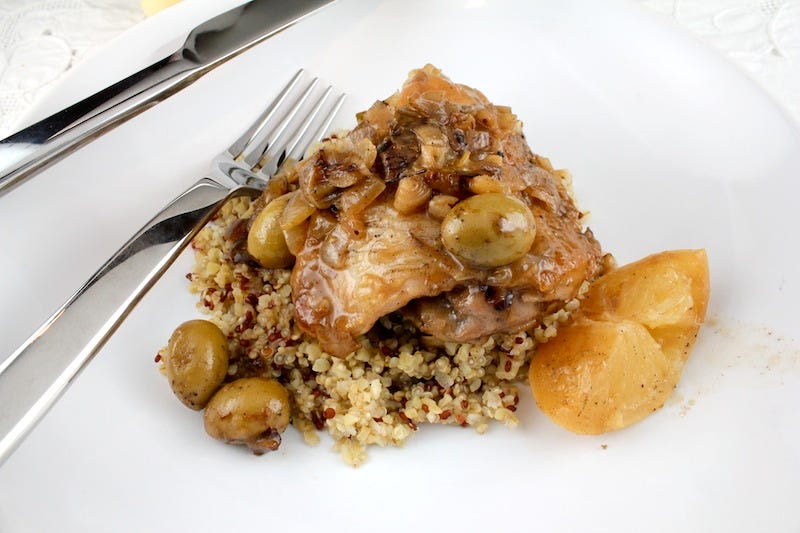
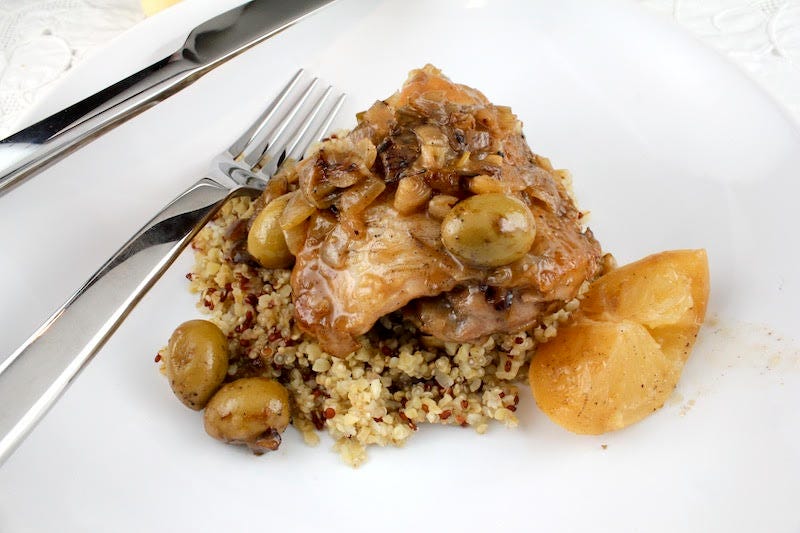
Chicken with Preserved Lemons and Olives
Serves: 4 servings
Chicken with preserved lemons and olives is tender chicken infused with the bright, sparkling flavor of lemon, lightly caramelized onions, and a handful of olives that give the dish a salty edge. Fast and easy to prepare, this dish packs a flavorful punch, perfect to serve simply over couscous grains, quinoa or mixed grains, mashed potatoes, or pilaf.
My husband often adds ½ teaspoon of saffron powder when he adds the water.
1 preserved lemon
Zest and 2 tablespoons juice from 1 fresh lemon
About 6 tablespoons (40 grams) flour seasoned with salt and pepper
1 chicken cut in pieces or 2 leg/thigh sections and 2 breasts
A few tablespoons olive oil
1 onion, trimmed, peeled and chopped
1 garlic clove, peeled and chopped
½ cup — about a dozen or so — pitted green or purple olives, soaked in cold water for about an hour (we don’t always do this, it’s up to you)
½ cup (125 ml) water
Salt and freshly ground black pepper
Cut the preserved lemon in half and then each half in 2 or 4 wedges. Set aside.
Place the seasoned flour in a plate or soup bowl. Pat the chicken pieces clean and dry.
Place a few tablespoons olive oil in a large, heavy pot with a lid and heat over medium to medium-high heat. When the oil is hot and a few drops of water spritzed onto the oil sizzle, dredge the chicken pieces in the seasoned flour and brown in the oil; you may have to do this in two or three batches as you do not want to crowd the chicken in the pot. Turn the pieces to brown well on each side; this could take 6 – 8 minutes per piece. Add more oil to the pot if needed.
As the chicken pieces are browned, carefully lift them out of the pot and place on a plate.
When all the chicken pieces are well browned and out of the pot, add the chopped onion and garlic to the pot and cook, stirring often, until tender and transparent, scraping up the dark bits from the bottom of the pot.
Add the chicken pieces back to the pot and continue to cook for a few minutes, stirring, until the onion bits are beginning to brown around the edges.
Add the wedges of preserved lemon, the zest, and the water; drain the olives and add to the pot.
Salt and pepper and bring just to a boil, reduce the heat, cover the pot and allow to simmer for 30 to 45 minutes or until the chicken is cooked through. Add a little more water during the cooking if needed.
When the chicken is cooked, remove the pot from the heat and add the lemon juice.
Serve immediately over couscous, mixed grains, or pilaf.
Jamie Schler is an American food and culture writer — immersed in French culinary history — living in France where she owns a hotel, makes jam, and writes the Substack Life’s a Feast.

Join the fight now and get 25% off an annual subscription
Contrarians in Court bring hundreds of cases and legal matters against Trump’s regime — by joining our community today, YOU help STOP the chaos!

Enjoyed your writing about the stories, and the dish sounds good. I don't know about making preserved lemons although it sounds easy. Thank you.
This recipe looks so good. I've added it to my files, although with a husband who has issues with lemon and onions, I'm not sure I will have a chance to make it. I'll have to look up preserved lemons. Even getting good regular lemons in north-central Indiana is not easy. When we recently visited California for a wedding, my sister gave me a dozen glorious lemons from her tree to bring home.