

By Frederic J. Frommer
In again prohibiting President Trump’s name to be displayed on the Kennedy Center, U.S. District Judge Christopher Cooper Tuesday cited “Congress’s decision to memorialize President Kennedy, and no one else, at the Center bearing his name.”
Congress did so expeditiously, naming it the John F. Kennedy Center for the Performing Arts in the wake of the president’s assassination on Nov. 22, 1963. The Senate approved the plan on voice vote on Dec. 18 of that year, the House followed suit the following month, and LBJ signed it into law on January 23, 1964. But it would be another seven years before the Kennedy Center opened.
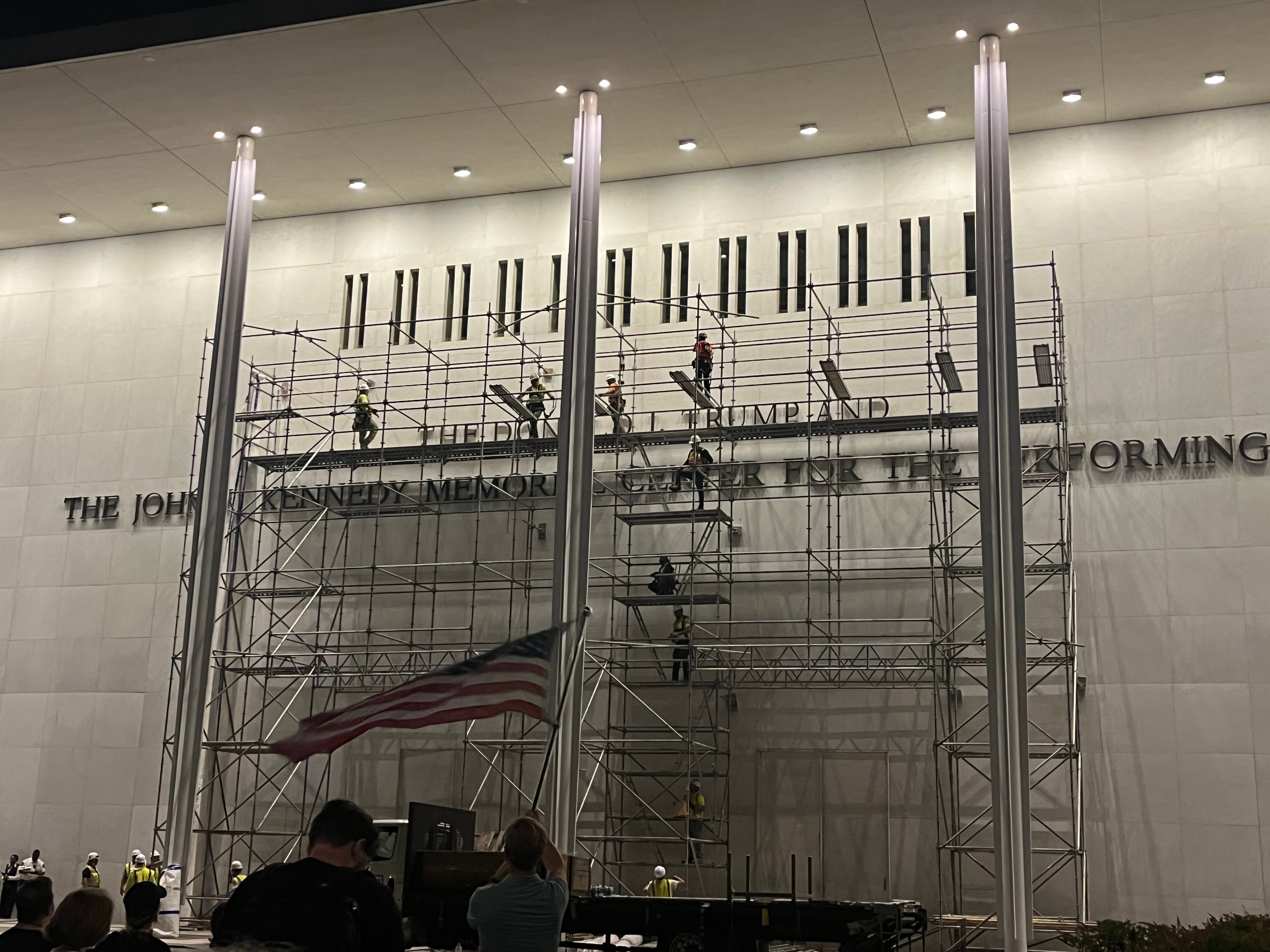
On Tuesday, the Kennedy Center closed to the public, and Trump said he’d block $257 million renovation unless his name returned to the front of the building.
In a show of how much the nation was united in its desire to honor Kennedy in 1963, on the same day of the Senate vote, New York City Mayor Robert F. Wagner signed a bill renaming New York International Airport at Idlewild the John F. Kennedy International Airport. The mayor called it a “fitting tribute to our late, great president.” Also that day, the Senate gave final approval for a half-dollar coin with JFK’s likeness.
There was one more accolade to Kennedy that chilly December day in New York City. A Christmas tree arrived at the airport as a gift to his widow, Jacqueline Kennedy, and her two children, Caroline and John Jr. It came from the children of the Iranian city of Shiraz, who had raised money to cover the cost of shipping it on an Air France plane, with the help of Air France employees in Tehran.
The idea for a cultural center in Washington, D.C., dates back to Kennedy’s predecessor, President Dwight D. Eisenhower, who in 1955 established a commission for a new cultural center in the nation’s capital. In 1958, Ike signed legislation to create the center, which he later called a “true mecca for artists.”
Then on November 29, 1962 — just under a year before his assassination — JFK and the first lady hosted a closed-circuit televised fundraiser for the performing arts center, with a goal of $30 million. The program, which went past midnight, featured Leonard Bernstein as master of ceremonies and included celebrities such as Robert Frost, Danny Kaye, Bob Newhart, and Harry Belafonte, as well as Eisenhower and his wife, Mamie.
At that event, Kennedy talked up the important role artists play in society.
“Behind the storm of daily conflict and crisis,” he said, “the dramatic confrontations, the tumult of political struggle, the poet, the artist, the musician continues the quiet work of centuries, building bridges of experience between peoples, reminding man of the universality of his feelings and desires and despairs, and reminding him that the forces that unite are deeper than those that divide.”
The program was telecast into nearly 70 theaters, auditoriums, concert halls, and ballrooms in two-dozen states, and to TV sets in cities throughout the United States and Canada.
Given Kennedy’s muscular support for the cultural center, many thought it a natural tribute to name it for him after his death — and the Kennedy family championed the idea. But after Senate passage, the idea ran into opposition from some House Republicans over the bill’s provision to spend money on the center to match private donations.
Iowa Rep. H.R. Gross and other Republicans wondered aloud how spending money on such a facility squared with President Lyndon Johnson’s declaration of a “war on poverty.”
“I don’t associate a cultural center, this kind of spending, with the poverty we heard so much about a while ago,” Gross said.
In a mostly party-line vote, the House defeated a GOP amendment to cut federal funding 148-100.
One notable Republican supporter was James C. Auchincloss of New Jersey, the top‐ranking Republican on the House Public Works Committee who was serving the final of his 11 terms in Congress.
“The people of the United States are back of this idea 100 percent,” Auchincloss said according to the Washington Post. “Let’s don’t be penny‐wise and pound foolish.”
Two weeks later, Johnson signed the bill in a ceremony that included Sen. Edward Kennedy, one of JFK’s younger brothers.
“President Kennedy was actively concerned in the progress of the plans for this project,” the new president noted. “He was, himself, a man of a very inquiring mind, a distinguished historian, a master of language, and a lover of excellence wherever it appeared. He delighted not only in the classic forms through which our civilization has found expression, but also in the popular arts of today, with their variety, their humor, and the capacity to touch the lives of all of our people.”
“Th president expressed the hope that he might see it completed during his term of office,” LBJ added. “It is, therefore, I think, entirely fitting that the center should be named in his memory, and should be dedicated anew to the great purposes for which it was originally conceived.”
Johnson — who would break ground on the project In December 1964 using the same shovel used at ceremonies for the Lincoln Memorial in 1914 and the Jefferson Memorial in 1938 — said the goal was to have the center complete by late 1966 or early ’67. That proved to be wildly optimistic: It didn’t open until 1971.
Frederic J. Frommer, a sports and politics historian who has written for the Washington Post, the New York Times, the Atlantic and other national publications, is working on a book on ‘70s baseball.
One of the few smart things congress has done. The arts enrich our minds our souls and our country!
Thank you for a great history lesson, even though no fascist will ever read it.