


Courage is often confused with virtue. But, stripped to its core—acting despite fear or uncertainty—it is morally neutral. Courage can belong to Nathan Hale on the gallows but also to Adolf Hitler in a beer hall putsch. The trait says nothing about the cause it serves. That is why political language built around heroics often misleads. Resolve is too often celebrated when it is depravity in disguise. Hesitation can be dressed up as prudence when it is cowardice in practice.
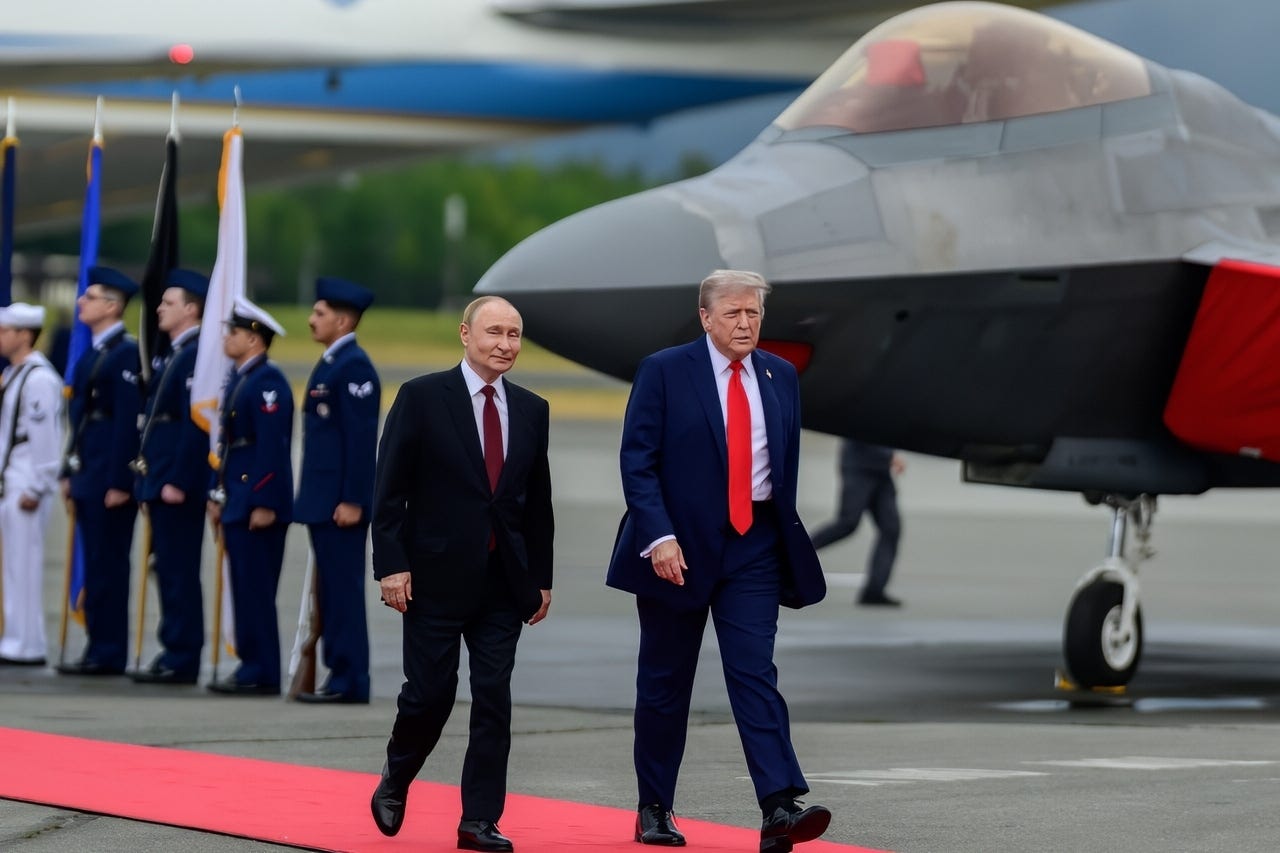
In Anchorage on Friday, Russian President Vladimir Putin came with ultimatums to resolve the war in Ukraine: control of Donbas, negotiations without ceasefire, narrative dominance in the room. For President Donald Trump, courage would have meant rejecting those terms and protecting Ukraine from further predation. Instead, Putin conceded nothing and walked away with his isolation ended. Trump left, by his own telling to Fox News’s Sean Hannity, having moved closer to Moscow’s terms.
Friday’s meeting invites comparison with British Prime Minister Neville Chamberlain’s concession in 1938. Confronting an imminent European war, he accepted Hitler’s annexation of the Sudetenland in return for Hitler’s pledge that he had no further territorial ambitions. This allowed Chamberlain to claim that he had secured “peace for our time.” At the time, the danger was existential. Britain and France, still rearming and with French defenses weakened, lacked the capacity to resist an emboldened German military.
Characterizing Trump’s behavior as Chamberlain-esque is understandable, but what took place in Anchorage does not deserve comparisons with 1938. No Russian army threatens American soil. Two oceans and a nuclear arsenal make that clear. What’s at stake is Europe’s security—not America’s survival. Conceding on Ukraine is not a grim strategic necessity but a self-serving act: allowing Putin to walk away strengthened while trading an ally’s future for the illusion of progress.
Courage requires accepting risk yourself rather than shifting it onto others. In Anchorage, Trump did the opposite. He rushed to praise Putin’s strength while suggesting later that Ukraine accept the loss of territory. The consequence of that bargain would not fall on Trump but on Ukrainians forced to live under occupation and on Europeans left to face a Russia emboldened by rewards for aggression.
Vanity enters when indifference hardens into policy. Trump treated the red carpet for Putin as proof of chemistry, the warmth of the meeting as evidence of progress. Trump spoke of ending war not by constraining Russia, the aggressor, but by urging Ukraine to make a deal. Stripped of ceremony, the message was clear: survival of a democratic nation is negotiable.
Trump has repeatedly blustered about deserving the Nobel Peace Prize and the power of American leverage, boasting of his formidability in negotiations: “It’s what I do.” Yet, in Alaska, he lowered the bar he had set for Russia—dropping even the demand for an immediate ceasefire. What he pursued was not substance but speed.
True courage has been on display since 2022. Not in Washington, D.C. Certainly not in Moscow. But in Kyiv. It has been Ukraine’s refusal to surrender to an invading army. Kyiv’s courage has not been in making grand gestures or rhetorical flourishes. It is rooted in resilience and strategic ingenuity in the face of overwhelming force, constant bombardment of civilians, kidnapping of thousands of children, and a systematic campaign of urbicide.
On Monday in Washington, when Trump meets Ukrainian President Volodymyr Zelensky alongside Europe’s leaders, we will have an opportunity to measure courage against its proper definition. Trump will arrive with impatience disguised as boldness. Zelensky faces the harder task: defending his country’s survival without triggering Trump’s temper. For him, courage is balance—holding firm under pressure without giving the Oval Office another pretext for rupture.
The most important courage will be demanded of Europe’s leaders, many of whom will be present at the meeting between Zelensky and Trump. Their rhetoric in past weeks has reflected resolve, but the test will come when Trump presents Putin’s demands as compromise. Courage in that moment will not be words in a press conference but the willingness to endure the pain of Trump’s actions rather than trade away Ukraine’s survival. If they yield under that strain, their courage will prove as hollow as his.
By the end of this week, we might know whether courage still exists where it matters most.
Brian O’Neill, a retired senior executive from the CIA and National Counterterrorism Center, is an instructor on strategic intelligence at Georgia Tech. His Safehouse Briefing Substack looks at what’s ahead in global security, geopolitics, and national strategy.

I don't think Putin came with only ultimatums. I believe he came with proof that he has copies of all the videos that Epstein taped of sex with teenage girls. Trump is in those videos. Putin can blackmail Trump (or continue to blackmail him).
There was no heart, there was no courage, there was no brains.