


The attempted assassination of President Donald Trump and other attendees at the White House Correspondents’ Dinner on April 25 did not expose the absence of a White House ballroom. It exposed a protection problem at a high-risk venue under an administration that can no longer blame former President Joe Biden for the machinery it now controls.
The early reporting pointed in precisely that direction. Several news agencies reviewed surveillance footage showing the suspect sprinting through a security checkpoint at the Washington Hilton before a Secret Service officer fired at him. Some security personnel appeared to be disassembling a magnetometer as the suspect approached and that the footage raised questions about the precise sequence of shots and response.
The timeline of the scene inside the ballroom raised a similar question about the response sequence: Agents pulled Vice President JD Vance from his chair and moved him offstage within seconds while Trump remained seated behind an agent who stepped in front of him before he eventually was escorted out.
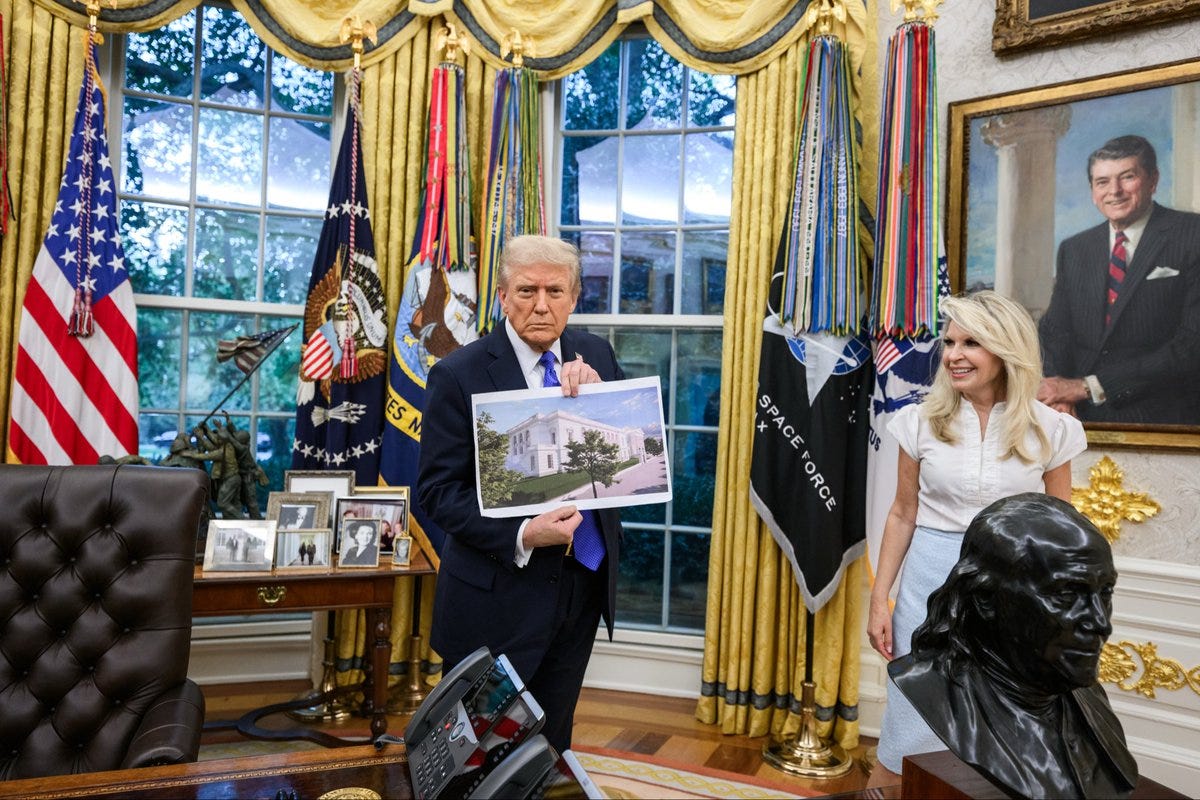
Yet, at a White House briefing after the attack, Trump’s focus was on the venue, claiming that the incident proves the need for a “Militarily Top-Secret Ballroom” on the White House grounds. Brushing aside the near-catastrophe that demands accountability, he made a louder sales pitch for architecture, grandeur, and control.
Sen. Lindsey Graham and other Senate Republicans then supplied the legislative translation. Two days after the attack, Graham said that he would push a bill to speed construction and finance most of the $400 million ballroom with public money, even though Trump had earlier said private donors would pay for it. Graham’s explanation was clarifying in its absurdity: private donors, he suggested, could cover “china and stuff like that.”
But I am not seeking to join the already-crowded debate over whether the ballroom is ugly, unnecessary, unlawful, unpopular, or just another monument to Trump’s appetite for gilded scale. The courts and the public have already taken up much of that case.
The incident and the responses that followed, for me, were a disquieting reminder that our politics often mistakes enclosure for courage: policymakers invoke toughness, then answer fear by narrowing the space in which public life can safely occur.
That pattern is not new. Guantánamo reflected it in one of its starkest post-9/11 forms. President George W. Bush created the detention facility as legal offshoring: a way to hold terrorism suspects on U.S.-controlled ground while claiming they were beyond the ordinary reach of federal courts. It was a spatial answer to a constitutional and political problem.
Its continued use became more plainly a politics of fear. President Barack Obama ordered Guantánamo closed early in his first term, only to see Senate Democrats join Republicans in blocking closure funds and barring detainee transfers into the United States. The Senate vote was 90–6, and Harry Reid put the instinct plainly: “We don’t want them around.” Obama made another major push in 2016, submitting a formal closure plan to Congress, but the resistance remained.
That fear was stated clearly in a 2016 House hearing, when Rep. Barry Loudermilk asked then-Gov. Nikki Haley whether housing detainees in South Carolina would “increase the risk of soft-target attacks.” Haley agreed it would give hostile actors “more of a reason” to go there. Loudermilk’s conclusion was blunt: “So Guantanamo Bay is working.”
Guantánamo was treated as success not because it solved the problem of long-term security but because it kept the danger somewhere else. Avoidance became resolve.
The architecture of American childhood has hardened in the same way. Schools now practice active-shooter drills, redesign entrances, add controlled-access vestibules, lock classroom doors, install cameras, and consider weapons-detection systems not as emergency exceptions but as features of daily life. Fear is answered with thicker doors, not harder choices about guns, mental health, or public safety. The National Academies reported in 2025 that active-shooter drills have become standard practice in nearly all U.S. schools, while warning that their mental and emotional effects remain insufficiently understood.
Campus speech has followed a related pattern. For years, some universities and campus activists treated offensive or dissenting arguments less as claims to be answered than as harms to be managed through disinvitations, shout-downs, speech codes, investigations, and administrative discipline. Trump has now adopted the mirror image from the right, invoking antisemitism — real and dangerous, not invented — to threaten funding, scrutinize foreign students, and pressure universities to police pro-Palestinian speech. In both versions, fear produces more control: smaller forums, narrower language, larger bureaucracies, and speakers trained to measure every sentence against punishment rather than persuasion.
No one is arguing that presidents should be exposed to unnecessary danger. A serious response to the attack would ask what failed, who was responsible, and how a high-risk venue with Secret Service protection allowed a gunman to breach the perimeter. That would be an argument about competence.
Let’s be clear-eyed and honest: Trump is not making a security argument. He is using one. The ballroom is about ego, grandeur, and possession. The shooting did not create the case for it; it gave him a better excuse to justify what he already wanted. The pivot is transparent, but Republicans have taken the bait, treating a vanity project as a sober response to political violence.
But that episode still belongs to the larger argument. Trump’s bad faith is not a distraction from the politics of enclosure. It is what the politics of enclosure makes possible — and what it often makes worse.
Danger moved offshore. Childhood hardened behind locked doors and drills. Campus speech narrowed under administrative fear. Public events remade around checkpoints and barriers. Each case is different, but the instinct is the same: When danger enters public life, the answer is too often not competence, confidence, or argument. It is retreat.
A republic cannot eliminate danger from public life. It can only decide whether danger becomes a reason to govern better or an excuse to make public life smaller.
Trump has chosen the walls. Republicans are helping him hang the chandeliers.
Brian O’Neill, a retired senior executive from the CIA and National Counterterrorism Center, is an instructor on strategic intelligence at Georgia Tech. His Safehouse Briefing Substack looks at what’s ahead in global security, geopolitics, and national strategy.

Governance has virtually stopped under this Republican Congress. No investigations about anything. They have "walled-off" reasoning, and hidden their thoughts behind closed doors, and refused to give town halls, walling off the public's view from consideration. Republicans are not only willing, they are eager to go along with every ludicrous idea of this Trump regime. The reason incompetence reigns, and our nation is being guided by fools who think they know better than the professionals and experts, is that Congress has allowed it. It is our money being spent ... on a ballroom, and on the war, among other major undertakings, and our representatives are not weighing in. There is a common theme amid the chaos: of disasters created by Trump's need to destroy ... and build anew. But what he is building with our money bears no resemblance to a democracy. It is what happens behind all those walls, in secret, that makes us all less secure (especially for any person criminalized and placed in a "detention camp").
Every one of the arguments in this article leave me with the definitive conclusion that this "assassination attempt" was staged in order to give the orange dumpster a stronger argument to build his golden monstrosity soonest.