


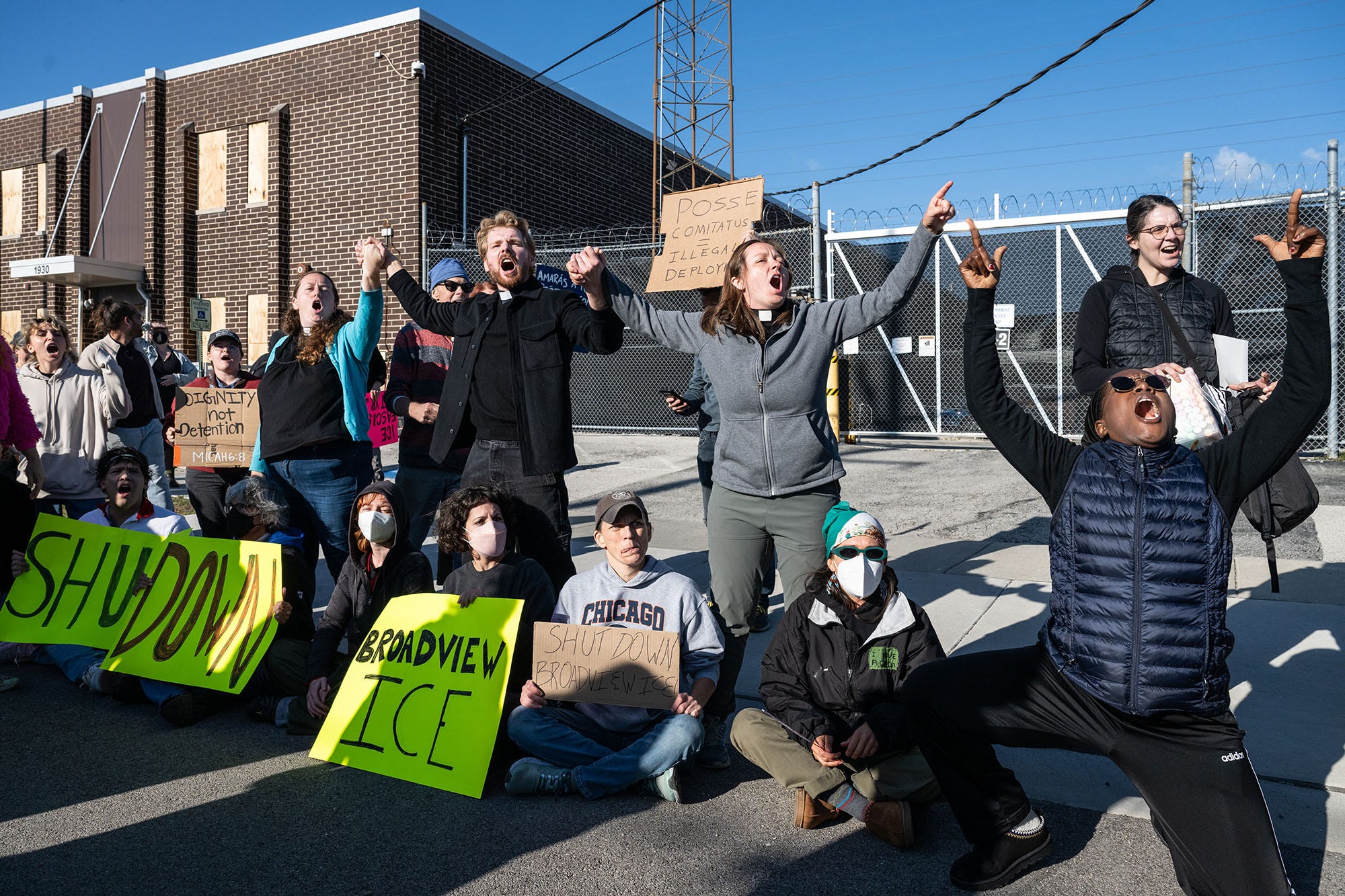
Pablo Moreno Gonzalez, a 56-year-old construction worker, was waiting for his boss to take him to a job site when he was grabbed by federal agents in Albany Park, a largely immigrant neighborhood on Chicago’s Northwest Side.
“I saw people running, so I got scared and ran too,” Gonzalez said. He was taken to an Immigration and Customs Enforcement facility in suburban Broadview and held for two days. The conditions there—dirty cells crammed with dozens of detainees, limited drinking water, cold sandwiches for meals, open toilets—were so appalling that a federal judge on Tuesday called them “disgusting.”
“It has really become a prison,” U.S. District Judge Robert Gettleman said in federal court Tuesday about Broadview, which was meant to be a processing center for detainees but has become a de facto detention center where immigrants are held for days at a time.
After hours of testimony from Gonzalez, the lead plaintiff in a federal lawsuit filed last week that called Broadview’s conditions “inhumane” and “unlawful,” Gettleman acted quickly. On Wednesday, he granted the lawsuit’s request for a temporary restraining order to force the Department of Homeland Security to improve conditions at Broadview. The lawsuit was filed last Thursday by the ACLU of Illinois, the MacArthur Justice Center and law firm Eimer Stahl.
Testifying in Spanish through an interpreter, Gonzalez recalled how he was put in a cell with perhaps 150 other men. When federal agents asked him if he wanted to go back to Mexico and tried to get him to sign papers—in English, which he can’t read—he told them no. “I don’t have anyone in Mexico. I don’t want to leave,” he said. Both of his adult children are U.S. citizens.
Because of the crowded conditions and lack of beds, some detainees had to sleep on the floor near smelly toilets that were only partially hidden by low privacy walls, Gonzalez testified. The cell was never cleaned thoroughly. He and other detainees were given small bottles of water two or three times a day with cold sandwiches. When they asked for more water, agents told them “there was no more water,” Gonzalez said.
No one had access to a shower or soap, and the smell of sweat “was bad,” Gonzalez said. At night, he could doze for just a few minutes at a time and had to sit up in a chair “or I would fall on the floor on top of someone.”
“It was too much, just too much,” Gonzalez added, breaking down on the stand.
Other detainees told similar stories. Felipe Agustin Zamacona, another plaintiff in the lawsuit, recalled trying to drink water that “tasted like sewage” from a fountain in the facility.
Claudia Carolina Guevara, who was deported back to Honduras, testified remotely and described being pressured to sign deportation papers. She felt she had no choice but to sign to get out of Broadview.
Her two children, a 5-year-old daughter and a 9-month-old son, are living now with her brother in the Chicago area.
“My children, they are so young,” Guevara said. “I don’t know when I will see them again.”
It’s clear that Broadview has become a “black box” that allows federal agents to act “with impunity,” as the ACLU described it. “They are coercing detainees to sign paperwork that they do not understand, leading people to unknowingly relinquish their rights to challenge removal and seek release.”
More secrets coming out
The Department of Homeland Security still claims that Broadview is officially just a “processing center,” intended to hold detainees for up to 12 hours before they are deported or sent to a detention center. In reality, detainees are now routinely held there for days, as shown by an analysis of ICE data obtained by the Chicago Sun-Times and local public radio station WBEZ.
Listening to Moreno Gonzalez and other detainees describe the terrible conditions at Broadview, it’s obvious why elected officials have been turned away when they tried to visit. The same has happened to public officials elsewhere, though elected officials have oversight authority to conduct inspections at Homeland Security facilities.
Thanks to Tuesday’s testimony and a legal system that still provides recourse to fight back against the administration’s abuses, the truth about what’s happening inside Broadview has come to light. More is to come: On Wednesday, another federal hearing began in Chicago regarding federal agents’ alleged use of excessive force against nonviolent protesters and journalists at Broadview.
The public, in Chicago and across the country, deserves to have all the dirty secrets of this administration brought out into the open.
Lorraine Forte is a Chicago journalist and former editorial page editor of the Chicago Sun-Times.

Imagine being locked in a cell with 150 people and only being given a small amount of water every day. This isn't detention, but human rights abuses. Thank you for helping bringing this into the daylight. We as a nation have a long road ahead of us if we want to hold the responsible people accountable and ensure that this never happens again and a crucial part of that journey requires journalists reporting on these abuses with the relentless tenacity that the legacy media has no interest in displaying.
These accounts of horrendous treatment of people by the trump administration are only going to worsen unless harsh reprisals are taken. This is not how we do things in America. ICE and DHS lackeys need to be charged and punished for this inhumanity, especially since it's being done under color of law.