



The New York Times this weekend provocatively declared that Donald Trump’s appointees to federal courts of appeals are “clearing the way for his policies and gradually eroding a perception early last year that the legal system was thwarting his efforts to amass presidential power.” That is wrong.
Yes, Trump-nominated appellate court judges have often and wrongly sided with the administration, as the Times noted. But according to the Times’ own numbers, after one year in office, judges have overall ruled against Trump and his regime about ⅔ of the time. That is a remarkable success rate for litigants against the administration. Moreover, the Times’ statistical analysis and methodology lacked crucial context that would present an even more damning portrait of Trump’s failures.
First, let’s break down the math. Taking the question the Times posed in one chart—“How often the courts have ruled in support of Trump’s policies”—the answer to that question, using the Times’ own calculations, is about 33%—meaning he’s lost 66% of the time. How do we get that number? The Times said that, out of 431 cases, Trump lost 75% of the time in district court—that equals about 323 total losses. Of those, only 156 cases were appealed, and Trump lost 49% of those rulings—that’s another 76 losses. And, out of the 24 cases the Supreme Court decided, he lost 12% of the time—another two losses. That adds up to over 400 losses out of 611 rulings.
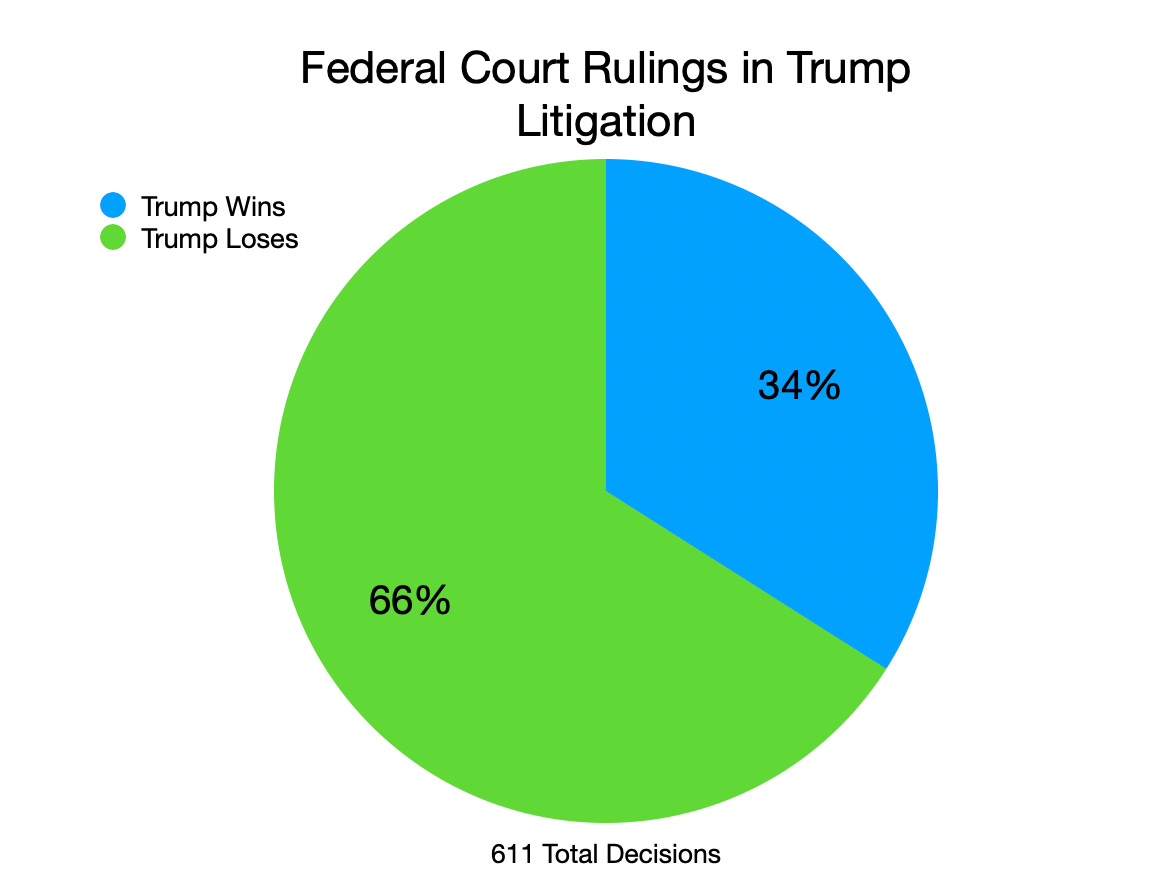
The Times noted that Trump, especially in his first term, worked hand-in-hand with a Republican Senate to pack the courts with loyalist and often unqualified judges. Yet, even with that effort to MAGAify the judiciary, the stunning reality is that Trump is still losing the vast majority of the time.
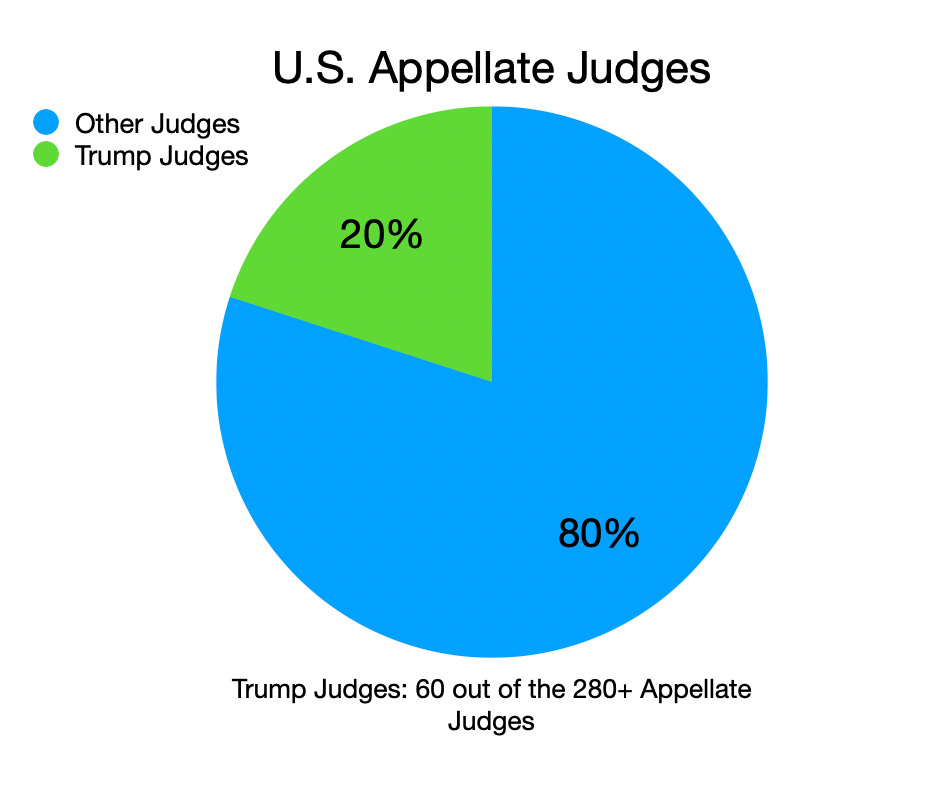
And that still does not fully capture the scope of the defeats Trump is suffering in court. The article noted Trump appointed 54 appellate judges in his first term and six so far this term. Though that sounds like a lot, there are 179 full-time judgeships across the 13 courts of appeal throughout the country. On top of that, there are 112 judges serving on “senior status” —meaning they still hear cases and issue rulings but work a reduced schedule and don’t count toward the 179 statutorily mandated seats. So, those Trump judges who are ruling for him disproportionately make up only 60 out of more than 280 appellate judges issuing decisions—or about 20%.
Furthermore, as the article acknowledged, the importance of some Trump-appointed appellate judges has been outsized, and their impact therefore skews the analysis. More than half of the rulings from Trump-appointed appellate judges in favor of the Trump administration come from just three MAGA judges, all on the D.C. Circuit Court of Appeals. Many of the biggest cases against the administration are brought in D.C., so that circuit has a high number of the relevant cases here. Appeals cases are heard by a randomly selected subset of the appellate judges on that circuit’s bench, called a “panel.” In the D.C. Circuit, the motions panels—the judges who hear the immediate motions, often for stays blocking implementation of district court rulings—have rotated monthly.
Thanks to the luck of the draw, these three Trump-appointed judges appeared on successive emergency panels in the D.C. Circuit last year, unusually tipping the balance in Trump’s favor. Not only was that an odd occurrence that affected the stats, but the D.C. Circuit appears to have changed how its motions panel operates so that it no longer sits in place for a full month. Thus, a disproportionate number of Trump-appointed judges will not be able to unduly influence the outcome of cases against the Trump administration.
Beyond all this, the Times did not simply count final rulings by courts of appeal. It also included administrative stays and stays pending appeal. That makes sense: Stays by appellate courts are important because they prevent district court rulings from going into effect. If a district court stops the Trump administration from implementing a policy or action because it is illegal or unconstitutional, and the government subsequently gets a stay from the appellate court, the administration is no longer prevented from taking certain actions while the appeal is underway.
However, not all those stays are made equal. Administrative stays are intended to be short-term and are used to give the court time to consider the posture of the case; the court does not have to take into account traditional considerations that usually warrant a stay. However, stays pending appeal, also a temporary measure, are more considered and longer-lasting. Those stays allow courts to freeze everything in place until they adjudicate the entire appeal—which can take many months. They often come with reasoned opinions that make initial determinations about the likelihood of success on the merits of the case itself.
The Times weighed both types of stays equally in its statistical analysis. But if a court denies the Trump administration’s request for a stay pending appeal after previously granting an administrative stay, that is, on the whole, a loss for Trump. That context was lacking in the Times’ report.
The Times also said it did not include immigration cases in which the remedy sought would be limited to one individual but noted that it did include three of the most high-profile of those types of cases—including Kilmar Abrego Garcia. We should at least note this full category of suits: Trump lost 309 cases and notched just 14 wins. Including those numbers boosts the overall winning percentage to 76%.
And there is a case for that higher win rate. Attacking immigrants individually, seeking their removal from the country, forms the backbone of the Trump administration’s assault on immigrants. Each and every loss the government faces on that count is a meaningful stand against its efforts and represents a hard-fought victory against the vast forces of the federal government.
Even if you consider those cases separately, the reality is that litigation against Trump has been so successful that it is plainly frustrating him from achieving his aims. As I detailed in my column on Saturday, Trump has faced a tsunami of losses in cases involving his power of the pen, purse, and personnel: his illegitimate executive orders and attempts to starve agencies of funding and fire their people. When he pivoted from there to prosecuting his perceived adversaries like Letitia James and Jim Comey, the courts shut him down again. Then he tried to take control of elections and was stopped yet again. So he turned to deploying the National Guard, and lost at the Supreme Court, where two of his other major initiatives—tariffs and revoking birthright citizenship—are in jeopardy this term.
While Trump continues to threaten judges, in increasingly desperate and deranged fashion, the courts have largely held. That is a remarkable testament to the courage of the individual judges who make up the judiciary, and the resilience of the American legal system. As we head into the second year of Trump’s second term, that should be the headline.
Norman Eisen is the publisher of The Contrarian. Joshua Kolb is counsel and manager of Rapid Legal Response at Democracy Defenders Fund & Democracy Defenders Action.
Great article about these mostly courageous judges. Unlike the fascist six on the McConnell/Roberts court, which will go down in infamy in future history books.
Thank you for putting this in the proper perspective. As the saying goes “statistics can be manipulated to say whatever the interpreter wants”