


If you think Donald Trump’s “musings” and “jokes” are not worth headlines, no matter how shocking or offensive they may be, then you haven’t been paying attention.
Trump’s latest insane, arguably treasonous, and definitely impeachable detour was suggesting that Iran “can take out a city, let ’em take out Los Angeles, let ’em take out San Diego. This is a very small price to pay.”
This has been going on for a long, long time. His campaigns, presidencies, and years out of office have been marked by the actions that follow those jokes, musings, and mob-boss-style evasions. As in, you’ll never pin this on me.
Sometimes the distance between casual remark and dead-serious follow-through is frighteningly short. Like the July 27, 2016, press conference where Trump famously said, “Russia, if you’re listening, I hope you’re able to find the 30,000 emails that are missing” from Hillary Clinton’s personal server.
It worked perfectly, as we learned two years later. That’s when special counsel Robert Mueller filed an indictment that PBS summarized as: “Trump asked Russia to find Clinton’s emails. On or around the same day, Russians targeted her accounts.”
The rest is history, which we are still enduring.
In a more recent example, a young man with a gun allegedly killed a California woman, an LGBTQ ally, who had gay pride banners and flags hanging at her clothing store in a tiny mountain tourism town in the San Bernardino National Forest. His social media accounts blared his hatred of gay people and Democrats, and his sentiments grew increasingly inflamed as it became more common on the right to attack and marginalize LGBTQ Americans.
Eight days later, another young man with a gun reportedly killed three Black people at a Dollar General Store in Jacksonville, Florida. Authorities said his white supremacist writings read like “the diary of a madman” and his AR-15-style rifle had swastikas drawn on it.
Both these incidents were in 2023, eight years after Trump and some of his disciples had made it “great again,” or at least acceptable, to target and exclude Muslims, Mexicans, immigrants, refugees, women, gay people, trans people, Black and Asian and Latino people, people from “shithole” countries, ad nauseum.
Trump, out of office after having lost in 2020, was running for president again, and it was open season on the authorities attempting to bring him to justice for the crimes he was accused of committing while president. “The way Trump goes after black and Hispanic prosecutors and judges poses a special menace because of the example he sets—the permission structure he creates—for white nationalism, white supremacy, racism, antisemitism, and immigrant-bashing,” I wrote in April 2023. By then, in a projection trifecta, he had branded as “racist” all three Black prosecutors trying to hold him accountable for various types of alleged wrongdoing (Fani Willis in Georgia and Alvin Bragg and Letitia James in New York).
There’s a term for Trump’s bullying, often racist sneers and attacks, accompanied by indirect (always indirect) calls to violence: stochastic terrorism, defined as hostile rhetoric that raises the statistical risk of ideological violence. Here’s how it works:
Trump conveys his racism or homophobia or xenophobia to an audience of tens of millions, using only words and his huge global media platforms. Chances are some of his listeners and readers are disturbed and a few may be disposed to violence, but there is plausible deniability for Trump if or when one of them acts out that racism or homophobia with a weapon.
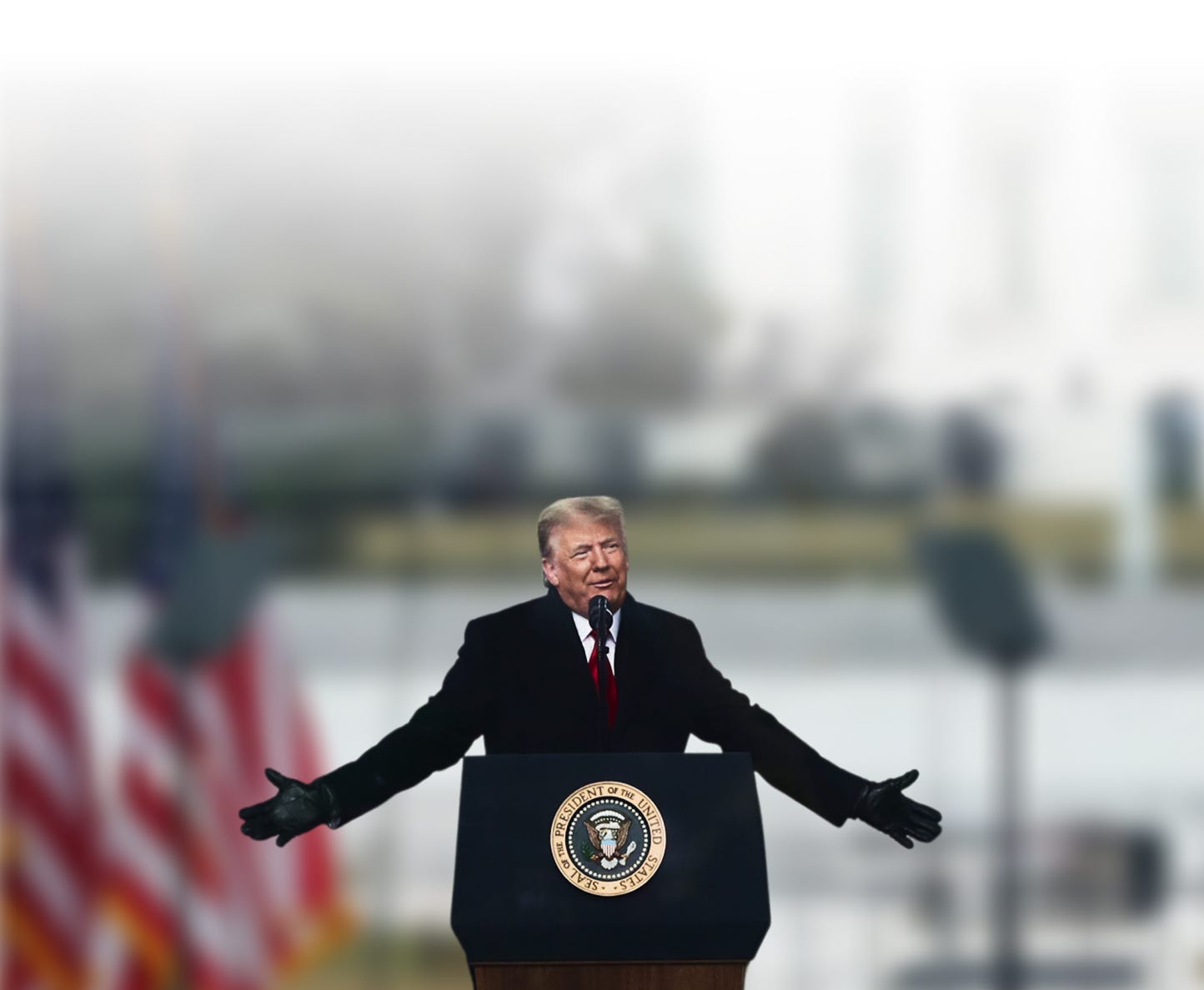
The purest distillation of these throwaway incitements to fight for an existential cause, and tacit encouragement to do damage, was Trump’s infamous January 6 speech. Reading it now, two things stand out.
One, Trump knew some people attending that speech had guns and other weapons. Later testimony to Congress revealed that he was angry about the crowd size and ordered security to ”let my people in,” armed or not. Two, the sentence about marching to the Capitol “to peacefully and patriotically make your voices heard” was a sharp contrast to the other 70 minutes of the speech. It was buried under an interminable recitation of lies, grievances, and repetitive exhortations to always fight and never give in.
“All of us here today do not want to see our election victory stolen by emboldened radical-left Democrats, which is what they’re doing. And stolen by the fake news media. We’re going to have to fight much harder…You’ll never take back our country with weakness. We will never give up. We will never concede…You don’t concede when there’s theft involved.”
(Audience chants: “Fight for Trump.”)
“Thank you.”
In that speech, the word “corrupt” came up ten times in connection with the 2020 election, the “fake” news and media, “Democrat-run cities,” the Washington “swamp,” and Georgia’s GOP governor, GOP secretary of state, Democratic Fulton County, and overall “system.” “Rigged” and “stolen” got multiple mentions. Lies also got a workout in Trump’s laundry list of false claims of fraud.
His finale included his repeated (and ultimately incorrect) implication that he would be marching with his listeners and his customary warning of America on the brink of extinction. “And we fight. We fight like hell. And if you don’t fight like hell, you’re not going to have a country anymore.”
If that all sounds like the usual Trump hype and hyperbole, well, here are the consequences his words helped bring about in the traumatic Capitol riot and its aftermath: At least seven people died in connection with the attack, some 140 police officers were injured, a trashed Capitol cost millions to repair, charges were filed against nearly 1,600 people, a series of devastating hearings followed, and — glory to the cause — he won in 2024 and issued a near-blanket January 2025 pardon for the rioters and insurrectionists, including some who beat up cops and some who have since been re-arrested.
Do you want to bet on whether Iran will act on Trump’s idea of attacking Los Angeles or San Diego? Or whether someone else, an individual or group or another country, will think it’s a good idea? I don’t, and it’s not because my son and a bunch of beloved cousins and good friends live out there. I just wish he’d never said it.
But he did, so I hope people take it seriously. You just can’t have the president of the United States idly suggesting a war foe could or might bomb a couple of U.S. cities, no big deal. Whether he meant it or not.
Jill Lawrence is the author of The Art of the Political Deal: How Congress Beat the Odds and Broke Through Gridlock.

Sorry, but every time I hear a discussion of whether this was a joke, my question is - what was the funny part? Iran could take out American cities and we'd be ok, it would be a small price to pay, so in that case, take out Los Angeles and San Diego. Hahaha?
We should accept the framing that it's funny to suggest sacrificing millions of Americans because their state didn't vote for Trump? THAT's their joke. So instead of arguing about whether he meant it as a joke, let's understand he said it knowing MAGA would think it was funny. Funny to "joke" about killing millions of Americans who didn't vote for Trump.
So when they tell us he was joking, can we ask them to explain the joke?
I feel safer in San Diego now because his endorsement is the kiss of death. Nobody will take that bet. He just sparks outrage. Don’t fall for it.