


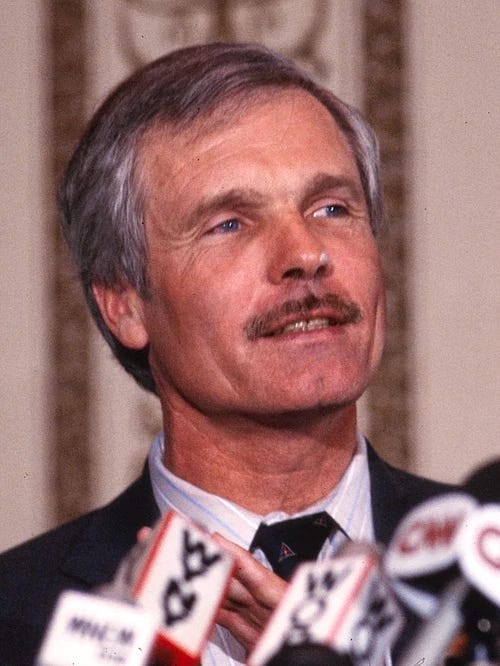
Ted Turner, the brash, iconoclastic media mogul, yachtsman, rancher, and philanthropist who ushered in the 24/7 news cycle and forged a cable empire on old movies, reruns, and sports programming, died Wednesday at eighty-seven years old.
Along with his bitter rival Rupert Murdoch, Turner was one of the most influential figures in media over the last half-century, dramatically reshaping how people around the world consume news, sports, and entertainment.
In the 1970s, he turned a small Atlanta TV channel into TBS, the country’s first “superstation.” In 1980, he launched Cable News Network, a.k.a. CNN, which offered round-the-clock programming at a time when the broadcast networks controlled TV news. As cable continued to grow over the next decade and a half, Turner expanded even further with channels including Turner Network Television, The Cartoon Network, and Turner Classic Movies, which — even (perhaps especially) in the streaming era — remains an essential repository for films from Hollywood’s golden era.
In 1996, the Turner Broadcasting System merged with Time Warner in an early wave of consolidation that has continued for three decades. He began to step away from business to focus more on philanthropy, pledging $1 billion dollars to create the United Nations Foundation in 1997, and conservation of the American West, acquiring 13 ranches that are now home to 45,000 bison.
Tributes poured in on Wednesday.
“Ted was a giant, whose extraordinary achievements were only outmatched by his profound generosity and resolve to create a better world,” said UN Foundation President and CEO Elizabeth Cousens in a statement.
Ex-wife Jane Fonda, who remained close to Turner even after their divorce in 2001, shared a moving tribute on Instagram, in which she called him the most competitive person she ever met, after Katharine Hepburn.
“He also taught me more than any other person or school classes, mostly about nature and wildlife….but also about business and strategy,” she wrote. “I loved Ted with all my heart. I see him in heaven now with all the wildlife he helped bring back from extinction…. they’re all gathered at the pearly gates applauding and thanking him for saving their species.”
For better and for worse, Turner set the standard for what it meant to be a modern media tycoon, with countless other billionaires emulating his swashbuckling style and thirst for adventure. As evident in the first sentence of nearly every obituary published yesterday, Turner’s most lingering achievement may be the founding of CNN, a risky programming experiment that utterly transformed the TV news business.
Turner was a man of “singular spirit,” says Lisa Napoli, author of Up All Night: Ted Turner, CNN, and the Birth of 24-Hour News, who spoke to The Contrarian about Turner’s impact. The following is an edited version of our conversation.
Why did Ted Turner get into TV in the first place? My understanding is he was not even a fan — he thought TV was vulgar and corrosive.
Ted’s dad was a very successful billboard salesman, and he unfortunately died by suicide. Ted, as a young man, inherited the billboard company, and found it to be boring. He wanted a challenge, so he bought a radio station. And he found that boring, too. Then he had a chance to buy a UHF television station in Atlanta in the late ‘60s; channel 17. He thought that that would be sexier and more fun. Because it was a UHF station, it didn’t have broadcast content. It was a scrappy local station, and he was buying movies and old TV shows [to air], but he had a public service requirement that he had to have a news show. He didn’t care about the news, but he had to fulfill this obligation. So he had Bill Tush, who was a local announcer, do a jokey newscast. Ted also didn’t understand why the station stopped broadcasting at midnight or one o’clock in the morning, after the last movie. He thought it was a waste of time. So he decided to put the news on late for insomniacs like him and others.
Fast forward, and technology allowed Ted to float the channel 17 signal around the region and then the country [as the station that became known as TBS]. By this point, he had bought the Atlanta Braves. He was doing something that no one had done before, which was broadcasting a local baseball team regionally and then nationally.
That’s the long answer to why he got into TV. He was experimenting. Initially, cable was just a utility, a way to get a signal to a place that was remote. But then people realized there’s more to it. We can put out more content than the three networks. And that’s when cable as we know it started. He got into the news, because ESPN had just started, HBO had just started, and people came to him and said, “Look, we can bust the triopoly of the three networks by offering a new type of news.”
So the idea of doing news at CNN was more of a business decision. He wasn’t trying to serve a journalistic need?
100%. People were frustrated with the status quo, but it was all purely a business play. He saw an opportunity. People don’t like to talk about it now, because they want to talk about his environmental stewardship and how he changed the news business, which is all absolutely true. But what they forget is how CNN started. It was very, very scrappy.
Do you think he had any sense of where it was going?
He was just experimenting. In those early days, he wanted to plant his flag into this new terrain. It was about a year in that he started to see the power of it, because Fidel Castro pirated the CNN signal. In the earliest days, cable was only in [some places] in the US. It was not in many homes. Fidel pirated the signal, and was tantalized by the idea of 24/7 news, and he sent an invitation. Ted Turner went down to Havana [in 1982] to meet Fidel. He was so dazzled by Fidel, and the fact that Fidel, a world leader, was watching his little cable news channel, that he came back and had this idea that he had to make CNN international.
About a year and a half into CNN’s existence, President Reagan was shot outside the Hilton. The White House press pool up until that point was just the three networks. People called CNN “Chicken Noodle News.” But on that day, Bernie Shaw, the main anchor of CNN, didn’t report things until he could verify them with two sources. That’s when people started to take CNN seriously, and that’s when Ted started to really take it seriously, too. Everybody wants to make it about “CNN is so liberal and Fox is so conservative.” It wasn’t like that at the beginning. Fox didn’t start till 16,17, years into CNN’s existence, neither did MSNBC. It was all a big experiment that wound up changing everything.
Do you think he understood intuitively something about the American public or the global TV audience that proved to be correct?
I wouldn’t say that he understood it. I think he was dazzled by it. He saw the potential of the interconnectivity of the shrunken world. He wasn’t a technologist. It wasn’t like he was an engineer, and he wasn’t a journalist, but he was a visionary, and he saw that there was opportunity there.
You worked at CNN shortly after it launched. What was that like?
I was an unpaid teenage intern for three summers in college. Back then, you literally could just call up and get an internship. Now, I’m sure it’s massively competitive. I was working at a video store and I wanted an interesting summer gig. I called up and they said, “Come in tomorrow.” That’s how I got in. When I got out of college, I worked at that old country club that they bought [as the original CNN headquarters]. All the people who started in the earliest years of CNN, with the exception of some of the frontline talent and the bigger producers, were people with very little to no experience. It’s not like today, where people go and get master’s degrees in communications. I was lucky to be a very teeny little cog in all of that, and I learned so much. How many people on Earth can say that they helped so many people start their careers, for better or worse? TV news is not necessarily the greatest force in the universe. But it’s not his fault. TV news would have accelerated without him, but he accelerated it in a very particular way. I always say that about hamburgers, too. I wrote a book about Ray Kroc. McDonald’s didn’t invent fast food.
As we all know, CNN is at this kind of existential crossroads and may soon be acquired by the Ellisons. How do you think he would have felt about this?
I would only be guessing. I know that he was enormously proud of what he created. I really couldn’t even hazard a guess as to what he or anybody who was working and active and most vibrant at the end of the last century would make of where we are today. Who knew? People speculated about the menacing power that television would have on the world, but a lot of people just didn’t believe that that was the case. If you go back and watch the movie Network and the movie The Candidate, they presaged the world we’re in today. But CNN, in its earliest days, was plain vanilla news.
This is not specific to Turner, but there are a lot of historical events that people point to as the birth of 24-7 news cycle — the first Gulf War, 9/11. Do you see a specific event that really ignited that news cycle in a permanent way?
You’ll hate this answer, but it’s a series of events. It was what I mentioned with the [Reagan] shooting. It was the Challenger space shuttle exploding. It was Tiananmen Square. There was Baby Jessica. It was the Gulf War. All those things that happened were happening in parallel to the growth of cable. It really is like the internet.
It was all happening as that medium was growing. Every time something big happened, it brought more attention to it. Then you have the late ‘90s, when Fox and MSNBC happened, and that really shines a spotlight on CNN. CNN didn’t get politicized quite right away, because it had good stewardship at that point but that was an inflection point. And then the internet, the World Wide Web, that’s an inflection point.
What do you see as Turner’s most enduring legacy?
I hope he is recognized as one of the great 20th century business people. He was a fearless entrepreneur who seized every opportunity in front of him and ran with it. He was a true entrepreneur, and people revere him for giving him their start in the business. His biggest connection was turning TV on 24/7. His second biggest connection was floating that TV signal around the US, and then around the world. He put a lasso around the earth in a way nobody had before. And that’s pretty enormous.
Meredith Blake is the culture columnist for The Contrarian
Jane Fonda's obituary is beautiful.
I wish there had been more emphasis on his conservation efforts and his philanthropy.