


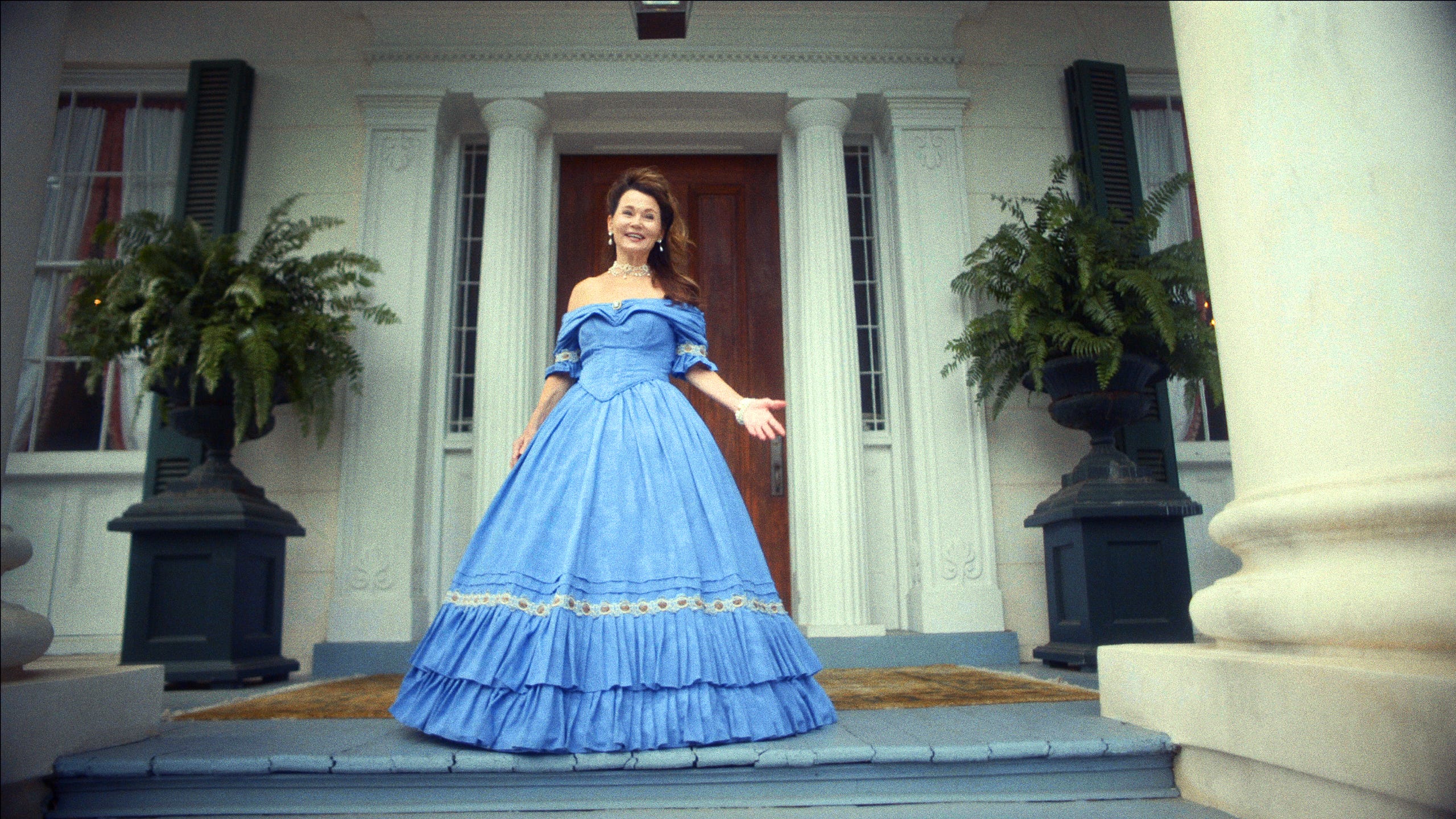
Every spring since 1932, tourists have flocked to the city of Natchez, Mississippi, to visit stately antebellum homes and gardens, where women in hoop skirts and men in Confederate regalia recreate a romanticized version of the Old South. The annual rite is known as the “pilgrimage,” presumably because it holds a quasi-spiritual appeal to believers in the Lost Cause.
Natchez, a documentary airing tonight on PBS’s Independent Lens, immerses viewers in a community where competing versions of history play out on a daily basis. Directed by Suzannah Herbert, the film follows a number of locals who make a living in tourism but who tell different stories about the region’s past. (It will also be available to stream on the PBS app and PBS Documentaries YouTube channel.)
Tracy “Rev” Collins is a Black preacher who talks openly about the ugly legacy of slavery and segregation and greets visitors by proudly announcing, “I’m about to violate some Southern pride narratives with truth and facts.” His tours include a stop at Forks of the Road, the former site of one of the busiest slave markets in the Deep South. Rev’s warts-and-all philosophy is a stark contrast to that of David Garner, the white, elderly owner of Choctaw Hall, who shows off the period finery in his well-preserved 19th-century mansion and whose gay identity doesn’t prevent him from going on racist tirades.
We also meet Tracy McCartney, a volunteer who gives tours of Choctaw Hall while dressed up like Scarlett O’Hara, yet also defies the Southern Belle stereotype, and Deborah Cosey, the first Black woman admitted to Natchez’s influential garden club, who pushes her white peers to acknowledge the enslaved people who once labored in their homes.
Even though Natchez was filmed before Trump returned to the White House, it feels particularly urgent at a moment when statues of Confederate generals are being restored, unvarnished depictions of the brutality of slavery are being removed from National Parks, and the gutting of the Voting Rights Act has paved the way for a new Jim Crow era in the South.
The film is “all about history,” Herbert says. “But it’s really about the stories we tell, how we engage with that history, and how people understand our past through our lived experiences.” For many in the community, Southern nostalgia is especially irresistible because it has also been economically beneficial.
“The history that they learned and the history that they believe is now being yanked out from under them,” says a National Park employee in the film. “It’s hard work to come to a point where you’re able to say, ‘The history I learned was a mythological construct that was used to sell tickets.’”
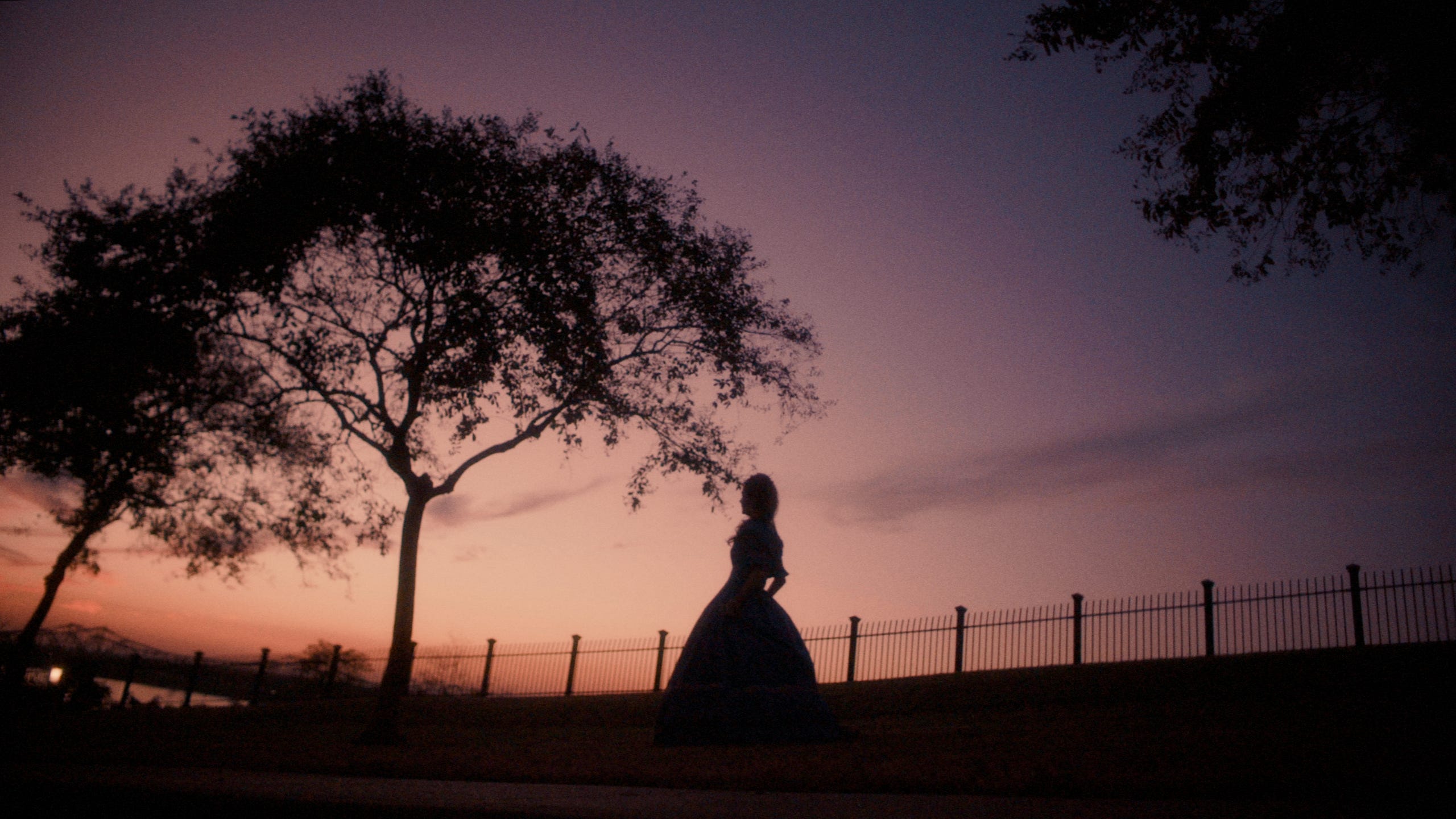
Natchez is devoid of the scholarly talking heads you might expect in a documentary about American history, and is instead rich with allusions to cinematic portrayals of the South, particularly Gone With the Wind. In a sequence that evokes one of the most memorable shots from the 1939 epic, McCartney takes a sunset walk in her period garb, her silhouette dark against the vivid sky.
Says Herbert:
I wanted the film to visually nod to Gone With the Wind, but also to make it a kind of antidote to Gone With the Wind. To this day, Gone With the Wind is still the highest-grossing film, adjusted for inflation, of all time. It has this huge grasp on white-dominant popular culture, and how we think about the South, American history and the Civil War. I wanted to disrupt that, but also pay homage to it.
Cinematographer Noah Collier shot the film using vintage lenses from the 1960s, which “really bring audiences into the fantasy and the allure of it, and show how enticing that is,” Herbert says.
Herbert, who grew up in Memphis, originally envisioned a different type of film: she planned to explore the phenomenon of heritage tourism by embedding herself at a Louisiana plantation over a single wedding season. But during a research trip, she stopped by Natchez — located on the banks of the Mississippi River across from Louisiana — and was unnerved by the experience.
“I was just so struck by the beauty and the fantasy of it all,” she says of the city, which was occupied by the Union for much of the Civil War. “It’s a unique place in that the antebellum structures are so well-preserved, but there was this underlying tension and pain that was right underneath the surface. That dichotomy made me really uncomfortable.”
Herbert eventually realized that discomfort is exactly what made Natchez a rich subject to explore. “Natchez is actually a community grappling with how we tell history,” she says, “and that’s actually so much more complicated and interesting than one specific site.”
Herbert started working on the film in 2022 and spent weeks in Natchez getting to know people before she even considered breaking out her camera. She went on countless tours and observed an array of approaches. In some of the private home tours led by white owners, “It was about what was not said, what was not acknowledged. If slavery was talked about, it was referred to with euphemisms or talking about how the ‘servants’ were happy.” But there were also homeowners who have been trying to engage with the history. “It definitely runs the spectrum,” Herbert says.
Because she’s a white woman, Herbert thinks some residents were more comfortable revealing their true selves to her — including Garner. In the film, he jokes that gay men are the only people with “the money and the taste” to take care of Natchez’s historic homes and also host an LGBTQ benefit at Choctaw Hall. But he also freely drops the N-word while the cameras are rolling.
“Just because he’s been oppressed doesn’t mean he cannot be an oppressor,” Herbert says. “The way he clutches on to his whiteness is so revealing.”
Garner notwithstanding, Herbert is heartened by the changes she’s witnessed in Natchez, where many community leaders “are really working to expand the narrative,” she says. Herbert points to the boom in tourism in Montgomery, Alabama, since the National Memorial for Peace and Justice was opened there. The city “has done an incredible job embracing its past,” she says. It turns out that good history can also be good for business.
Meredith Blake is the culture columnist for The Contrarian
It sounds like an interesting dichotomy. But for myself, I don't think I could keep my mouth shut around some of the "antebellum apologists" long enough to conduct any sort of interview.
You can be proud of your past, and even celebrate the undeniable beauty that the (Rich, White) Antebellum South portrayed without denying the evils of slavery that made much of that beauty and grace possible.
Wear your hoop skirts, tour the mansions and celebrate the chivalry of the period, but don't deny that the same rich, white guy that was willing to duel to the death for Miss Daisy's honor was also willing to whip his slave to death for dropping a cup of tea on the floor. And willing to sell that slave's children into slavery away from his wife, who he was "breeding" so he could make better slaves to sell. You did not get the pretty part without the ugly part paying the bills.
The Laura Plantation in Louisiana is a fascinating step back into a different kind of historical tour. It is a French sugar cane plantation but it does not sugar-coat slavery in the least. In fact, quite the opposite. It is a moving experience. I'm not sure why people are so fascinated with the Gone with the Wind disneyfication of these old plantations. There is no reason to perpetuate a lie.