


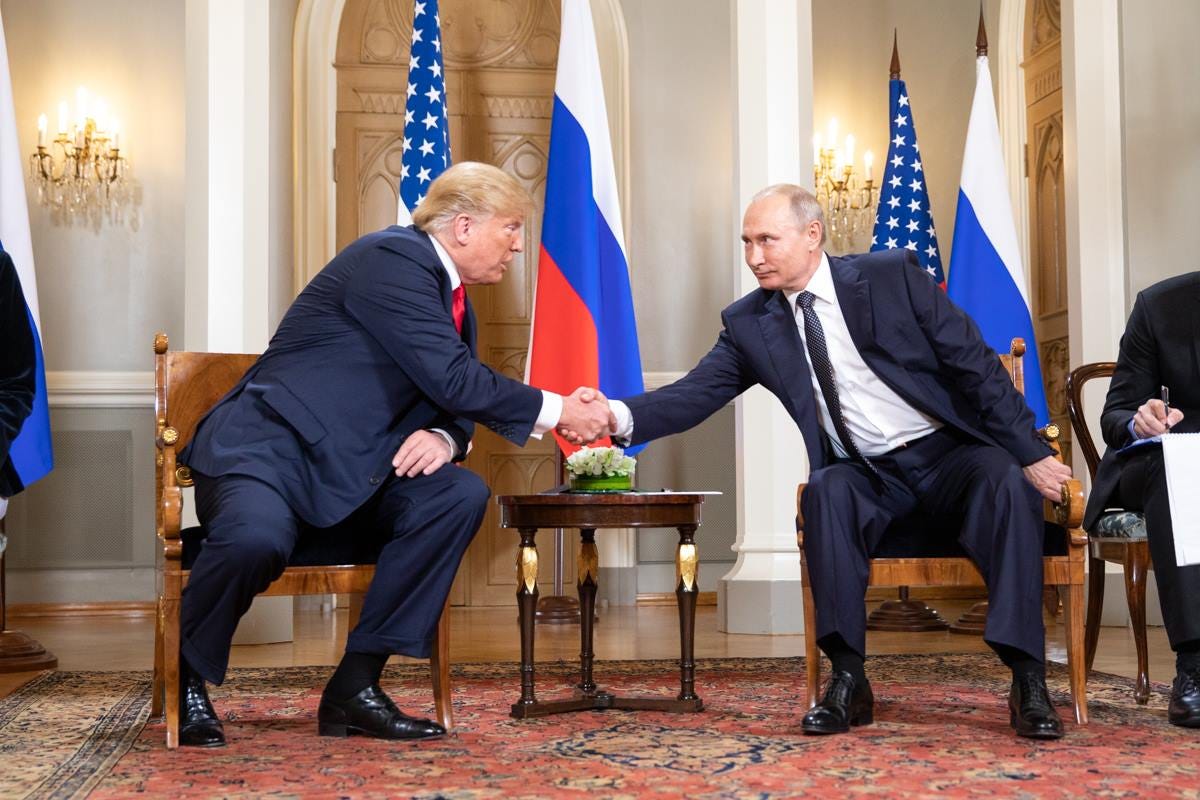
For a moment last week, President Donald Trump made a show of turning the screws on Russian President Vladimir Putin, announcing tariffs on India over its purchase of Russian oil and threatening similar secondary sanctions against other countries that prop up Russia’s war economy. If done right and sustained over time, a strategy of pressuring Russia’s enablers could have changed Putin’s calculations and helped bring his war on Ukraine to a just end.
But before Russia lost a single ruble in energy exports from this new sanctions push, Trump threw its war criminal leader a lifeline: an invitation to a one-on-one summit meeting in Alaska. Vice President JD Vance then ratcheted the pressure on Putin down further, saying that the United States is “done with” sending military aid to Ukraine, whether Russia continues the war or not.
The summit invitation came in response to an offer from Putin that only a man with as little experience as Steve Witkoff—Trump’s real estate friend-turned-envoy to Russia—could have seen as promising or even new. Putin reportedly proposed a ceasefire if Ukraine withdrew from the four eastern Ukrainian provinces that Russia now claims as its own. That was Putin’s opening offer at the start of the Trump administration, and it remains a non-starter. Why would Ukraine hand Putin territory that Russia was too weak to capture by force of arms and that Ukrainians gave their lives to successfully defend?
So, it’s hard to see anything good coming out of the Alaska summit. But for the sake of argument, let’s look at the issues and imagine what an acceptable deal might do.
1. Ceasefire
Stopping the killing should be the most urgent diplomatic goal. Ukraine and its European allies have rightly proposed that a ceasefire should come first, before agreement on more complicated issues such as land so Putin can’t use negotiations to buy time for his forces to advance. Putin might also try to entice Trump into supporting a partial ceasefire—for example, a freeze on air and missile strikes that allows Russia’s ground offensive to continue. Given the recent success of Ukraine’s long-range strikes on Russian airfields, arms depots, and oil infrastructure, anything short of a full ceasefire might help Russia more than Ukraine.
2. Territory
Whenever you hear that Ukraine should give up territory Russia claims, remember that surrendering that land would mean handing to a brutal dictatorship the hundreds of thousands of people who still live there or forcing those Ukrainians to abandon their homes and become refugees. Remember also the principle at stake in this war, that big powers such as Russia (and, by extension, China) should not be allowed to seize the sovereign territory of smaller countries by force.
As a practical matter, Ukraine will not be able to retake the territory Russia has already seized, including Crimea, any time soon. In any realistic deal to end the war, Ukraine and its allies would have to accept that, possibly for a very long time. But that doesn’t mean Ukraine should be forced to recognize the legality of Russia’s control of those territories (in fact, the Ukrainian Constitution precludes the Ukrainian government from doing so). The United States should also accept nothing more than a de facto Russian occupation of sovereign Ukrainian land, making clear that it does not recognize formal annexation—just as it did with respect to the Soviet Union’s 50-year occupation of the Baltic States and Russia’s current occupation of territories it seized from Georgia.
And if there are any “land swaps” in which Ukraine gives up territory it controls in exchange for territory Russia occupies, they should be no more than is necessary to create defensible lines of separation between Russian and Ukrainian forces, and minimize the displacement of civilians.
3. Children
The Russian government has kidnapped over 19,000 Ukrainian children, including many with families still in Ukraine, subjecting them to “re-education” and placing them for adoption in Russia. As any parent would understand, Ukrainians will not accept peace with a country that refuses to return their kids. Trump himself has acknowledged this. Any “deal” in Alaska that doesn’t address the issue would be an abject failure.
4. Sanctions and Seized Assets
It’s hard to imagine a peace deal without some Russia sanctions being lifted. The questions are to what extent and when? The best answer would be to require Russia to respect a ceasefire for a significant period before it receives significant sanctions relief and to keep at least the sanctions put in place after the invasion of Crimea in 2014, in light of the threat Russia still will pose to the United States and Europe. But Trump has a habit of trusting and rewarding Putin’s intentions without verifying them. And Putin will come to Alaska ready to exploit Trump’s ridiculous fantasies about America and Russia mining the riches of the Arctic together.
Then there is the question of who pays to rebuild what Russia destroyed in Ukraine. A bipartisan coalition Congress has said that at least some of the roughly $300 billion in Russian assets frozen by sanctions should be used for this purpose and to help Ukraine pay for its defense. The European countries where most of those assets are held agree. When Putin demands their full and immediate return, will Trump say yes?
5. Security Guarantees
How can Ukraine be reassured that Russia will not attack it again? The only true security guarantee for any European country is membership in NATO, and Trump will not agree to that for Ukraine any time soon. But Ukraine should not be forced to renounce forever its perfectly reasonable aspiration to join Europe’s only effective defensive alliance. Meanwhile, Ukraine must keep arming itself. Though Europe should take the lead in helping it do so, it makes no sense for the United States (which provides military aid to dozens of countries) to cut off aid to the one country actually fighting to keep one of our most dangerous adversaries at bay.
A final thought: Democrats and pro-Ukraine Republicans in Congress have agency this week and in the months to come. They should not act as passive bystanders if Trump bargains away Ukraine’s sovereignty and America’s security.
They should remind Trump and Putin before the summit that under current law, the U.S. president cannot lift most of the Russia sanctions without triggering a vote of Congress and say they will approve no sanctions relief absent an acceptable deal that Russia is actually implementing. Leading Democrats can say now that a future Democratic administration will not accept any legal recognition by Trump of Russia’s seizure of Ukrainian territory or abide by any promise to keep Ukraine out of NATO forever.
The war in Ukraine needs to end. But a sovereign and democratic Ukraine must survive, and the principles Ukrainians fought for, with America’s help and in America’s interest, must be vindicated in the peace that follows.
Tom Malinowski is a former member of Congress from New Jersey who was an assistant secretary of state in the Obama administration.

trump can leave Alaska a winner if he gets a brain transplant before he goes...no other way
What will Convicted Felon 47 extract from the deal? Rare Earth Minerals from Ukraine? A transaction fee from Putin for “negotiating” an agreement favorable to Russia?
We know he is stopping armaments and aid to Ukraine, will he squeeze Zelensky to step down?, Will he open the door and let Putin take whatever he wants?
I’m not hopeful Ukraine will have much agency if Trump’s idea of success is to give in to Putin and force Zelensky to give Trump mining/extraction rights.