


The month of June means waiting for the Supreme Court to release opinions. This June, one of the most anticipated cases is about President Donald Trump’s executive order that would nullify the constitutional guarantee of birthright citizenship. I expect the Supreme Court to invalidate this (obviously) unlawful move, which will garner the usual cycle of favorable media coverage. Some commentators will use such a decision to push back against claims that the Court is partisan at all, while others will suggest that our constitutional system needs the Supreme Court, even if it is this one, to ensure that people like Donald Trump can’t nullify the Constitution.
Don’t be fooled. A decision invalidating the birthright citizenship order might very well say that the President can’t nullify a provision of the Fourteenth Amendment. But this month (and before), the Supreme Court has allowed the nullification of other provisions of the Fourteenth (and Fifteenth) Amendment. The Court itself has nullified parts of those amendments.
The birthright citizenship case is, to put it mildly, easy. The first sentence of the Fourteenth Amendment says that “All persons born or naturalized in the United States, and subject to the jurisdiction thereof, are citizens of the United States.” The President’s executive order, by contrast, says that some people born in the United States are not citizens, including children born to parents who are legally, but temporarily, here, as well as children born to parents who do not have legal authorization to be in the country.
There’s no serious question that the order offends both the constitutional text and its “original meaning.” The provision was adopted to overturn Dred Scott v. Sandford, the infamous decision holding that Black Americans could not be citizens based on racist reasoning that sought to determine who real Americans are. The drafters of the amendment understood it to apply to children of noncitizens and migrants; the Supreme Court agreed in Wong Kim Ark, holding that the guarantee of birthright citizenship extended to a child born in the United States to parents who were not even eligible for U.S. citizenship. Nothing in the amendment turns on the legal status of a child’s parents; it says nothing about domicile or allegiance, the concepts the government now leans on.
The birthright citizenship case, in other words, comes down to whether the Supreme Court will say that President Donald Trump can throw constitutional law out the window.
But here’s the rub: The Supreme Court has already allowed erosions of the Fourteenth Amendment and its Reconstruction-era companion, the Fifteenth Amendment. This very month, it practically invited states to continue that erosion. The sentence in the Fourteenth Amendment that follows the guarantee of birthright citizenship provides that “no State shall deny to any person within its jurisdiction the equal protection of the laws.” This command prohibits states from discriminating on the basis of race. The first sentence of the Fifteenth Amendment is equally direct: “[t]he right of citizens of the United States to vote shall not be denied or abridged by … any State on account of race, color, or previous condition of servitude.” Like the guarantee of birthright citizenship, that language is quite clear.
Yet in Allen v. Milligan (the 2026 version), the Supreme Court allowed Alabama to press forward with redistricting maps that a lower federal court—comprised of a majority of judges nominated by Donald Trump—had twice concluded were intentionally discriminated against Black voters. Alabama drew the maps in 2023, after the Supreme Court’s decision in Allen v. Milligan (the 2023 version) had concluded that Alabama’s previous maps, which created only one majority-Black district out of seven in a state where more than 25% of the population was Black, violated the Voting Rights Act. The state had concentrated many Black voters into a single district and split apart the “Black Belt,” a geographic region with a large Black population, dispersing other Black voters into majority white districts.
Alabama responded to Milligan (the 2023 version) by drawing another set of maps that again contained only one majority-Black district continued to split apart the Black Belt—maps that the lower federal court found violated not only the Voting Rights Act but also the Constitution, because Alabama had intentionally discriminated on the basis of race. The Supreme Court (again, the 2023 version) seemed to agree—in 2023, it declined to stay the lower court order blocking Alabama from using its post-Milligan maps in the 2024 election.
Fast forward to 2026, when the Supreme Court allowed Alabama to use its post-Milligan maps, which apparently weren’t racially discriminatory after all. Alabama’s resistance to the 2023 decision, the Court said, amounted to mere “legal disagreement.”
Milligan (the 2026 version) adopted a legal test that makes it well-nigh impossible to enforce the Constitution’s prohibitions on racial discrimination in voting. Milligan (again, the 2026 version) said that the plaintiffs failed to establish intentional discrimination because, among other reasons, the plaintiffs had not supplied an “alternative map [that] performed ‘just as well’ with respect to all of the State’s constitutionally permissible districting criteria”--which included partisan objectives, according to the Court’s recent decision in Louisiana v. Callais. In other words, the plaintiffs could prove discrimination if they could show that it would be possible to draw a second majority-Black district (out of seven) while also retaining six out of seven districts that would elect Republican representatives. That is a null set; because of the extensive racial polarization in the South, where Black voters overwhelmingly prefer Democratic candidates and white voters mostly prefer Republican ones, there is no set of maps that would have an additional majority-minority district that would elect a Republican.
The Court’s opinion in Milligan practically begged states to hurry up and draw new districts that federal courts won’t be able to stop. “While federal courts should not impose changes close to an election, States are free to decide for themselves whether last-minute changes to an election are in their best interests.”
The Supreme Court itself has nullified multiple provisions of the Fourteenth and Fifteenth Amendments. A few years ago, in Trump v. Anderson, the Supreme Court said that the Fourteenth Amendment’s prohibition on insurrectionists holding office could not be enforced unless Congress passed implementing legislation. That decision cleared the way for Donald Trump to appear on the ballot in the 2024 presidential election.
The Reconstruction Amendments also contain enforcement clauses, which provide that “[t]he Congress shall have power to enforce this article by appropriate legislation.” But when Congress attempted to enforce the Fourteenth and Fifteenth Amendments by enacting and reauthorizing the Voting Rights Act, the Supreme Court repeatedly invalidated or otherwise nullified the legislation.
That was Louisiana v. Callais. In Callais, the Court insisted that Congress had only the power to restrict intentional discrimination. In one of the more outlandish passages of its opinion, the Supreme Court described Congress as having only “limited authority” under the Fifteenth Amendment—something that would have come as a shock to the Reconstruction Congress, which deeply distrusted the Supreme Court. In another passage that all but eliminated Congress’s authority to give meaning to the Reconstruction Amendments, Callais pronounced that “our,” i.e., the Supreme Court’s, “Fourteenth and Fifteenth Amendment jurisprudence delineates what constitutes ‘appropriate’ legislation” under those amendments. But why would Congress be so limited? Again, the Reconstruction Congress was no fan of the Supreme Court; it stripped the Court’s jurisdiction in part to limit the damage that the Court might do to Reconstruction law.
So when the Supreme Court says that the President can’t nullify a provision of the Fourteenth Amendment, keep in mind that the Supreme Court is not a reliable check against this administration’s impulse to discard the portions of the Constitution it doesn’t like. In fact, it’s a frequent partner in crime.
Join the fight now and get 25% off an annual subscription
Contrarians in Court bring hundreds of cases and legal matters against Trump’s regime — by joining our community today, YOU help STOP the chaos!
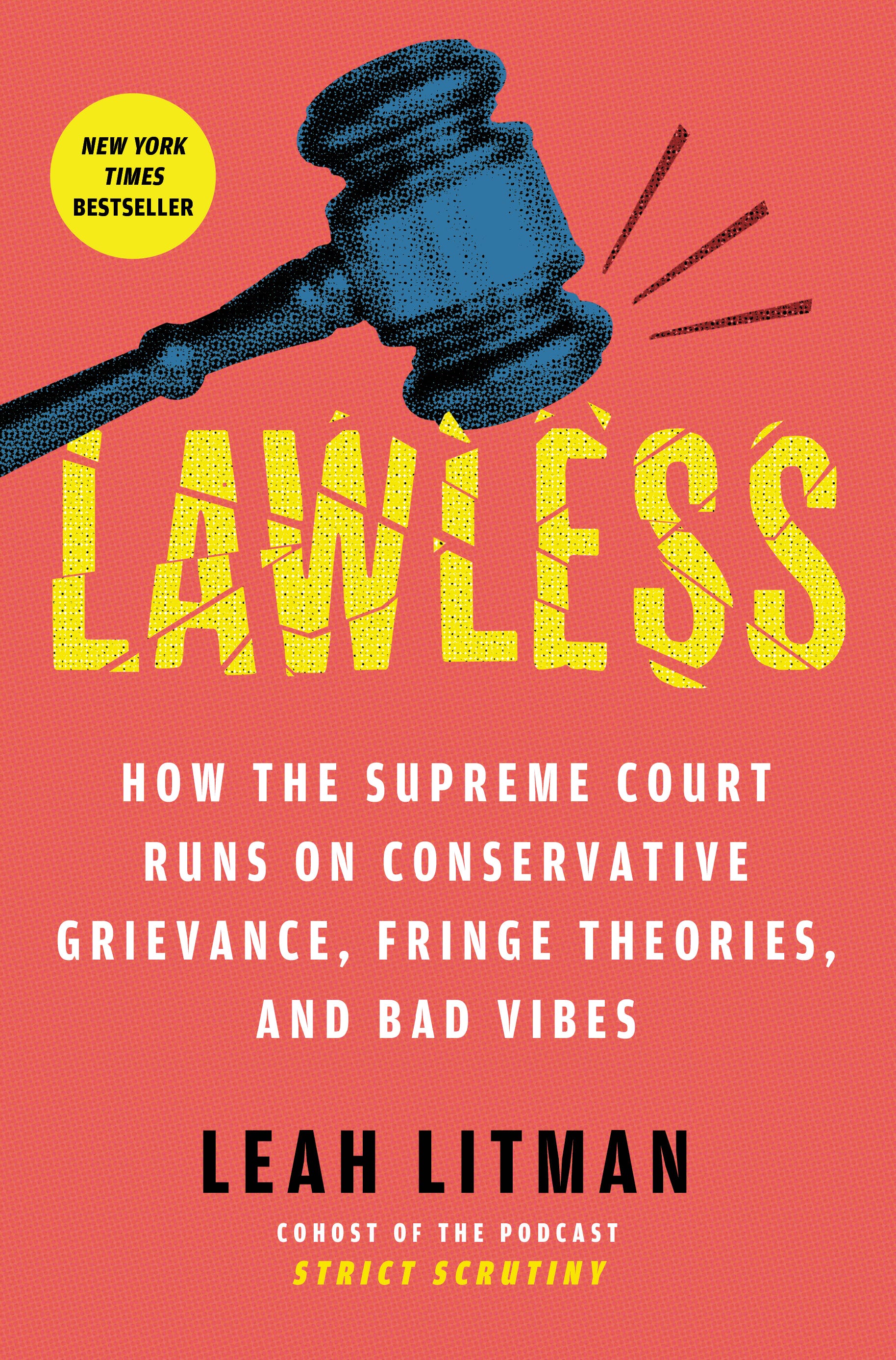
Leah Litman is a professor of law at the University of Michigan, co-host of Strict Scrutiny, and author of the New York Times bestseller Lawless: How the Supreme Court Runs on Conservative Grievance, Fringe Theories, and Bad Vibes. The updated paperback version of Lawless, which will be released on June 16, 2026, contains a new section on how the Supreme Court has enabled Donald Trump.

It is indeed a very sad day when the Supreme Court can allow a President to overthrow part of the Constitution by Executive Order. The Constitution lays out very clearly the process for changing the Constitution, and it does NOT include a Presidential Executive Order. Perhaps the Supreme Court should consider reading the Constitution?
This particular Supreme Court, purposely imbalanced courtesy of Mitch McConnell, does not interpret the law, and justice; they rewrite it, and edit it ... as if they know better than the founders. They are "originalists," but only in one sense; the Republican appointees have a very original take on what the Constitution says, and what their role is ... in turning it on its head.