

Is Trump Building ‘Concentration Camps’? These Experts Have No Doubts
ICE’s immigrant mass-detention facilities fit a dark, century-old pattern

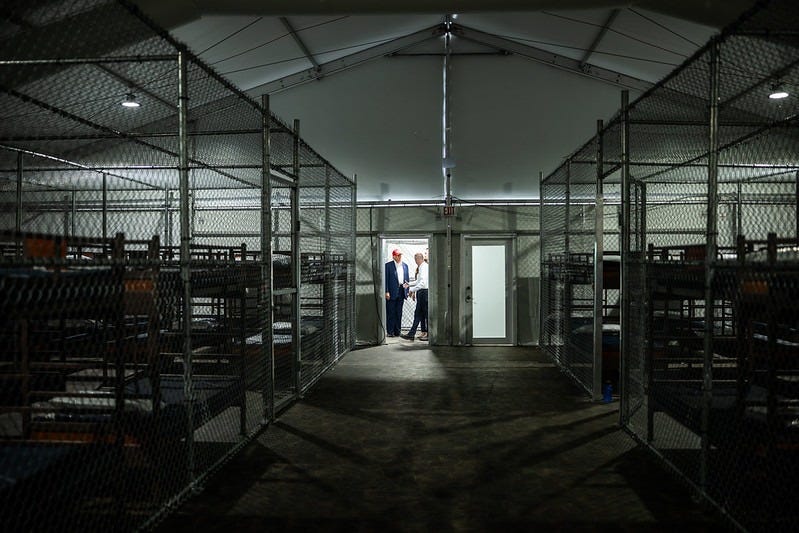
Donald Trump’s brutal ICE detention facilities have been blasted as “concentration camps.” This is a freighted term — summoning more than a century of deplorable history. But experts in the field have no hesitation in using these words to describe the network of facilities that the federal government is using to literally warehouse tens of thousands of immigrants — men, women, and even children — snatched out of their communities by masked federal agents.
The activist group 50501 recently hosted a video call on this topic. It featured Andrea Pizer, the author of One Long Night: A Global History of Concentration Camps, as well as journalist Frank Abe, co-editor of The Literature of Japanese American Incarceration and a longtime activist in pursuing redress for the abuses of America’s World War II camps.
In his introductory remarks, Abe insisted that Trump’s new ICE warehouses “are nothing but 21st Century American concentration camps.” He added that the subject was personal to him: “I’m a third-generation Japanese American, and I know a concentration camp when I see one.”
The words “concentration camp,” for many, evoke the horrors of Hitler and of facilities like Auschwitz, where more than 1 million people were murdered by the Nazis. But Pitzer drew a firm distinction (as do other experts) between “extermination centers” and concentration camps. The latter are not synonymous with “death camps” — although people held in concentration camps often die by disease, deprivation, or indifference.
Concentration camps have been around since the 1890s and documented on six continents. Pitzer, who has traced that history, offered the audience her own general definition: “A concentration camp is a mass detention of civilians on the basis of identity — something you are, rather than what you’ve done,” she said. “It is generally used without due process. And it is done to entrench and expand political power for an authoritarian-style government.”
The label “concentration camp” has always been controversial. Nearly from the beginning, Pitzer explained, authorities running concentration camps have routinely denied that they are, in fact, running “concentration camps.” The first camps were established by the Spanish in Cuba — followed shortly by the British in southern Africa. But even those Brits were adamant that their camps were different. “Literally from the beginning of concentration camp history, every country that had concentration camps would argue, ‘No. These aren’t really like those other camps,’” making the claim that their regime of mass-incarceration was somehow justified on the basis of public safety, rather than cruelty and control.
“This is a dialogue and a debate that still goes on today,” Pitzer underscored. “So if you hear that about immigrant detention today — ‘Well, it’s not really concentration camps’’ — it is very much so.”
A key indicator that Trump’s ICE camps fit the definition, for Pitzer, is the lawless way the administration is filling them. “You have masked secret police that don’t identify themselves on the streets, kidnapping people,” she described, “and taking them quickly from a local detention to a transit camp — so attorneys can’t find them to give them legal rights.”
And then there is the “dismal” reality of ICE camps themselves — where detention conditions are a threat to human health and so noxious that many detainees agree to deportation rather than pursuing their rights to due process. “People in feces [from overflowing toilets]. People without clean water to drink. People without adequate food,” Pitzer said, reeling off a litany. “They’re denied medical care. They’re denied their own medicine, even if they brought them in. There have been multiple deaths — with one of them even declared a homicide.”
Emphasizing that these are the early days of a system that is unlikely to improve, Pitzer added: “We are already looking at a tremendous amount of suffering” — including outbreaks of deadly disease ranging from measles to tuberculosis.
That suffering is attributable, in part, to a mad rush by the administration, and state allies like Florida, to expand detention capacity by erecting makeshift tent-walled camps. These include Camp East Montana — the largest facility in the ICE network, built at an El Paso military base that was previously the site of a Japanese “internment camp;” and Alligator Alcatraz, a Florida-state facility that operates in conjunction with the Trump regime. (Tallahassee and the MAGA administration are now feuding over who should pay for the $600 million camp.) The experience at both facilities have been hellish for detainees, but also logistically: “Hygiene, water, weather, disease outbreaks — different things [are] just going horribly for them,” Pitzer said.
The administration is now pivoting to more permanent facilities — seeking to spend as much as $38 billion to acquire new detention centers. Many of these will consist of caged bunkhouses, built inside huge industrial warehouses — with the goal of adding tens of thousands of additional bunks to the ICE system. The largest facilities, described by the government as “mega-centers,” — could house 10,000 people apiece.
That scale that would put ICE camps on par with the federal camps opened during World War II to incarcerate Japanese Americans. “That’s the size of a Manzanar or Tule Lake,” said Abe, naming two giant “relocation” facilities that have been acknowledged in federal records (and by the Truman Library) as “concentration camps.”
Abe helped secure a national apology during the Reagan administration to Americans of Japanese descent who were imprisoned at such camps, including his father and stepfather. “We won that in 1988. We thought, Mission Accomplished; America will never do that again,” Abe said. “And yet, here we are.”
ICE is currently detaining about 70,000 people, nearly three-quarters of whom have no criminal record, and whose only alleged wrongdoing relates to civil violations of immigration statutes. Nonetheless, the government is working overtime in the courts to prevent such individuals from being released on bond until their immigration cases are resolved.
The number of ICE detainees has soared by about 75 percent since Trump took office. And if anti-immigrant zealots in the White House, like Stephen Miller, have their way, the administration is just getting started. “Their goal is to deport 15 to 20 million people,” Pitzer said. “For historical context, that is [the size of] the Soviet Gulag. The Soviet concentration camp system had 18 to 20 million people move through it in more than 20 years.”
The Trump regime is seeking to move much more quickly. “That is impossible to do without a tremendous amount of death and suffering — even if we never reach the stage of extermination camps that we saw in Nazi Germany,” Pitzer said, adding: “I don’t think that we are close to those.”
But the concentration camp scholar emphasized that stopping short of Nazi crimes against humanity is a cold comfort. “There can be plenty of deaths without ending up with gas chambers and mass executions,” she said. “The system itself will do a lot of that.”
The hour-long 50501 presentation is well worth your time, and includes success stories of local activists who marshalled their communities to block the administration’s planned acquisition of warehouse space. The video is available at the link below:
Tim Dickinson is the senior political writer for The Contrarian
Thank you for this, though some of us (particularly those who are Jewish or Japanese and who carry their history through generations) have been very aware of this. Communities are fighting back but, what we really need to do it to pressure the GOP to stop funding all of this. That's a huge task. The damage we are causing, both to ourselves and to the rest of the world, because of the actions of this administration is terrifying. I wake up with a knot in my stomach every single day.
Sarah Palin accused the Democrats of wanting to build concentration camps 'for your mothers' when she was the vice president nominee. Now the republicans are doing just that. It seems that everything the republicans say is projection of what hey want to do or are doing.