


Democracy advocates should consider this: “The main source of power in this country is people with cardboard signs.” That observation actually came from Anton Tymoshenko, a Ukrainian comedian, quoted in the Wall Street Journal, highlighting the explosion of popular criticism that followed a move by former comedian, now Ukrainian President Volodymyr Zelensky, to disable anti-corruption bodies—including National Anticorruption Bureau. His comment certainly has application to the United States. (By the way, comedians appear to be best source of political leadership in Ukraine. Perhaps Stephen Colbert should consider a career change?)
As a result of Ukrainians’ outpouring of anger and disgust over rising corruption, Zelensky did a U-turn, restoring the anti-corruption bodies. He paid tribute to the power of public opinion. “Ukraine is a democracy—absolutely no doubt about it.” While Ukraine and the U.S. have dramatically different challenges, there are two key lessons for America’s pro-democracy movement.
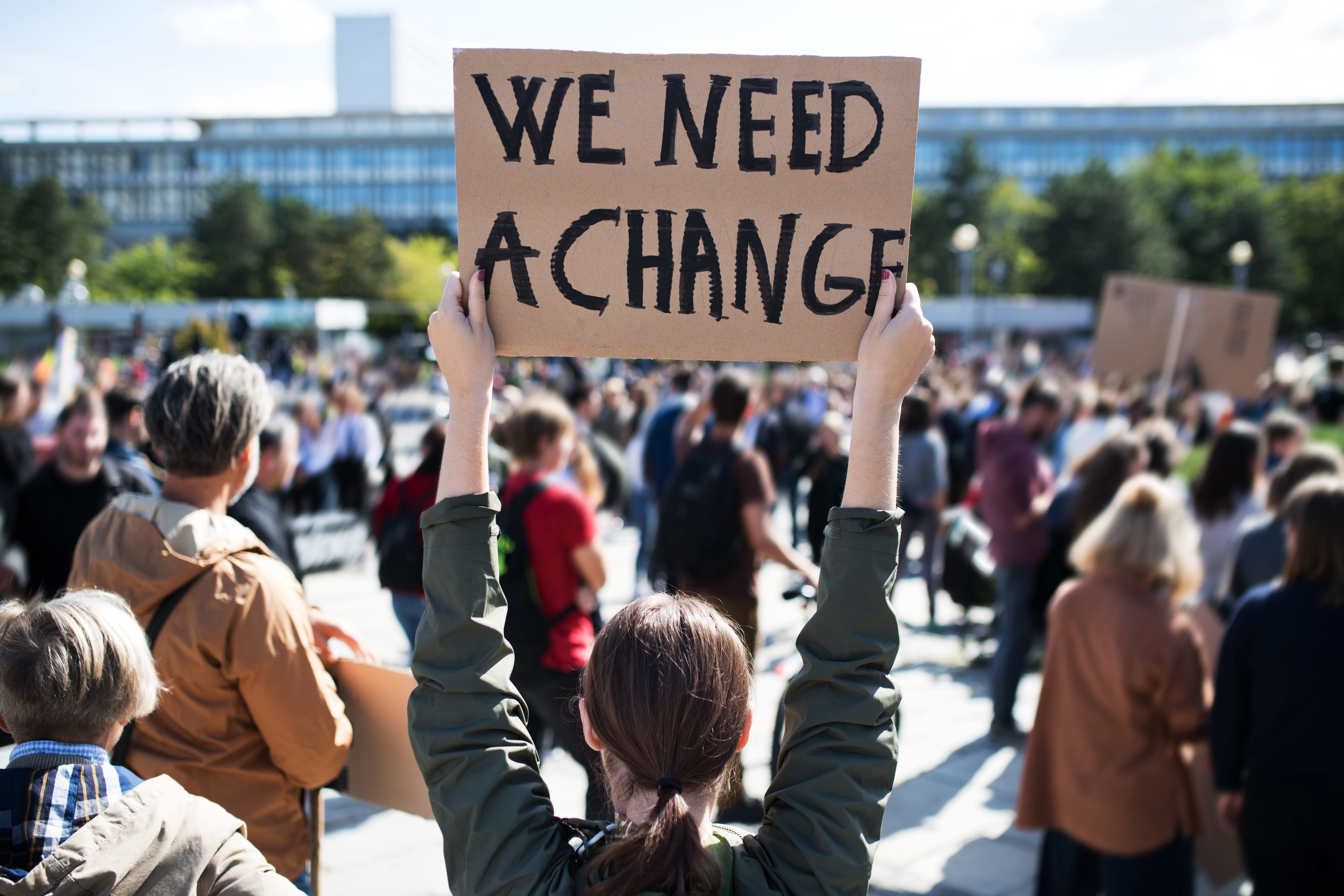
First, snooty Democratic politicians, consultants, and pundits who scoff at the power of mass protests (They’ll fade! Not serious!) are politically tone deaf, not to mention dead wrong. There is a well-developed body of research that shows the connection between political protest and electoral votes.
More than a decade ago, Erica Chenoweth at Harvard assembled impressive data showing the power of popular, nonviolent protest. The BBC summarized her findings:
Looking at hundreds of campaigns over the last century, Chenoweth found that nonviolent campaigns are twice as likely to achieve their goals as violent campaigns. And although the exact dynamics will depend on many factors, she has shown it takes around 3.5% of the population actively participating in the protests to ensure serious political change.
Her study thereby gave birth to the so-called “3.5% rule” eagerly monitored by demonstrators around the globe.
Studying over 300 protests from a host of countries over a century, Chenoweth and her researchers found that nonviolent campaigns “led to political change 53% of the time compared to 26% for the violent protests.” The reasons are not complicated. A broad cross section of society can participate in peaceful events; visible mass events garner media attention and can build social bonds needed to sustain opposition movements.
Subsequent research has confirmed her findings.
A study co-authored by Sarah A. Soule at Stanford Graduate School of Business and Daniel Q. Gillion at University of Pennsylvania, for example, determined:
On average, a wave of liberal protesting in a congressional district can increase a Democratic candidate’s vote share by 2% and reduce a GOP candidate’s share by 6%. A wave of conservative protests, like those by the Tea Party in 2010, will on average reduce the Democratic vote share by 2% and increase the Republican share by 6%.
On top of that, big protests by progressives have spurred increases in the quality of Democrats who decide to challenge incumbents. (Conservative protests haven’t had the same impact motivating Republican challengers, however.) That seems to be what has happened in 2018, when record numbers of women both marched in the streets and decided to run as Democrats for Congress, but the pattern isn’t unique to this year.
In sum, dismissing the importance of remarkably robust mass organizing events amounts to political malpractice.
Second, corruption is a powerful subject, one that American democracy defenders would be smart to elevate in importance. It may be just as influential with voters as violations of the rule of law and reverse Robin-Hood economics (e.g., slashing healthcare and food benefits to pay for tax cuts for the rich).
Kleptocracy of this nature, heretofore seen in places like Russia, has come home in the disgusting, piggish and—in the eyes of many experts—illegal use of the White House to enrich Trump and his family.
At the 100-day mark in Trump’s presidency, Sen. Elizabeth Warren (D-Mass.) documented 100 instances of blatant corruption including “a private dinner with Trump himself—and a special tour of the White House—for the top 220 holders of his meme coin, permitting Trump and his family to profit both from the run up in the value of the coin AND the increase in trading on the Trump platform”; pardons of Trump loyalists convicted of white collar crimes; non-enforcement of certain corporate transparency, fraud, and foreign bribery statutes; and firing of inspectors general.
The pace and extent of the graft has only increased since then. Trump accepted a $400B “gift” from the Qataris. He continues to host events at his properties, most recently at his golf course in Scotland, which he promotes on the taxpayers’ dime.
Trump’s profiteering on the crypto front alone has raised a host of questions about conflicts of interest and violations of the emoluments clause. As the nonpartisan Public Citizen put it in calling for investigations and regulations: “All available signs point to Donald Trump trading deregulation of the crypto industry in exchange for personal and political enrichment.…As is often the case with this administration, the corruption and scandal is happening out in the open, right in front of our eyes.”
Trump has effectively institutionalized his graft operation in an outfit called MAGA, Inc. As the New York Times documented, “dozens of seven- and eight-figure contributions to MAGA Inc. from crypto and other interests revealed in a campaign finance filing on Thursday night that hinted at the access Mr. Trump accords those willing to pay.”
We have never seen pay-to-play on a scale of this magnitude. “[L]obbyists, political consultants and others in the influence industry have capitalized on Mr. Trump’s aggressive fund-raising while in office to deliver for clients and earn chits with a president who keeps close tabs on who is delivering cash and listens to their appeals.” The days when a scandal erupted over Bill Clinton allowing donors to sleep in the Lincoln bedroom (gasp!) seem like ancient history.
Pro-democracy advocates might also keep a running total of Trump’s ill-gotten gains, commit to investigating and permanently banning from government contracting those individuals and entities that engaged in illegal activity, prosecute any violations of the Corrupt Practices Act and other white collar crimes that Trump let slide (including improper conduct by representatives of foreign powers), and appoint a special counsel to pursue all criminal and civil avenues available to disgorge from Trump largesse improperly accumulated during his tenure.
In addition, Democrats certainly should commit to anti-corruption legislation that imposes stiff penalties on anyone, including all members of the executive branch, who participates in or enable deals that use the power of their offices to get rich. Given the Trump example, we apparently need a law mandating that presidents put their holdings in a blind trust and cease private business operations while in office.
A simple but powerful message would likely resonate in 2026 and 2028: “They ripped you off and enriched themselves. We will get your money back.” Let Republicans defend their acquiescence in the worst spate of corruption in U.S. history.
Especially in this day and age, when one hand-made cardboard sign can go viral in a flash, protest is critical. Out of many, many worthy contenders, my favorite is still an old lady on No Kings Day carrying one with You Know Who's ugly, sneering demented face on it, with the simple words:
"DOES THIS ASS MAKE MY COUNTRY LOOK SMALL?"
I'm a Democrat, but I'll be damned if I'm not sometimes disgusted by the passivity and sense of decorum some of our leaders in Congress have displayed, pretty much the last 50 years. Unlike we the people, these elected officials have failed to see the Republicans slowly taking over state houses, driving up income inequality, gerrymandering, blocking useful legislation by Democratic presidents, stacking the SCOTUS, etc. They thought our guadrails will hold. They didn't count on a scoundrel like Trump and the weird hold he seems to have on Congress. We need to keep hammering our representatives, especially in red states like mine, to let them know we are watching and we won't abide by any more BS.