


In honor of Rep. Bob Onger’s (R-Mo.) new bill to rename the Kennedy Center the “Donald J. Trump Center for the Performing Arts” (a bill titled, naturally, Make Entertainment Great Again), here are a few other things to which House Republicans have proposed adding their Dear Leader’s name or likeness:
The DC Metro, which would become the “Trump Train”
Dulles Airport, which would become “Trump International Airport”
The $100 bill, on which Trump would replace Benjamin Franklin
U.S. coastal waters, which would become the “Donald John Trump Exclusive Economic Zone of the United States”
Flag Day, which would become a combined national holiday with Trump’s birthday
Mt. Rushmore, despite the National Park Service’s claim that there’s no room for his face
Trump began his term with renamings in the whitewashed, red-blooded argot of MAGA: a Day One executive order decreed that Mt. Denali revert back to Mt. McKinley and that the Gulf of Mexico become…well, you remember. His administration has continued erasing the contributions of non-male, non-straight, non-white Americans wherever possible (except if the reference to non-whiteness is a racist epithet). But when his real project is to entrench his own personal power, while minimizing the visibility of everything and everyone else, why not just eliminate the middlemen and name everything after himself? The middling men in Congress are ready to make the ask.
In the understatement of the century, Trump is no stranger to self-branding. What distinguishes the above list from slapping his name on buildings, steaks, or golden sneakers is that he’s moving beyond products in the marketplace. He wants to subsume our infrastructure, art, and American history itself under Trump™.
This broader quest for visible ubiquity brings new challenges. With the Kennedy Center, the proposal seems illegal. In line with the act passed by Lyndon Johnson that established the center as a “living memorial” to Kennedy, U.S. code states that “no additional memorials or plaques in the nature of memorials shall be designated or installed in the public areas of the John F. Kennedy Center for the Performing Arts.” To circumvent this, Republicans will have to either change the law or Trump will just ignore it. Which is not impossible to imagine.
Whatever happens with the (for now) Kennedy Center, to say nothing of what looms on Republicans’ wish list, one thing seems clear. By bringing the twin logics of capitalism and autocracy to bear in arenas that are not of them, Trump is threatening permanent damage to American institutions while simultaneously dooming his own stupid quest for immortality.
The more grounded a naming is in the principles of a gift, rather than commerce, the longer it’s likely to stick around. The way Trump has put his stamp on things before now is through 1:1 rules of property: I own this [building, beef, company,] so I get to mark my territory. That lasts as long as you own it. When the residents of a group of hi-rises Trump no longer owned wanted to take his name off their homes, he had no power to stop them. Further along the spectrum, if you donate a heap of money to get a museum to name a wing for you, it’s harder to change that (but not impossible).
A memorial is the furthest thing from the principle of market exchange. The black wall of the Vietnam Memorial in DC is not available for purchase as billboard space; the memorial to the September 11 attacks will not be converted into a water park if a new developer comes along. The Kennedy Center is a “living memorial,” in that remembrance isn’t its sole purpose—it’s pointedly, in function, the National Culture Center that JFK championed during his presidency. The memorial aspect, eternal and non-fungible, is all in the name. Far-sightedly, the language barring future plaques ensured that no mega-donors could demand recognition and thereby erase its original purpose. Let’s hope that law was far-sighted enough to foil a president hell-bent on rewriting democracy.
With his decimation of aid and allyship, Trump has shown himself not to understand gifts. He wants to make the world a zero-sum exchange—one that America will somehow win forever. His thinking around the Kennedy Center is a microcosm of this greed-rooted short-termism. Sure, he could change the law and force through the rebrand. This will give him his name in gold on yet another building—and Melania’s, too, if a related bill to rename the center’s Opera House after her goes through—but it will never give either of them the timeless prestige of Kennedy. It will destroy the memorial quality of the space itself, cheapening it to something to be sold to the next highest bidder.
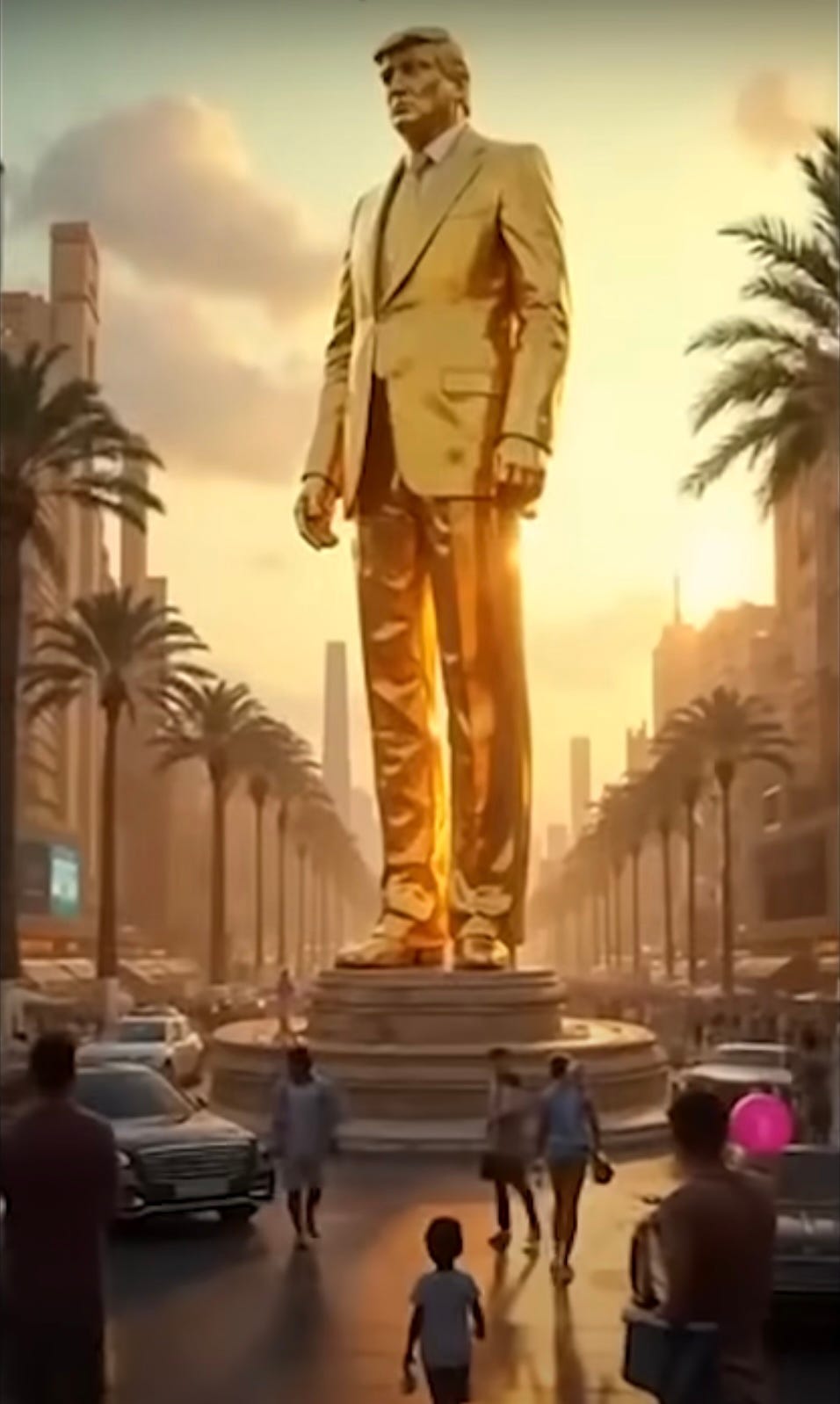
Trump wants to make of history a palimpsest, and of public spaces walled and sponsored gardens. He’s not the first rich man to do this via rebranding, even recently; when Elon Musk took over Twitter and pronounced it X, he took a private enterprise that had made the rare leap into becoming a commons and remade it in his own image. He robbed us of a verb (to tweet) that had belonged to everyone. Now, if we want to stay in that world, we have to either use his words or speak a living memorial every time we refer to it (“formerly known as Twitter”).
Rampant, egomaniacal renaming is, of course, also straight out of the authoritarian playbook—it gets at what John Ganz has called “the two great enemies of demagogues: context and memory.” But what the renamer wants is exactly what he can’t have, because mortality is the curse of any cult of personality. Take a thing that’s bigger than any man, suggest it’s synonymous with said man, and you’ve instantly given it an expiration date. The only bright spot in imagining the horrors of a JD Vance presidency is picturing him as the so-called leader of the so-called free world while existing in the shadow of the Trump flag on the lawn, forever deputized by the smirk of Trump’s mug on the $100 bill in his pocket.
Unless, that is, the aftermath of Trump’s presidency goes more like it went for his spiritual brother, former president of Turkmenistan Saparmurat Niyazov. From 1985 to 2006 Niyazov, self-styled as Turkmenbashi (“father of all Turkmen”), remolded his nation’s life around himself. He renamed the months of the year after his family, made his book required daily reading in schools, spent billions reengineering the desert climate of the capital city, and of course banned dissent. In the capital’s center a 12-meter-tall, gold-plated statue of him rotated to always face the sun.
After Turkmenbashi died his successor started renaming things for himself, taking notes from Niyazov’s playbook. Turkmenbashi’s name is disappearing from public life, his only certain legacy the open seat of one of the most repressive regimes in history. Now his successor’s son is president, thanks to an election dubbed neither free nor fair. A dynasty that eluded the “father of all Turkmen” has been established.
The twelve-meter golden statue has been exiled to a hill in a distant suburb. It no longer rotates, but faces only back towards the capital, its gaze fixed on the eroding fantasy of its dead namesake.
He reminds me more of Ceausescu of Romania in his gilded grandiosity. If he winds up with same fate, I wouldn’t cry.
How is it possible for House Republicans to sink any lower than to desecrate the Kennedy Center by renaming it after their dear leader? No worries. They'll keep trying to cheapen our legacy.