


Let’s start with a caveat: By official metrics, we’re not in a recession. But the vibes, very clearly, are bad. Everyone I know is either un- or underemployed, and tension is universally high. I don’t know about you, but I’m not exactly in a going-out mood.
But life, and its requisite demands for calories, marches on. Even in moments of personal and financial crisis, we’ve still got to eat. The answer, of course, is one employed by working people all over the world since time immemorial: the humble legume and the grains you can pair with it to make a complete and nourishing protein.
Beans have long been the answer to undernourishment. Forget what the paleo folks tell you: The ancient days of gastronomy weren’t all about meat and organic veggies. Even before currency existed, these high-value foods were quick to deplete the nutritional budget. Vegetables, while easy to come by, don’t offer much in the way of all-day sustenance, and meat was a treat earned after long days of trekking across the savannah.
Grains and legumes came in clutch on those long ancient afternoons, and they do so today, too. All around the world, blends of grains and legumes are a staple of the proletariat diet, from the Chinese peasant food staple of millet porridge with preserved veggies to French cassoulet. Budget-friendly and nourishing, these dishes are as hearty as they are delicious–inspiring, hopefully, you to continue fighting the rising economic tides another day.
The other sneaky truth is this: cucina povera can be a glorious thing. We’d all obviously like to have the budget for unlimited sirloin, but even if I had all the money in the world, I’d still be into lentils. And in economically compromised times, there is something really joyful about finding the time to eat well and cheaply, glorying in the sensual experiences we can create for ourselves.
Some of the happiest times I’ve had around the table have been the cheapest—the time in grad school when I made a huge batch of eggplant parmesan for all my broke student friends with a pile of free eggplant from the community garden, a baby shower I threw for a friend with less than a hundred dollars worth in groceries from the middle eastern market. Gathering and eating well should be about the company, the experience of slowing down, and giving yourself a break, not about how much money you can afford to spend.
American society has a bad habit of associating poverty with virtue, so when money is scarce it feels as if enjoyment should be, too. We already have a fraught relationship with the idea of pleasure in general—but it seems, I think, more allowable when that pleasure is measured out in doses of dollar bills.
So if you, like me, are one of the legions of economically uncertain, let this be your sign: You deserve to eat well, too. To sit down with people you love and share a meal, a little reminder that even amid chaos, there is joy and pleasure to be found. Especially if you happen to like lentils and rice.
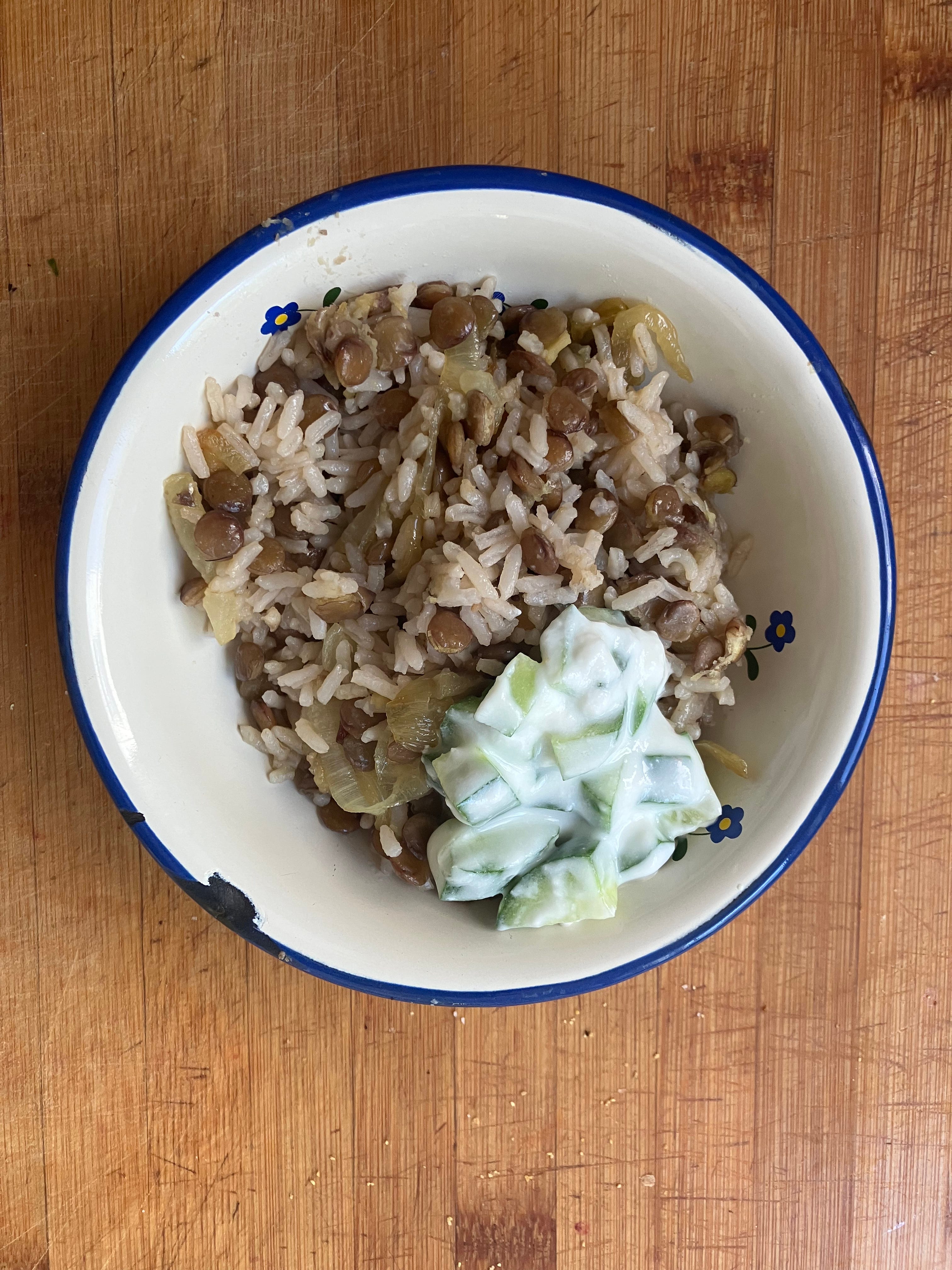
Make it Work Mujadara
1 cup long-grain white rice
½ cup lentils
2 ½ cups water
4 thinly sliced onions
¼ cup olive oil
¼ cup butter
1 tsp. Salt
Optional yogurt sauce:
1 small cucumber, grated or diced
⅓ cup whole-milk yogurt
Generous pinch of salt
Method:
Caramelizing onions takes forever, so start there. Place them in a pan with your olive oil and top with a generous sprinkle of salt, cooking over low heat and stirring occasionally until soft and dark brown, about half an hour.
Combine the lentils and one cup of your water in a saucepan. Bring to a boil and then cover and simmer for 15 minutes.
Add rice, the rest of the water, and salt, and bring back to a boil. Cover and simmer for 30 minutes.
If you’re making the cucumber yogurt sauce, now’s a good time to get that done. Mix together all your ingredients and give it a good stir.
Place your butter on top of the cooked lentils and rice, cover again, and cook for another 10 minutes. Stir half your caramelized onions in before serving, and eat with the rest of the onions on the side, plus your optional cucumber and yogurt sauce.
Emily Beyda’s writing has appeared in the Los Angeles Times, Built, Refinery29, Smartmouth, Fodors, the Thrillist, the Austin Chronicle, and more. Her novel, “The Body Double,” was published in 2021.

That recipe could go all kinds of ways. Thank you for sharing.
I usually take my lentils straight up. Rice gets served with black beans or pintos. I’ll have to try this combo sometime.