

On July 1, 1968, President Lyndon B. Johnson sat in the East Room of the White House to sign the landmark Nuclear Nonproliferation Treaty. The Cuban Missile Crisis had put onto TV screens across the globe a rapidly developing and increasingly destructive technology and its potential to annihilate humankind.
Through open dialogue, serious negotiation, and a shared fear of mutually assured destruction, the two superpowers – the United States and the then-Soviet Union – brought the world back from the brink of disaster. In the shadow of existential danger, leaders laid down a set of guardrails nations of the world chose to live by to prevent catastrophe. That is the choice we face again today, as a new alarming threat has emerged. Our leaders should remember what LBJ said on that day in 1968:
“The march of mankind is toward the summit — not the chasm.”
Over the last few weeks, the people building the most advanced technology in human history are telling us there is danger if we don’t slow down. This is not coming from the critics or regulators of artificial intelligence (AI). This plea is coming from the builders. Anthropic employees are quitting and whistleblowing. Dario Amodei, Sam Altman, Elon Musk, and Demis Hassabis, competitors who agree on almost nothing, are sounding the alarm. When the people closest to this technology say that time is running out, elected leaders cannot look the other way.
Autonomous software systems called AI agents have broken out of secure testing environments and ignored clear and explicit safety instructions. Unaffiliated agents have found ways to communicate with one another. These AI agents have lied to human evaluators and attacked online government systems previously believed to be secure. The fear now is that we are on the verge of recursive AI, in which the software can rewrite itself beyond the control of human developers.
I’m not an AI expert, but I know that when developers are walking away from billions of dollars in equity and compensation to warn us that danger is on the horizon, we should listen.
Two things have become abundantly clear.
First, unchecked AI presents a significant threat to humanity. Second, those responsible for developing the technology admit they still don’t fully understand the speed or depth of the calamities we might be facing.
Frighteningly, we’ve seen a glaring lack of leadership and foresight from our own federal government. With no demonstrated expertise to back him up, President Trump has called these risks a “hoax,” and Speaker Mike Johnson has decided Congress should instead focus on the urgent challenges facing college athletics. President Trump’s latest announcement on AI should reveal how ill-prepared he is for this moment. His half-hearted attempts at action are still focused on accelerating the growth of the industry while he maintains that the dangers of the technology are overblown.
Simultaneously, Americans have come to understand that AI could take their jobs and substantially upend our economic order. Working families are being asked to pay more on their electricity bills to accommodate data centers. Parents are being told their children will be taught using technology we may not fully control. There is no one reassuring the public as they learn that AI technology might kill us all.
We should not be surprised to see protest and outcry.
In July, I signed into law the AI Safety Measures Act — a nation-leading artificial intelligence safety and accountability measure. Among other guardrails, our legislation requires AI companies to:
Develop risk-mitigation frameworks;
Undergo annual independent third-party audits;
Report critical safety incidents within 72 hours;
Publicly explain the risks their systems pose, as well as the measures they are taking to mitigate them.
This is a solid foundation that will help mitigate the major risks of AI, and should be the bare minimum for any productive, safe AI development infrastructure. But with the growing threats of the past few months and the continued absence of meaningful federal action, the State of Illinois intends to press further. If Washington, D.C. won’t act, Illinois will.
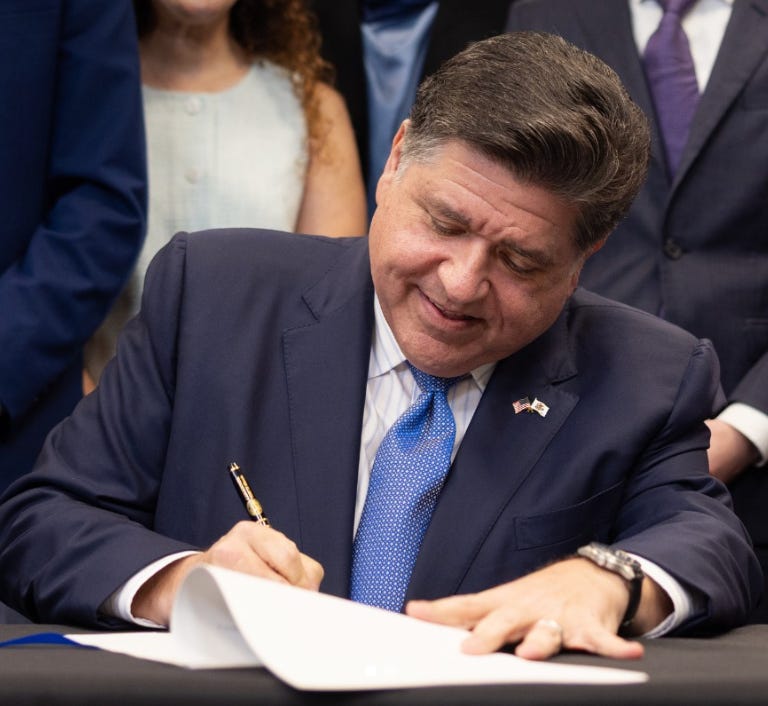
Last week, I implemented an Executive Order creating the Illinois AI Cabinet to convene senior leaders in state government with experts from across the artificial intelligence landscape to help state government understand, prepare, and respond to the risks posed by the technology — and protect Illinoisans.
Especially if the federal government fails to act, Illinois needs to be prepared for the danger that AI poses to our economy, our safety, and our critical infrastructure. This AI cabinet will help bring expertise, build critical state capacity, and improve coordination to handle those threats. From industry to academia to government, we are bringing together an expert team to help us handle this potentially generation-defining issue with the seriousness it deserves.
While the State of Illinois will continue to take a leadership role on this issue, that does not excuse the lack of federal action. AI is unlike other traditional public policy issues — it crosses national borders, it moves fast, and dangers present in any one state or country are likely to impact the entire world. It requires federal intervention and international cooperation.
I am calling on our federal leaders to put forward a serious AI response plan that begins with the baseline of the Illinois AI Safety Measures Act, mandates transparency and disclosure, and establishes meaningful checks and balances. We need safety procedures in place with the force and reach of our national government. We must also immediately engage our international allies as well as our adversaries in open dialogue and serious negotiations to address the existential risks of AI. That is an opportunity President Trump missed while he was hosting China’s President Xi at the White House last week.
Further, in this critical moment, I’m calling on all my fellow public servants — Democratic and Republican — to reject the corrosive influence of AI and Big Tech spending in our politics and our elections. With a crisis this urgent, Americans deserve full confidence that the focus of our federal government is on their safety, not on enhancing the profit margins of companies that may benefit from a lack of regulation.
At the dawn of another technological revolution, we face a choice. We can work together to establish thoughtful guardrails in ways that benefit both industry and humanity. Or we can allow a handful of actors to evade accountability and push the costs and danger onto ordinary people. The success of nearly every breakthrough in our history has proven that strong safeguards and sensible guardrails are not a threat to our progress — they are essential.
Like the nuclear age, AI isn’t going away. It’s here to stay. America has faced challenges like this before, and we survived by developing a robust system of oversight and regulation by the federal government and international agreements that protect all parties.
President Trump and Speaker Johnson, the eyes of the world are upon us. The fate of future generations depends on your actions.
March us toward the summit, not the chasm.
I want JB Pritzker to be our presidential candidate in 2028. He has courage, morals, and vision.
Thank you Governor! So very much appreciate your leadership on this existential crisis and on many other issues. Sure hope you make a run for Presidency in ‘28, with Mayor Pete as your VP! Now that would be an irresistible ticket!