


Part of the reason why Congress seems like it’s run by distant elites who don’t get it is because it is run by elites, who have little experience of what it means to struggle in this country. Only two percent of Congress members have spent any part of their adulthood in the working class, according to a 2021 report. The legislative branch pulls, instead, from the top strata of our economic society. A New York Times survey a few years ago found that more than 70 percent of Representatives were lawyers, medical professionals, or business people.
That may be changing.

In 2026, Democrats are running a strong slate of working-class folks for Congress. “There’s a lot of people that are running for office right now… they’ve been working their entire lives,” says Bob Brooks, a fireman and union leader running for a House seat in Pennsylvania. “We’re tired of being pushed around. We’re tired of people making rules for things that don’t involve us. We want rules made to make our lives better.”
These Democrats running for office include a teacher, an ironworker, a nurse, a logger, a pastor, and urban- and wildland firefighters. Around the office, we’ve dubbed this group the Busytown Caucus, as their professions seem to be lifted from pages of Richard Scarry’s classic storybook.
But their qualifications are far from cartoonish. These candidates understand the affordability crisis because they have lived it. They feel the strains on public education because they work in inadequately resourced schools. They see the administration’s mismanagement of the VA system because they work inside its emergency rooms. They felt the damage DOGE did to the Forest Service because their hourly-wage colleagues got the ax.
These real-world candidates are up against the MAGA movement’s fake populists and moneyed elites — including the world’s only former trillionaire, Elon Musk. The still-richest-man-in-the-world has reportedly spent $276 million since July in an attempt to rescue Republicans from the Democrats, including this working class wave of candidates.
Predominantly political rookies, the Democratic candidates are running for office because they want to improve normal people’s lives. “I’m constantly working for better: Better wages, better working conditions, and better pay,” says Brooks, who has also served as a union leader. “If we can fix some of that, we’re fixing a lot of good things for the everyday person…who can’t afford anything right now.”
Teacher Jake
Jake Johnson is a math teacher in southern Minnesota running to represent a House district that stretches across the lower belt of the state from Rochester to the South Dakota border. He recalls growing up in a “very working class family” but clarifies: “You know, here, ‘working class’ means ‘broke.’ My dad was a garbage collector. My mom was a meter reader at the gas company. And I have 10 siblings.”
Johnson’s family squeaked by with community support. “It was part of who we are in southern Minnesota. We take care of each other.” But they also relied on federal programs. “I was a SNAP kid, and we were a Medicaid family,” he says. “I would not have gone to college if not for Pell Grants and subsidized Stafford loans.”
Johnson now has four boys of his own. His wife is a school paraprofessional. And he decided to challenge MAGA Rep. Brad Finstad because of the incumbent’s enthusiastic backing of Trump’s One Big Beautiful Bill. “What got me into this race was seeing our congressman be so proud of the cuts to SNAP, the cuts to Medicaid — a lot of the programs that I needed and many of my students need and utilize.”
Finstad’s approach conflicts, Johnson says, with his own version of the American Dream, which insists that “everybody’s worth investing and believing in.” As he did in his childhood, Johnson is again relying again on community support. “We’ve built a people-powered effort here to take back our voice, which is sorely missing right now,” in Washington, Johnson says, “as we just have a [Trump] rubber-stamp sitting in Congress.”
Watch Johnson’s interview with the Contrarian here.
Nurse Mitchell
Mitchell Berman is a VA nurse campaigning for the southern Wisconsin House seat once occupied by Speaker Paul Ryan and now filled by a Ryan protege, Rep. Bryan Steil. Berman says that the lived experience of the working class is essential to making the House of Representatives actually representative. “Honestly,” he says, “we could use a few more nurses, a few more teachers, a few more people with some lived experience in Washington right now.”

Berman’s mother worked in a foundry; his father built a small business. “They taught me the values of hard work and selflessness and to always stick up for the little guy.” Berman is a first-generation college student who graduated with “a mountain” of student loan debt. “I had to eat bologna sandwiches for five years to take care of that,” he says.
He now works as a nurse in a VA emergency room. “We don’t only treat health problems in the emergency room, but we see a lot of social aspects of what goes into health,” he says. “People here in our district are hemorrhaging and they need someone to help fix problems. That’s something I carry with me out of the ER. And that’s something that I plan to carry with me to Washington.”
Watch Mitchell’s interview with the Contrarian here.
Ironworker Brian
Brian Poindexter is a union ironworker who is taking on the disgraced Trump ally Rep. Max Miller, who has been accused of horrific domestic violence and been denounced as unfit for office by his former father-in-law, Sen. Bernie Moreno (R-OH). (Miller denies the abuse.)
“The strength I bring to this campaign, and what I’ll bring to Washington is my perspective: I know what it’s like to work and live paycheck to paycheck,” Poindexter tells the Contrarian. “I know what it means when you don’t make it to the next paycheck.”

Poindexter insists that politicians like Miller are “completely out of touch with what we’re going through.” This leads them to “keep doubling down and tripling down on trickle-down economics” like Trump’s Big, Beautiful Bill. “That was one of the largest transfers of wealth from the bottom to the top,” Poindexter says. “And people see that.”
Running in a red district, Poindexter is relying on his blue-collar background to help voters look beyond familiar partisan divides. “I am just like them,” he says. “Any bill that comes across the desk, I’m going to be looking at it through the lens of a working person, a pragmatic view that’s been missing in Washington for quite a long time.”
Watch Poindexter’s interview with the Contrarian here.
Fireman Bob
Campaigning for a House seat from Pennsylvania’s Lehigh Valley, anchored by Allentown, Bob Brooks is a firefighter and a union member. He insists his profession is “the best job in the world. Every day you wake up, you go to work, you can help somebody on their worst day.”
Why give that up to go to Washington, D.C.? “We’re not really represented there,” Brooks says. “Sixty percent of America is from the working class, while two percent of Congress is. So, who’s making the laws for us? Nobody.”
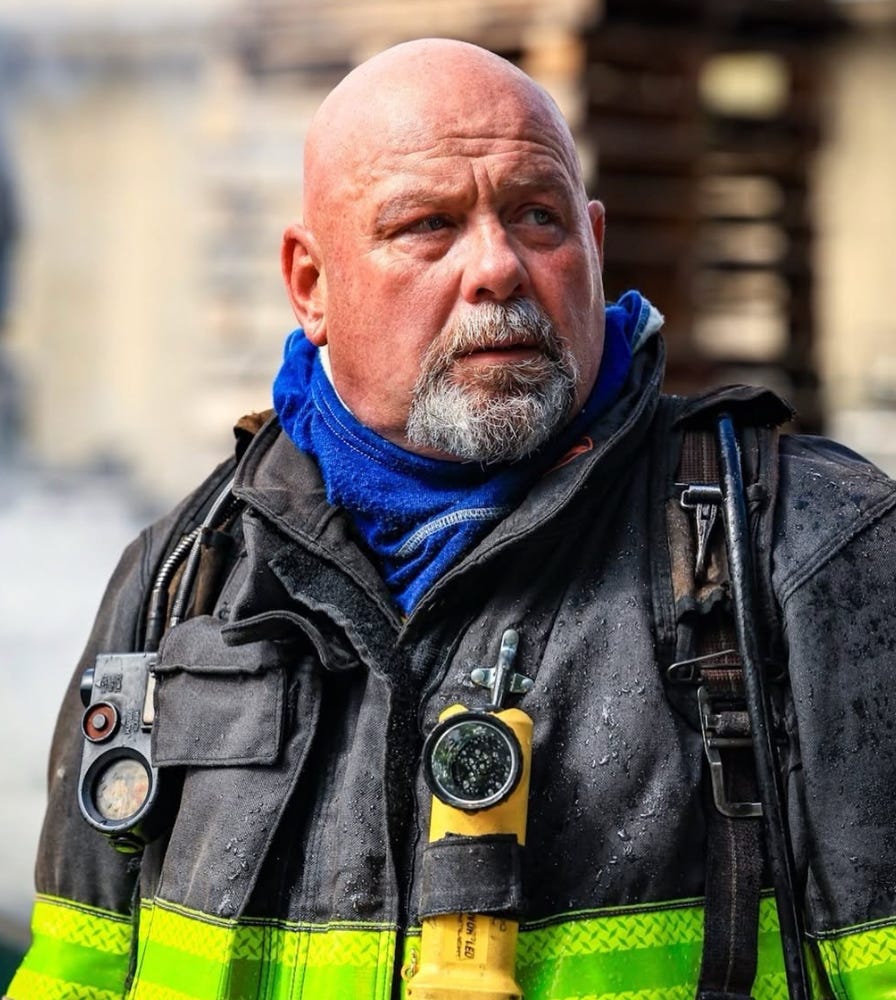
Brooks is challenging a career politician in incumbent Rep. Ryan Mackenzie. “Mackenzie’s never had a job,” Brooks says. “He went from Harvard to the state house to Washington. So, quite honestly, it’s a real big thing for me to make this guy fill out his first application.”
Watch Brooks’ interview with the Contrarian here.
Smokejumper Sam
Sam Forstag is running to represent western Montana in Congress. He’s also a firefighter by profession, and even jumps out of airplanes to fight blazes. “In the last four years. I’ve been working as a smokejumper,” he tells the Contrarian. “We parachute to put out wildfires while they’re still small.”
Forstag loves the work. “It’s the most incredible job I’ve ever had out of 20-some jobs — I’ve had a whole lot of jobs just to get by,” he says. “There are less and less job opportunities to work with your hands in a way that you can see the fruit of your labor. That’s the saw line we created and that fire is done. It’s stopped,” he says of extinguishing dangerous blazes. “And I think that the metaphors for what we’re dealing with right now in Washington are just endless.”
Forstag was motivated to run by the lunacy of the DOGE cuts committed under Elon Musk’s watch. “We lost just shy of a quarter of the Forest Service in Montana in one year. And the overwhelming majority of the people they fired in my agency were people making less than $20 an hour.” Forstag recognizes that there’s bloat in government, but the inefficiencies, he insists, “are not not the people making 15 bucks an hour swinging a tool in the woods to keep a trail clear.”
Forstag seeks to fill the seat of outgoing congressman and former Interior Secretary Ryan Zinke, who put up no fight against Musk’s destruction. His opponent is a right-wing radio talk show host, Aaron Flint, who is campaigning with Donald Trump – a president who has made billions while in office, while being blasted for corruption.
Watch Forstag’s interview with the Contrarian here.
Pastor Adam
Adam Hamilton is a church leader in Kansas who is running for Senate against a MAGA opponent, Sen. Roger “Doc” Marshall. The incumbent has voted to cut healthcare subsidies as a politician while, in his career as a doctor, he habitually sues working-class people who can’t pay their medical bills, sending several of them to jail.
Hamilton was born to teenage high school dropouts. His father managed a gas station. His parents divorced and his mom ended up in bankruptcy, leaving the family to live in an abandoned farmhouse. “The gift of the chaos and financial hardship we lived through,” Hamilton writes, “was a compassion for people who struggle.”
In an interview with the Contrairian, Hamilton reflected on Marshall suing for overdue bills: “I know people who have struggled to be able to pay their medical debts. I don’t know any other doctors who make that a routine practice,” he said. “700 people were sued, 81 people were arrested, three or four spent time in jail.”

Hamilton says this controversy strengthens his conviction that Marshall needs to go. “Here’s a man who was suing people for not being able to pay their bills, low-income struggling people. And then he’s taking away health insurance from 51,000 more people in Kansas” by voting for Trump’s tax-cut bill for the wealthiest, financed by cuts to Obamacare and Medicaid (among other social safety net programs). “There’s just a fundamental indecency about this,” Hamilton says. “We have to find a better solution than that.”
Watch Hamilton’s interview with the Contrarian here.
Logger Troy
Troy Jackson grew up in northern Maine, near the Canadian border. “I come from a logging family. I’m fifth generation,” he says. “I watched growing up how people with a lot of power in the logging industry held communities back.”
As a young man, Jackson helped lead a border blockade, seeking federal support for American loggers who were being displaced by Canadian temporary workers. It didn’t materialize. “My eyes, at 29 years old, got opened to the fact that government doesn’t work for people that don’t have the bigger checkbooks,” he says. “Ever since then, I’ve been trying to change that.”

In more recent years, Jackson has risen through the ranks of Maine government to become the president of the state senate. He’s now going up against MAGA enabler Sen. Susan Collins, who masquerades as a moderate. “She counts the votes and throws one towards working-class people when it doesn’t count for anything,” Jackson says of Collins’ MO. But the incumbent — who is enmeshed in a wild corruption scandal — is a reliable vote for the plutocrats when needed. “She’s giving tax cuts to the wealthiest people in this country. I mean, the ultra, ultra wealthy. And she’s done it on the backs of our health care system,” Jackson says.
Trying to appear an ally of the working class in a recent debate, Collins bragged of removing tariffs from road salt used to melt ice in winter. Jackson, in a defining exchange — not only in the debate but in the national discussion of the affordability crisis — shot back, “We can’t eat road salt,” and asked: “What about everything else?”
Jackson promises to be a voice for collective bargaining in the Senate. “I’ve watched in my career how if you don’t have that strength, you can be singled out, pitted against each other.” He vows that Congress can still be forged into a force for good for the working class: “The government is completely not working for everyday people,” he says. “And we can change that.”
Watch Jackson’s interview with the Contrarian here.
Tim Dickinson is the Senior Political writer for The Contrarian