


All week, the Trump administration has been using Los Angeles as a stage for fascist theatrics.
It began last weekend, when the president sent masked Immigration and Customs Enforcement agents to conduct sweeping raids at churches, farms, and Home Depots; it continued when he deployed thousands of National Guard troops and Marines to crack down on anti-ICE protests. And it reached alarming new heights Thursday afternoon, when Secret Service agents tackled and handcuffed Sen. Alex Padilla, a Mexican-American Angeleno, for the crime of asking questions at a press conference.
It’s no secret why Trump—or, more accurately, his ghoulish right-hand man, Stephen Miller—is targeting the city. According to the U.S. census, a third of L.A. County’ 10 million people were born outside the United States. And 48.6% of L.A. County is Hispanic or Latino.
“We represent everything that he doesn't want for the United States,” said Carolina A. Miranda, an independent culture writer based in Los Angeles. “It's a majority-minority city. Even our name is Spanish. It is a place where undocumented people live and work, and they are part of our communities and our families. They are not in MS-13. It’s the guy who sells corn and the day laborers at Home Depot. There is an element of our city that has been so historically demonized, like all urban centers, as a scary place of chaos and brown people. Los Angeles makes an easy target for the kind of red-hot MAGA base.” (Miller, who grew up in Santa Monica, appears to harbor a serious grudge against his hometown.)
For as long as it’s existed and as long as it’s drawn outsiders seeking opportunity, L.A. has been a center for activism and political protest, often led by immigrants and communities of color. Though the 1992 uprising and the 1965 Watts rebellion are well-known, the city’s role in the fight for racial and economic justice often gets overlooked compared with other major metropolitan areas. In the popular imagination, L.A. is viewed as a sunny dream factory populated by white movie stars.
“L.A. is sometimes dismissed as suburban and placid,” Miranda said. “That is just not the case at all.”
Diversity has been a part of the city from the very beginning, Miranda noted, “L.A. was not established by the Dutch or British. It was founded by 44 Mexican pobladores, the vast majority of whom were Indigenous, mestizo, or mixed race. L.A. has been diverse since its establishment in 1781. This is who we are. In trying to erase Latinos, Stephen Miller is erasing history.”
Before it became part of the United States, L.A. was ruled by indigenous people, then Spain, then Mexico. After California became a U.S. state in 1850, the Mexicans who had lived in L.A. for generations were suddenly viewed as outsiders. Asian immigrants began to arrive in L.A. and faced horrific mob violence. After World War II came a massive influx of Black people fleeing persecution in the South only to encounter segregation so stark that James Baldwin once likened L.A. to Birmingham.
This is not the first time L.A.’s diversity has made it a target. Miranda said she sees an “eerie echo” between “this moment in which the military is being deployed against Latinos,” and the Zoot Suit Riots of 1943. The so-called “riots” were actually a series of attacks perpetrated by servicemen stationed in L.A. on young Mexican-Americans, whose voluminous outfits were viewed as unpatriotic—and even criminal—in an era of wartime rationing.
“That was a case in which Navy men took it upon themselves to behave like vigilantes against Mexican-Americans, and the LAPD let them do it,” Miranda said. The event is “wildly understudied, but still haunts the city and its history.”
L.A. also gets left out of the story of the 1960s, which is dominated by San Francisco flower children and white undergrads at Berkeley and Columbia. In an effort to set the record straight, Mike Davis and Jon Wiener wrote a massive movement history called Set the Night on Fire: L.A. in the Sixties, focusing on the contributions of Black and brown activists in marginalized neighborhoods, including the thousands of Chicano high school students who staged walkouts in 1968.
A key event in the history of L.A. activism—and police brutality—was the Chicano Moratorium in August 1970, in which an estimated 30,000 people, most of them Mexican-American, marched down Whittier Boulevard in East L.A. to protest the Vietnam War. Police tried to break up the march, leading to violence. Three people were ultimately killed, including Ruben Salazar, a pioneering Los Angeles Times columnist who was shot in the head with a tear gas canister while sitting in a bar.
“There is an intense tradition of activism among the Mexican and Chicano community here that goes back a very long time. I think to underestimate that is a mistake,” Miranda said.
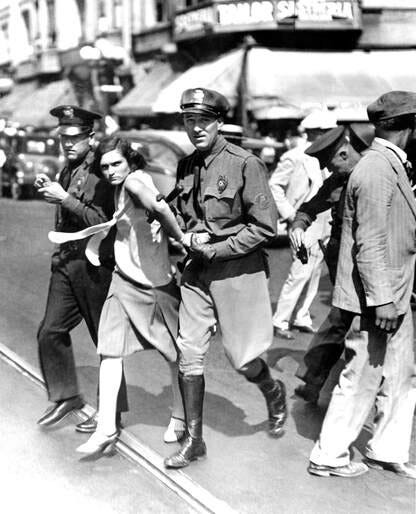
In some ways, the sprawling geography of L.A. makes it a difficult place in which to stage an effective protest. Still, there are also centralized areas known as hubs for political and social change. Many of this week’s protests took place downtown. Nearby is Los Angeles Plaza, a landmark that dates back centuries and was, for a time, one of the few places demonstrations were allowed in the city. In the 1930s, it was a gathering place for communists and other activists.
‘That space was just a hotbed of protest and activity. To some degree, we still return to the same places to protest,” Miranda said.
Trump and his ilk are also cracking down on L.A. at a uniquely vulnerable moment, just months after devastating wildfires that destroyed thousands of homes and amid a prolonged entertainment industry slump that has left many wondering if it’s time to give up the California dream.
“We were already facing this punch in the gut from the fires, and this definitely feels like ‘kick them when they're down’,” Miranda said. “But, but you know, L.A. doesn't go down that easily.”
Meredith Blake is The Contrarian’s culture columnist.
I am so in awe of those very manly white men who have to wear masks to hide their masculinity in order to take down especially women and children.
(Yes, I am a very sarcastic person.)
Trump and Noem are behaving like children bent on a vengeance mission. Let's see them do the same in Little Rock, Dallas, Miami, Columbus, Mobile, or Kansas City.