

By Frederic J. Frommer
Fifty years ago this Saturday, the Yankees hired Billy Martin as their manager for the first time, marking the beginning of a famously combustive relationship that would see him come and go five times as the New York skipper.
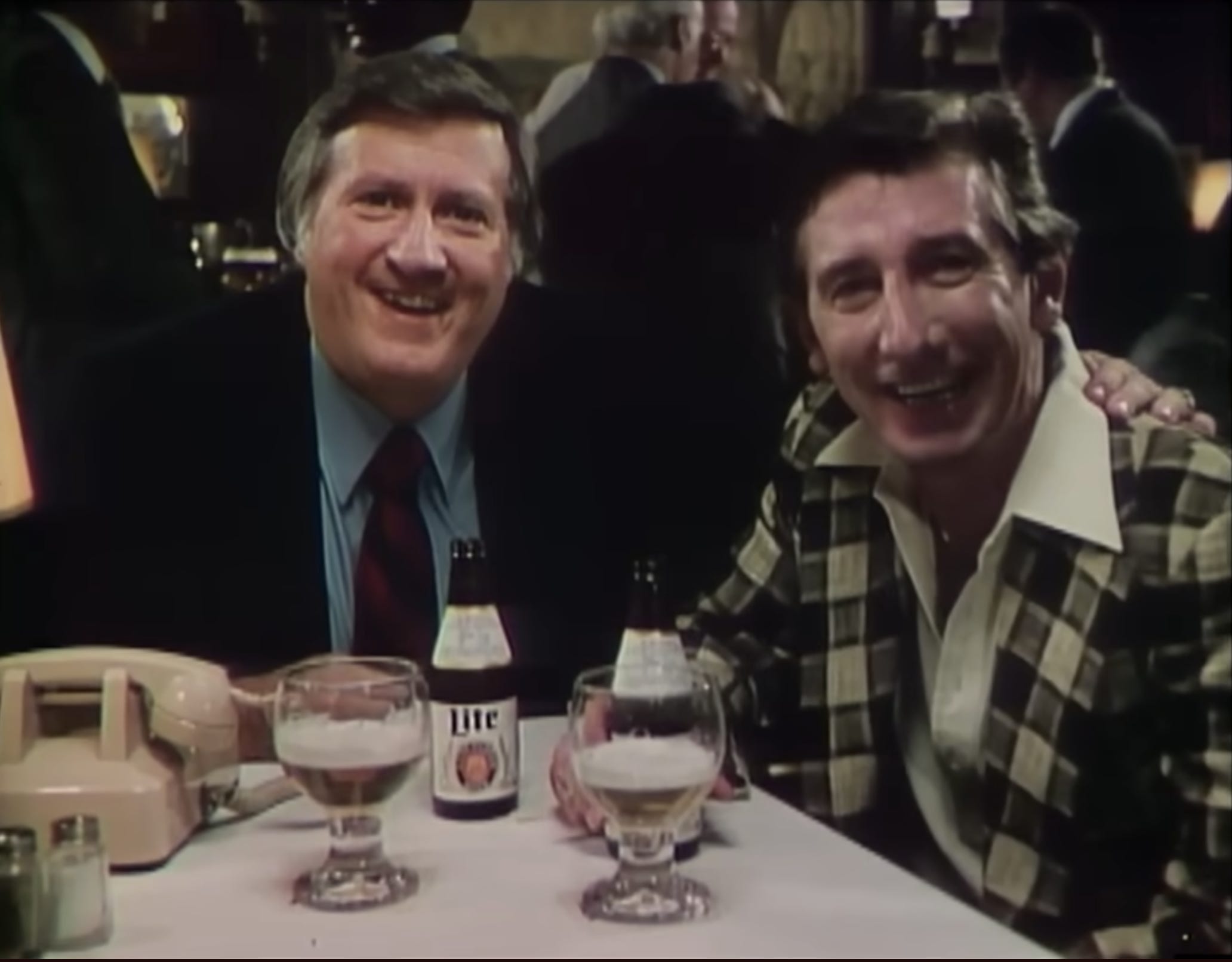
And perhaps no moment best captured that drama—albeit in a parody—than a 1978 Miller Lite commercial that ends with Yankees owner George Steinbrenner firing Martin after they disagree about the beer’s best quality. The spot was part of a series of Miller beer commercials featuring sport personalities sparring on the “tastes great/less filling” question.
"You know a lot of people think Billy and I argue all the time. Actually, we agree on just about everything, right Bill?” says Steinbrenner, wearing a coat and tie, as he places his hand on the back of Martin, wearing a garishly plaid ‘70s sports jacket.
“You betcha, George,” says Martin.
“We even drink the same beer,” Steinbrenner observes.
“Lite beer from Miller,” says Martin, who helpfully points out it has less calories than the regular beer.
“And the best thing is it tastes so great,” says Steinbrenner.
“No, George, the best thing is less filling,” Martin retorts.
The conversation gets more heated, until Steinbrenner says “Billy?”
“Yeah George.”
“You’re fired.”
Then the Martin punchline: “Not again,” as both men laugh.
Viewed many years later, it appears as if Martin is talking about one of the many times that Steinbrenner fired him. But in fact, the mercurial owner had yet to fire Martin; the joke was a reference to all the other teams that had axed Martin—the Minnesota Twins, Detroit Tigers and Texas Rangers—starting in 1969.
Still, Martin’s frustration with Steinbrenner would soon boil over, making the commercial all too real.
On July 23, 1978, after the commercial was filmed but before it aired, Martin ripped both Steinbrenner and superstar Reggie Jackson, declaring “The two of them deserve each other. One’s a born liar, the other’s convicted.” That second diss was a reference to Steinbrenner’s conviction on charges of making illegal campaign contributions in the early ‘70s.
Martin, facing near-certain termination, resigned the next day.
Executives at Miller found themselves in an uncomfortable position. Should they run the ad, which joked about Martin getting fired, after he was essentially forced out?
“The Miller Brewing Company of Milwaukee has a television commercial on its hands that might be a touch too realistic,” the news agency UPI reported in a June 26 story. It quoted a Miller spokesman as saying, “No air time is scheduled at this time.” The Washington Post reported later that the company’s top officials were divided on whether they should air the ad.
But the Yankees salvaged the commercial with a strange sleight of hand. Just a few days later, on Old-Timers’ Day, the team announced that Martin would come back to manage the team in 1980. So the ad wound up running on July 31, 1978—an early, if unintended, version of reality TV.
In any event, Steinbrenner wound up firing manager Bob Lemon in 1979 and brought Martin back a year early—only to fire Martin after the season, before the agreed-upon 1980 return date. After every Martin dismissal that followed, the commercial would look even more realistic.
The Steinbrenner-Martin relationship started in the summer of 1975. Just 10 days after the Rangers fired him as their manager, the Yankees tracked him down on a fishing trip in Colorado to offer him their manager’s job. It was a triumphant return for Martin, who was a second baseman on the Yankees dynasty of the 1950s.
“I was out there on a mountain in Colorado fishing with my family, and how they ever found me, I'll never know,” Martin said at the time. “But I'm very happy, very proud to be coming back to New York. Every manager feels very low when he's fired, and every time they fired me in the past, people said it would be the last time I'd ever manage again.”
“We had a tough time getting in touch with Billy,” said team president Gabe Paul. “I left New York on Tuesday night and flew to Chicago. We somehow found a phone number of Billy's father‐in‐law and we learned that Billy was in Colorado fishing with his family, but Colorado is a big state with a lot of mountains and streams.” Paul tracked him down near Denver, and they met for breakfast the next morning.
At the time, Steinbrenner was serving a suspension for his illegal campaign contributions, meaning he wasn’t supposed to making personnel decisions. But as the New York Times reported, “It seemed clear that the switch had been dictated by George Steinbrenner.”
So, on Aug. 2, 1975, at 1 a.m., New York fired Bill Virdon as manager and signed Martin at 1:30. Martin was announced at 9:45 as the new manager, in time for him to play in that day’s Old‐Timers reunion before nearly 44,000 fans at Shea Stadium, where the Yankees were playing while Yankee Stadium was being renovated.
The feisty skipper quickly helped restore the luster to a franchise that had lost its way. The next season, 1976, Martin guided the team to the American League pennant – its first postseason appearance since 1964. The Yankees lost the World Series to the Cincinnati Reds in four games, but beat the Los Angeles Dodgers to win the 1977 World Series. They repeated that feat in ’78 under Martin’s replacement, Bob Lemon.
Martin never recaptured that success in his four subsequent stints as Yankees manager, all of which ended with his firing. Most of those came after one of Martin’s fights. In perhaps the most bizarre incident, Martin was dismissed in 1979 after punching a marshmallow salesman—“the only marshmallow salesman to be part of baseball history,” as New York Times columnist Dave Anderson put it.
Frederic J. Frommer, a writer and sports and politics historian, has written for the Washington Post, the New York Times, the Atlantic, History.com and other national publications. A former Associated Press reporter, Frommer is the author of several books, including “You Gotta Have Heart: Washington Baseball from Walter Johnson to the 2019 World Series Champion Nationals." Follow him on X.
The article is good. Thank you for you do.
It's a lot funnier from this historical perspective than it was back then.