


Terrible things are happening on Earth. Existential dread has gone from an occasional nuisance to a constant companion. A secret police force roams the streets, a pedophilic cabal is being protected by those supposed to hold them to account, for God’s sake, the president of the United States threatened the extermination of an entire civilization last week. The nervous system of humanity is shot.
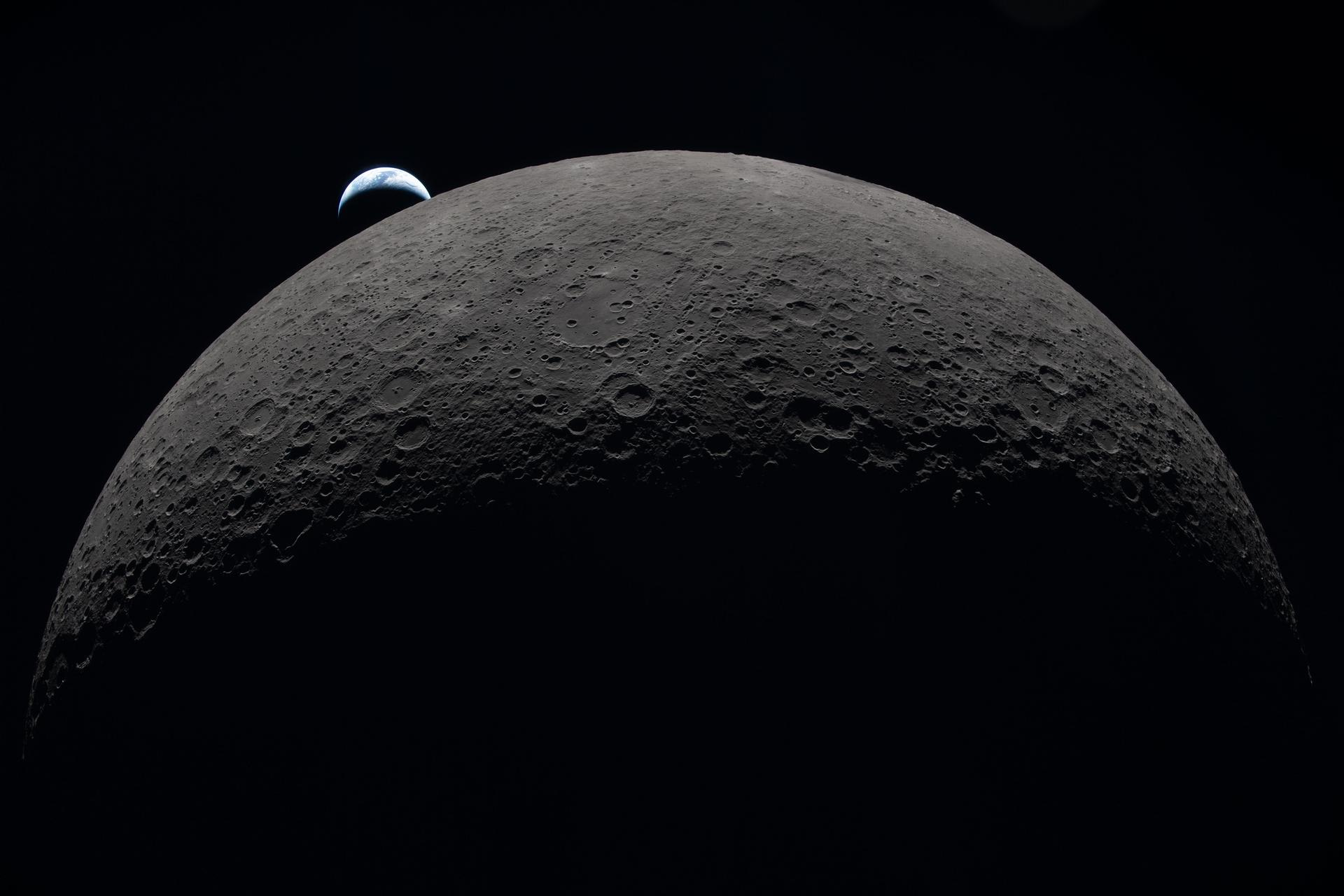
Yet on April 6, something amazing happened. Four astronauts were the farthest distance from Earth ever recorded in human history: 248,655 miles. Mission Specialist Christina Koch, Mission Specialist Jeremy Hansen, Commander Reid Wiseman, and Pilot Victor Glover became the first people ever to see the complete face of the lunar farside (better known as the “dark side,” despite it constantly being lit by the sun). The amount of science, precision, technology, and human bravery it took to get four humans there and back safely is impossible to comprehend.
Thanks to advancements in communications technology, a large portion of the ten-day mission was live-streamed, including the initial launch in Florida, a flyby around the moon, and splashdown near the coast of San Diego. People from around the world could tune in, enabling a feeling of emotional connection with the crew members and an investment in their wellbeing. Furthermore, the photographs that came from the mission were absolutely jaw-dropping. Seeing Earth from the perspective of space elicits a sense of wonder, awe, and often a perspective shift. We have only one planet to call home.
The odds of our planet having the physical, biological, and chemical necessities to host intelligent life are estimated to be 1-in-700-quintillion. Earth is positioned in the “Goldilocks Zone” — not too close to the sun and not too far. As such, we are the only planet in our solar system to have liquid water. The gravity of Earth offers the perfect conditions for keeping the atmosphere in place, maintaining habitable temperatures, and protecting life from cosmic rays. We are also unique in that we have only one moon; all other planets have multiple satellites (with the exception of Mercury and Venus, which have none). All this to say: Earth is a very special place.
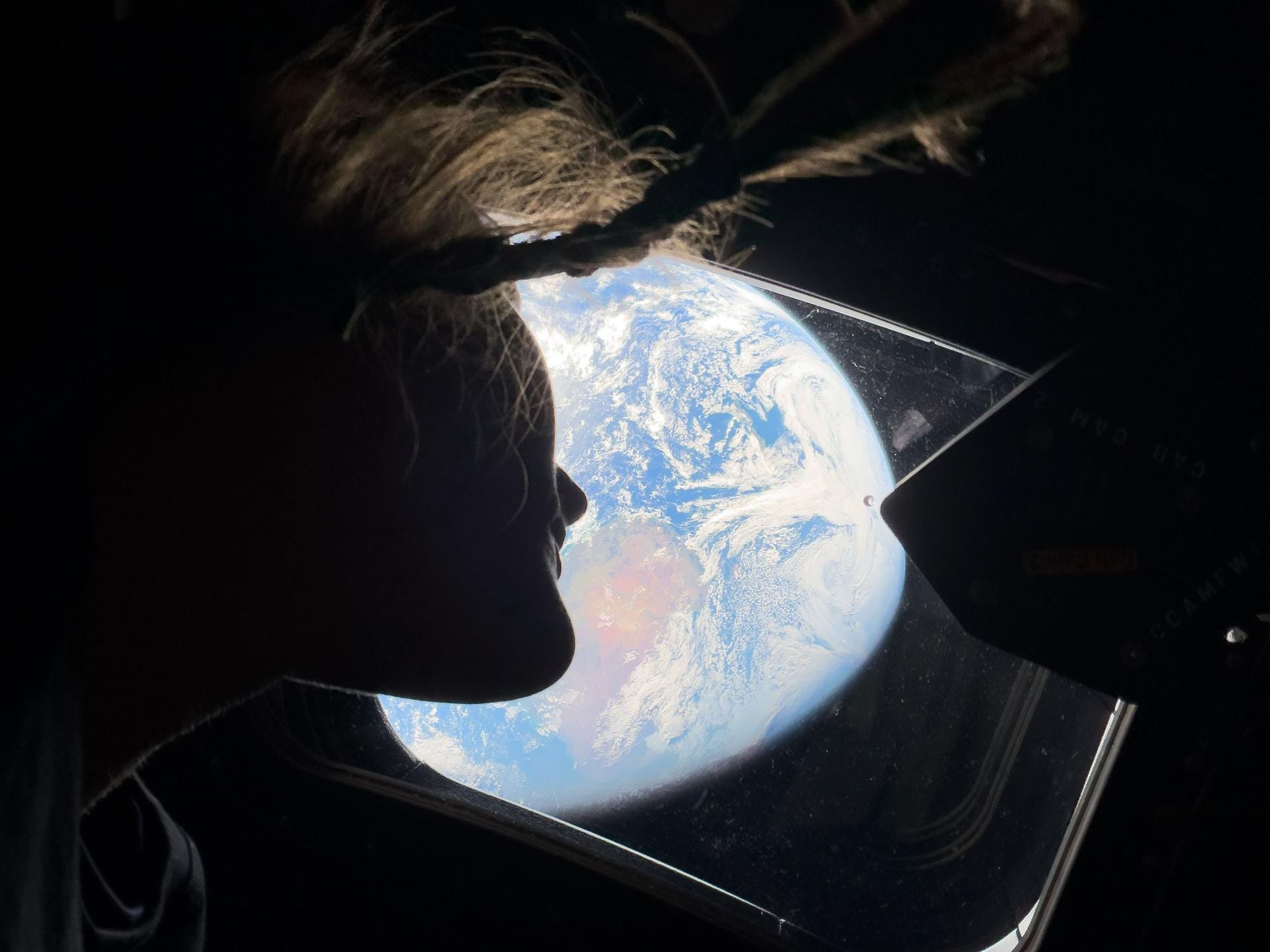
While on a call to the International Space Station (the first ever of its kind between moonship and spaceship), Koch described how she felt looking back at Earth from space,
The thing that changed for me, looking back at Earth, was that I found myself noticing not only the beauty of the Earth, but how much blackness there was around it and how it just made it even more special…It truly emphasized how alike we are, how the same thing keeps every single person on planet Earth alive.
With the Artemis II mission being accessible to anyone online and never-before seen 4k pictures instantly going viral, the internet was able to collectively revel in that wonder.
The reaction resulting from “perceived emotional synchrony” is known as collective effervescence. Anything can trigger it, but the key element is feeling as though you’re experiencing with others something that is larger than yourself. Not only was it spectacular to witness the Earth and moon from a brand new angle — reminding us how small we really are — but seeing a competent, kind group of people work together to reach a goal for the sake of humanity is something we have not seen from our leaders in a long time. Throughout the mission, each crew member embodied the namesake of moonship: Integrity. The name was given to the Orion spacecraft to reflect “the foundation of trust, respect, candor, and humility,” qualities found within the four astronauts and the many, many scientists who made the mission a success.
One of the most touching examples of this came during the sixth day of the mission. After seeing an unnamed crater on surface of the moon, the crew called down to mission control in Houston to suggest a name:
A number of years ago, we started this journey in our close-knit astronaut family and we lost a loved one. And there is a feature in a really neat place on the Moon, and it is on the nearside/farside boundary. In fact, it’s just on the nearside of that boundary, and so at certain times of the Moon’s transit around Earth, we will be able to see this from Earth. And so we lost a loved one. Her name was Carroll, the spouse of Reid, the mother of Katie and Ellie. And if you want to find this one, you look at Glushko, and it’s just to the northwest of that, at the same latitude as Ohm, and it’s a bright spot on the Moon. And we would like to call it Carroll.
The internet quickly latched on to the joy and awe radiating from the Artemis II crew. NASA coined the term “moon joy” after an interaction between Wiseman and mission control communicators went viral. The term quickly caught on as a way to describe the collective effervescence rippling throughout the mission and the observers back on Earth.
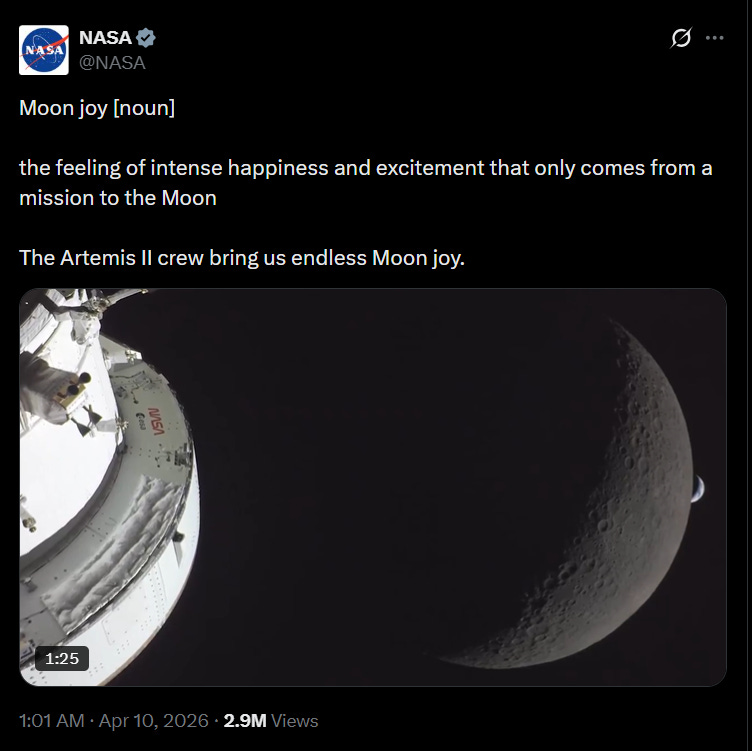
Even when people weren’t using the term explicitly, they were certainly participating in and expressing their moon joy. From a sudden feeling of being connected to humanity, to remembering that government organizations are actually meant to foster human growth and achievement rather than quash it, the sentiment online regarding Artemis II felt jarring (but not unwelcome) amid social media’s usual flood of bad news.
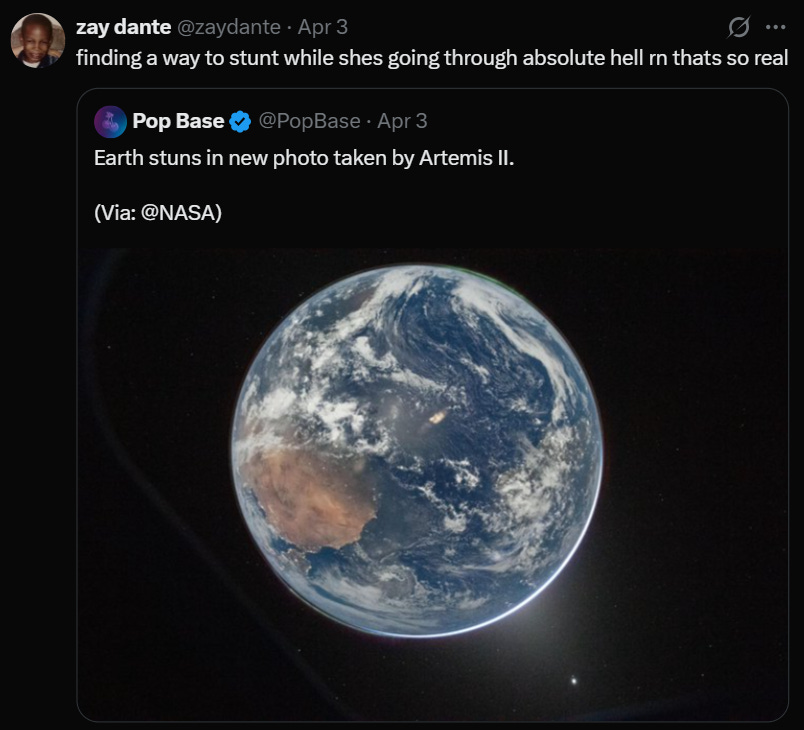
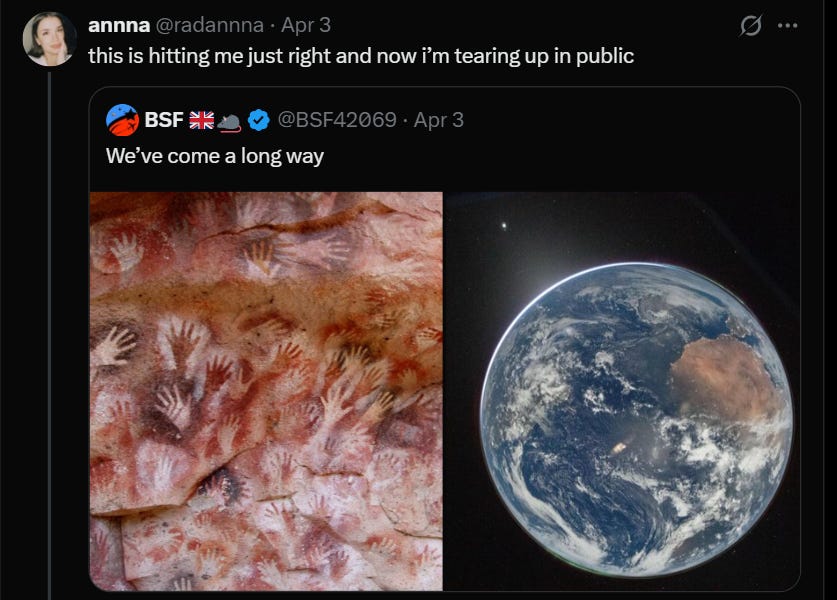

How are we supposed to reconcile the wonders of this accomplishment with the atrocities being committed simultaneously? How can the same species send four humans 248,655 miles away from our planet while bombing each other on Earth? Can we hold two truths at the same time? That humanity, existing together in a universe of such beauty, is capable of both jaw-dropping courage and horrific brutality?
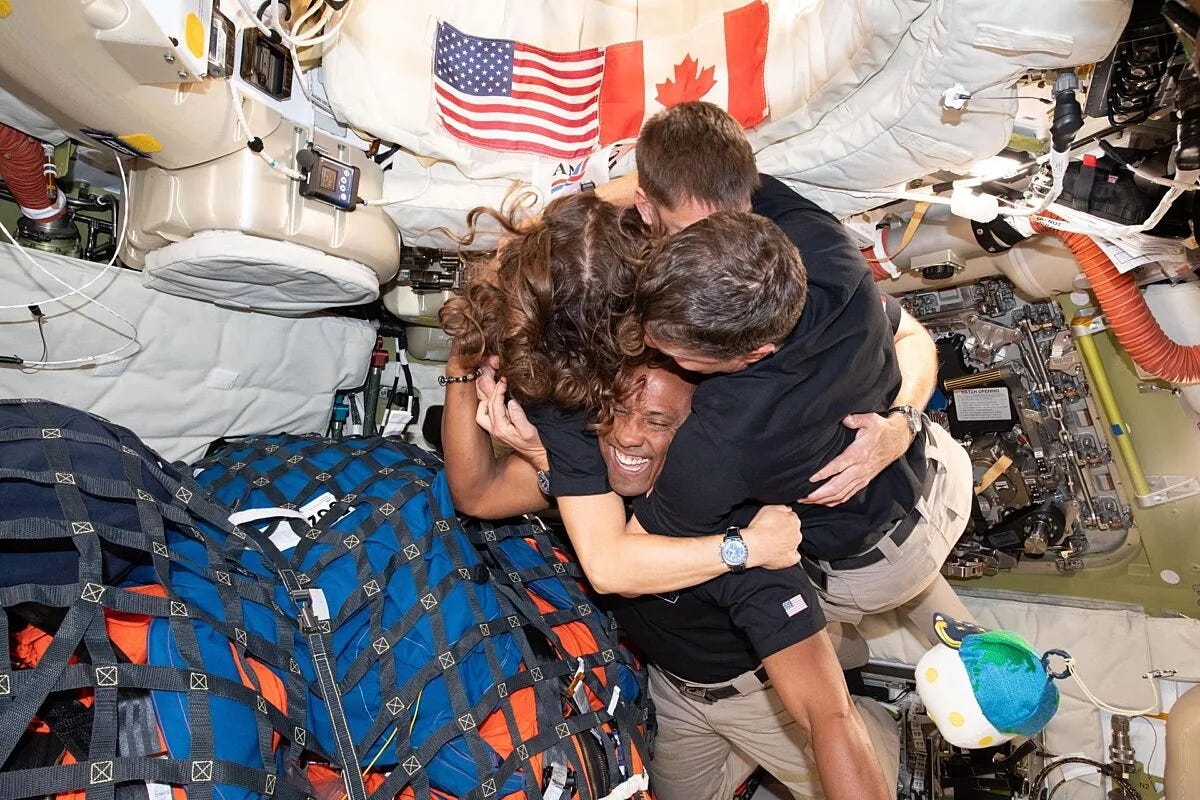
After the mission had concluded and the astronauts were back on land, Hansen reflected on the outpouring of love the crew received: “What you saw was a group of people who loved contributing, having meaningful contribution and extracting joy out of that. And what we’ve been hearing is that was something special for you to witness. I would suggest to you that when you look up here, you’re not looking at us. We are a mirror reflecting you, and if you like what you see, then just look a little deeper. This is you.”
Perhaps we’re all capable of finding joy in contributing to something greater than ourselves. Perhaps unity and a shared interest in protecting humanity can be the launchpad for enacting meaningful change. If it took seeing four wonderful people travel to the moon and back to make us realize that, so be it.
Lily Conway is the associate producer of The Contrarian.
More please. I cannot imagine any human not tearing up after reading this again after actually witnessing it live. Thank you
Looking at the earth from far away is nothing short of a miracle come to life. Thanks to the astronauts, technicians, scientists and other personnel who provided us with this awesome view of our planet. We were able to pause from the disturbances upon its surface to look on with wonder. We need to work far more diligently and competently to preserve it.