


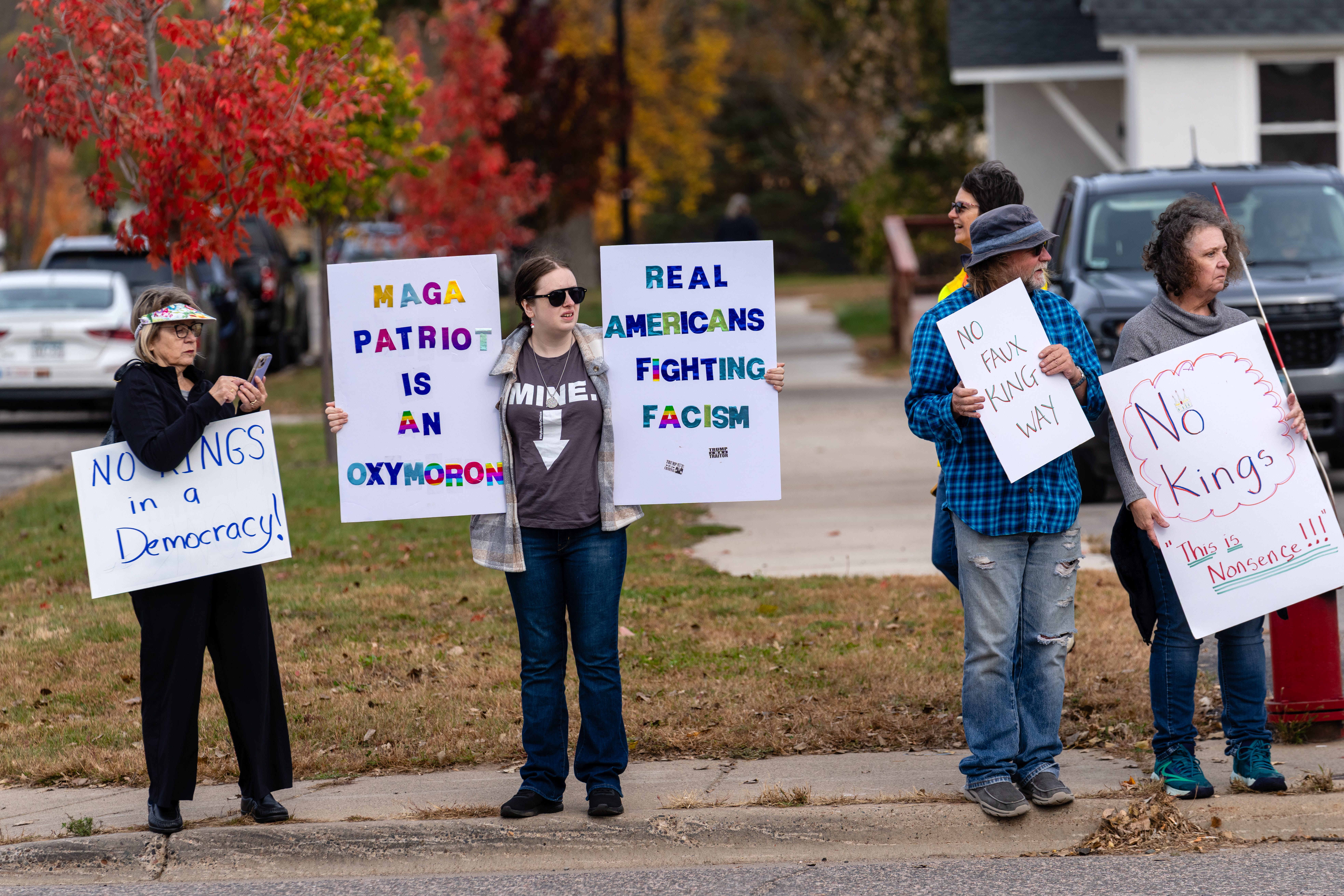
Things aren’t nearly as bad as we feel they are, but they could become much worse. This was how I felt after taking part in one of the weekend’s wonderful No Kings rallies.
First, the optimistic part: Though the danger of creeping authoritarianism is real, and the Trump administration’s bad intentions are clear, America is still very much a democracy.
If we had already crossed the threshold to dictatorship or to fascism—as anyone who has experienced such evils would tell you—millions of Americans would not have been able to spend weeks openly organizing demonstrations opposing and poking fun at their president and to march in them without the slightest hindrance.
Here is what would have happened in a true dictatorship, even a relatively mild one: The regime would have tried to prevent the protests by rounding up the organizers for questioning, sending thugs to beat them in their homes, having them fired from their jobs, or simply throwing them in prison. It would have denied protesters permits to march and warned them that showing up would be illegal. It would have met them with actual violence or identified them by their cellphone signatures or from video footage and gone after them later.
In Russia, China, Egypt, or Venezuela, big-city police departments would not have responded to the protests like this:
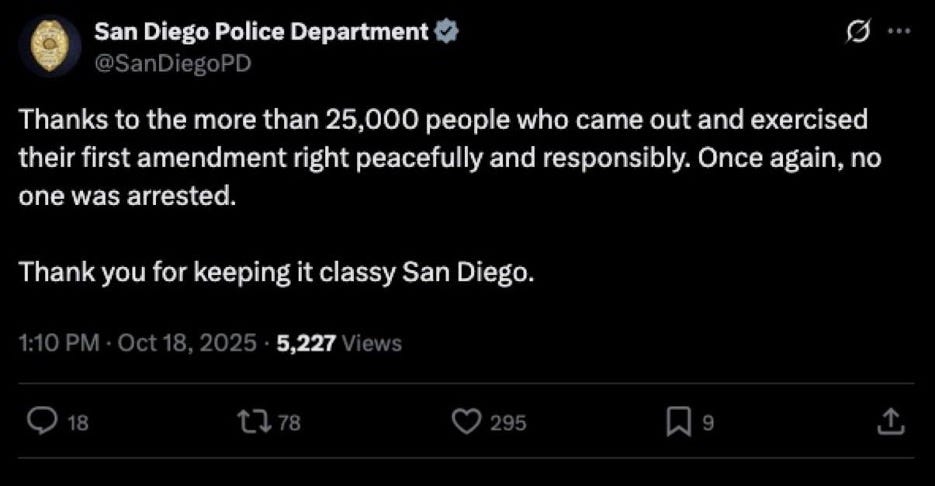
Or allowed countless newspaper headlines like this:
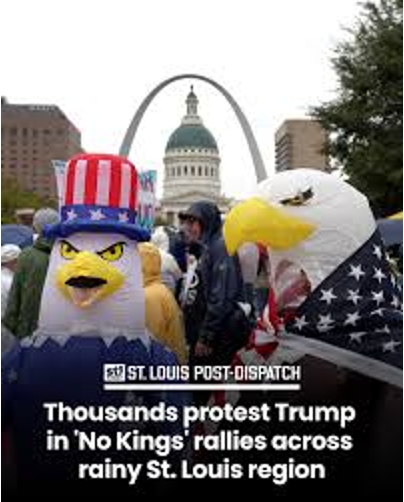
Yes, the Trump administration has suggested it might investigate those who allegedly funded the rallies (as if there is something nefarious about spending money on constitutionally protected speech) and accused peaceful protesters of being part of a non-existent terrorist group. These threats are meant to intimidate. But so long as those targeted stand their ground, they will win in court 100% of the time—and possibly even win damages from the government.
And, also yes, the Department of Homeland Security’s masked, militarized immigration roundups resemble what security forces do in countries transitioning to dictatorship. But the reason we know that Immigration and Customs Enforcement officers are behaving outrageously is that everywhere they go, concerned citizens are pointing cameras at their faces and filming their every move while calling them cowards and Nazis and telling them to get out of Dodge. In a dictatorship, such citizens would be arrested or shot on the spot.
But here is the flip side of my glass-half-full analysis: What if an ICE officer actually did pull out a gun and kill one of the bystanders filming him? What if DHS agents in an SUV were to run people down on purpose at a peaceful rally? What if President Donald Trump responded hours after such an event with one of his “if they spit, we hit” social media posts? Would Attorney General Pam Bondi prosecute the agents involved or hand them over to local authorities to face justice? The answer is almost certainly no. What then?
Some related questions: Imagine you were an FBI agent, and you came upon evidence that a right-wing group was considering a violent attack, perhaps on liberal activists, or on a Democratic-majority state legislature, or on a polling place in a Democratic precinct. Would you ask for a wiretap, seek arrest warrants, or take any other formal steps to prevent violence, knowing that Bondi and FBI Director Kash Patel fired agents who investigated groups that assaulted the Capitol on Jan. 6, 2021, and that the president considers those who attacked cops that day to be patriots?
Or, if you were a federal prosecutor, would you act on evidence of corruption or criminality by a prominent Trump backer, knowing that the president is protecting his border czar, Tom Homan, from credible accusations of bribery and has pardoned or commuted the sentences of every Republican member of Congress—10 in total—convicted of a crime in recent years?
So, with little risk of punishment, what is stopping administration officials (who are already committing many unlawful procedural acts) from authorizing more forceful actions to suppress dissent? What would keep a federal agent who takes his leaders’ “antifa” or “immigrant invasion” rhetoric literally from shooting a protester? What’s preventing more Trump officials or MAGA congressmen from demanding to be paid for official acts? Maybe it’s whatever inner moral compass they have, or that they’ve lived their lives in an America where one is not supposed to do such things, or a fear of public embarrassment. But it’s not fear of legal repercussions.
So, it’s hard to escape the conclusion that though American democracy is still alive, it no longer reliably rests on the rule of law. It depends instead on the willpower of its defenders and the hesitation of its enemies, who have not yet dared to cross certain lines.
So, what can be done?
First, deterrence is still possible. Democrats should make clear what they will do when they regain power to investigate and prosecute those who break the law today.
Second, the massive protests should continue. It’s easier to attack seven people or 700 than the estimated 7 million who turned out last weekend. A movement that can mobilize almost 3 percent of the American adult population to hit the streets on a single day—the most in U.S. history—is a formidable obstacle to anyone thinking of asserting dictatorial power.
Third, that strength must be applied to helping Democrats win state and local offices (because state and local governments control most police and because federalism can be a check against centralized tyranny)—and to win the midterm elections next year. Democrats won 60 million votes in their Blue Wave sweep in 2018, which would still likely be enough to overcome virtually any structural obstacles. The No Kings protesters by themselves represent nearly 12 percent of that electoral “win number.” If they all knocked on doors and organized their personal networks to vote, the goal would absolutely be reached.
We can still use democracy to save it. And, to paraphrase the late Sen. John McCain, if we’re brave, the rest will be easy.
Tom Malinowski is a former member of Congress from New Jersey who was an assistant secretary of state in the Obama administration.

thank you... thoughtful and helpful., Jonathan Cohen, Ph.D.
Thank you. I’m trying to spread a thought. If we could get enough people to make a small donation each to whoever runs against little Mikey Johnson in Louisiana for 2026 and get him out that would be a great help I think.!