


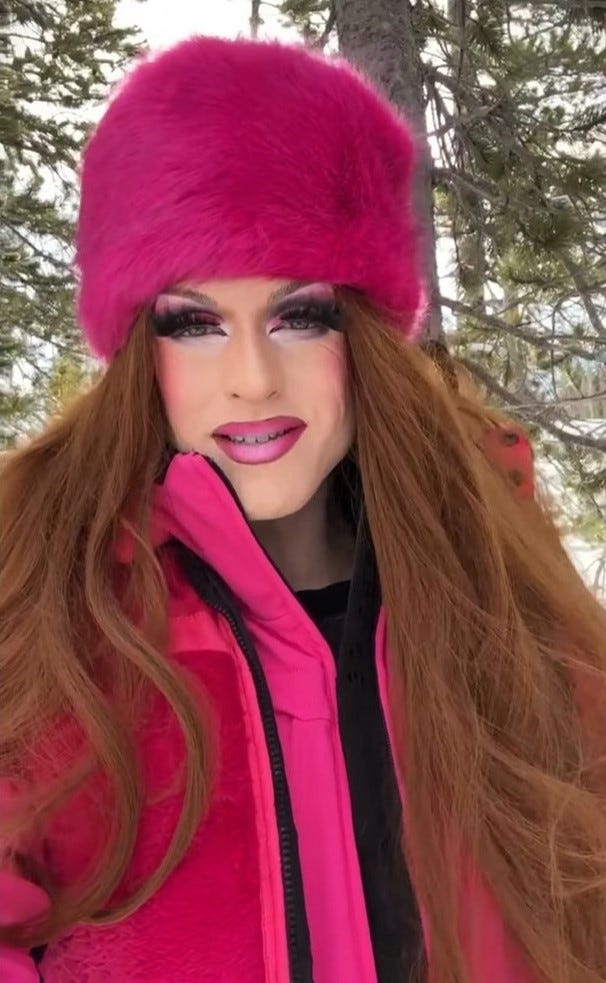
One day in 2018, when 26-year-old photographer Wyn Wiley filmed himself in the mountains dancing in a pair of high-heeled boots, an unexpected new drag persona was born: Pattie Gonia, “the world’s first backpacking queen.”
That initial post went viral, and Pattie’s popularity has grown steadily since. She now boasts more than 1.8 million followers on Instagram and close to 900,000 on TikTok — numbers achieved by few drag performers who haven’t appeared on RuPaul’s Drag Race.
A self-styled climate activist and community organizer, Pattie Gonia has carved out a niche in intersectional environmentalism, advocating to protect the earth while making outdoors spaces more hospitable to LGBTQ+ people.
She’s given TED talks about the importance of bringing joy to climate activism, raised a million dollars by hiking in drag, and challenged Pete Hegseth to a kettlebell-swing competition in a post mocking his performative masculinity. “I’ll do it tucked and in heels,” Pattie Gonia said.
With a bushy red mustache and an even more voluminous red wig, Pattie Gonia’s look is at once high glam and rugged. Her costumes bring new meaning to the “camp” drag performers have long embraced: She wears carabiners as earrings and tents as skirts.
Pattie is, in short, a rising star in the worlds of drag, social media, and activism.
Yet she finds herself at the center of a legal dispute with Patagonia, the eco-friendly outdoor clothing brand (which is, in turn, named after the region of South America known for its stunning natural beauty).
In January, the company (which was restructured in 2022 so that profits fight climate change) filed a trademark infringement lawsuit against Pattie Gonia, who had begun to sell branded apparel and also a trademark application for the “Pattie Gonia” name.
The public didn’t really take notice until earlier this month, when Pattie Gonia took to social media to urge her followers to speak up on her behalf. “This is a corporation trying to erase an activist, and this is how corporations bully individuals who cannot match their resources,” she said in a lengthy Instagram post.
In a statement, Patagonia said the lawsuit only came after repeated attempts to find a path forward with Pattie Gonia. “This matter is not about seeking financial gain, nor is it about challenging anyone’s identity or right to advocacy, protest, or creative expression,” the statement read. “The last thing we wanted was a legal fight with someone who shares our values, but we must protect our business and employees.” (Pattie Gonia did not respond to a request for comment.)
The story has taken off online, where many see Patagonia as a hypocritical corporation claiming it owns the name of a place.
But there has also been some pushback from within the drag/queer community.
Tom Fitzgerald, one half of the fashion and pop culture criticism duo Tom & Lorenzo, weighed in a recent episode of the duo’s podcast. “When you start trying to sell things, when you bring your drag to a more merchandisable level, then you’re no longer the underground drag artist who’s poking fun,” he said. “You’re actually a company and a brand.”
Vanity Fair last week detailed the protracted and messy legal back-and-forth between Patagonia and Pattie Gonia — and made the compelling case that this expensive fight has no real winners. (When progressives are squabbling over trademarks, the only people benefitting are the lawyers.)
But the lawsuit has also drawn attention to the importance that names often play in the creation of a drag persona — and the unforeseen complications that arise when a name borrows from a well-known company.
The name game
Along with wigs, makeup, costumes, and choreography, names are part of “the distinctive way an artist creates a drag character,” says Lawrence La Fountain-Stokes, an expert on Puerto Rican drag and a professor at the University of Michigan. “Names are a world unto themselves.”
A drag name can “convey all sorts of information,” he said. “It can be a tribute. It can highlight femininity, but it can also center comedy. It really varies. Names are a space of engagement, and they signal as much as your appearance and your performance,” explained La Fountain-Stokes, who performs drag as Lola von Miramar, a name that references a neighborhood in his hometown of San Juan.
“The performer’s name serves as your introduction to them,” said Joe E. Jeffreys, a drag historian who teaches at New York University. “Their name establishes their tone or points of reference.”
Alexis Michelle, who appeared on RuPaul’s Drag Race and the reality series Dragnificent!, remembers flipping through queer magazines in the 1990s and seeing performers whose clever names instantly captured their wit, such as Hedda Lettuce and Miss Understood.
When it came time to create her own name, she thought of doing something punny, but “nothing resonated.” Ultimately, she settled on a feminized version of her legal name. “I wasn’t deeply passionate about that choice when I made it, but everything happens for a reason,” she said, noting that the less showy name ultimately suited her best. “I really realized that my drag is not a costume to me, it’s not an alter ego, it’s not a character, it’s my female side.”
The pundamentals
In her initial post, Pattie Gonia argued that “drag is built on parody, puns, and jokes.”
Drag is meant to be a transgressive art form that sends up mainstream culture through a queer lens, and camp humor is often a part of that.
La Fountain-Stokes also cited the example of Hedda Lettuce, who commits to the bit by dressing in shades of green. “The name immediately communicates her style of drag — comedy queen. Invoking camp, making people laugh or chuckle just by repeating your name or hearing your name — it’s to your advantage. You’re already ahead with the audience.”
There’s a long tradition of names that, like Hedda Luttuce, use puns and wordplay. They can be cheeky, irreverent, bawdy, or silly. (e.g. Tess Tickle, Dixie Normous, and Izzy Uncut.) But clever, playful names don’t have to be limiting, said Alexis Michelle.
Jan Sport, another drag queen with a name based on a well-known brand, is “a multi-hyphenate artist who has the ability to be very funny and silly, but by no means is that the center of her brand,” she said. Brita Filter is also more than a goofy joke about water purification systems.
“Her main sense of purpose outside of performance is politics, and standing up for our community,” Alexis Michelle said. “Even with these honey campy brand names, people are not defined or boxed in by them.”
Brita Filter and Jan Sport have been careful about using their names in ways that avoid legal trouble. They both starred on RuPaul’s Drag Race and went by “Brita” and “Jan,” respectively. Jan Sport collaborated with Jansport on a line of backpacks, suggesting a fruitful partnership between corporations and the drag queens sending them up is possible.
Similarly, Trixie Mattel, a Barbie enthusiast and Drag Race alum, uses only her first name on business ventures such as Trixie Cosmetics and the Trixie Motel.
La Fountain-Stokes said that Pattie Gonia is “a really interesting example of the political things that drag can do. She is in that tradition of using drag as a tool to offer social critique at the same time that she entertains,”
He thinks Patagonia’s lawsuit is “ridiculous.”
“Pattie Gonia represents no tangible threat to this corporation,” he says. “It signals people who don’t understand anything about drag.”
Meredith Blake is the Contrarian’s culture columnist.

Join the fight now and get 25% off an annual subscription
Contrarians in Court bring hundreds of cases and legal matters against Trump’s regime — by joining our community today, YOU help STOP the chaos!
Drag is fun, mocking, biting and meant to make you laugh. In my former gay square dance club, a nerdy computer guy found his true niche as "Lois Carmen Denominator," which still makes me laugh. I cannot understand what people find so threatening about it. If anything, Pattie has probably increased Patagonia's sales. And it isn't their name anyway, but the land's.
Meredith, will you or someone else please explain something to me? What did Pattie Gonia think would happen if she sold branded merch? Especially if she tried to trademark the name? I'm not a lawyer. But 1 could have seen the lawsuit coming from miles away if someone tried to trademark that name. If a drag king named themself Dicks Goods, Dicks Sporting Goods would probably sue.