


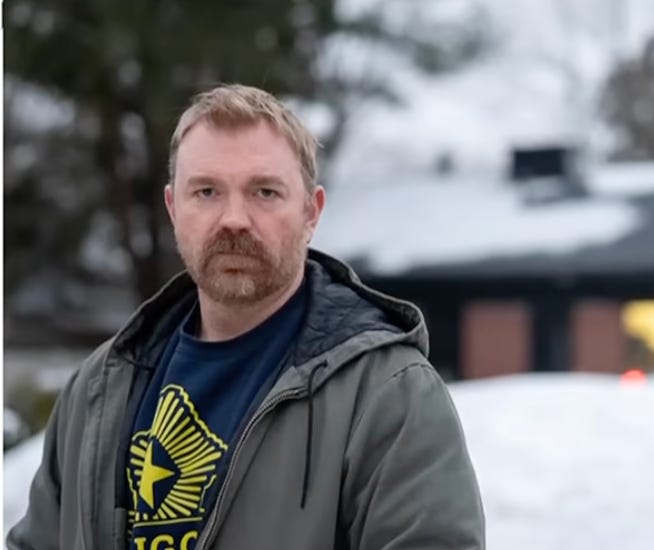
Democrats’ Maine nightmare is over. Last night, just two days after Senate nominee Graham Platner was hit with a horrendous, credible allegation of sexual assault (which he denied before swiftly agreeing to rethink his campaign), he announced he would pull out of the race, allowing the state party to devise a process for filling the vacancy. Ending an exhausting run of scandal, controversy, denial, and intraparty sniping that threatened to derail a key Senate race, Platner’s exit keeps Democrats’ hope alive for toppling the perpetually “concerned” and spineless Sen. Susan Collins and winning majority control of the Senate.
Platner, reflecting every ounce of self-absorption and flaunting the very inability to take ownership for his egregious conduct that made this outcome inevitable, released a video message, declaring, “We’re not doing it because of the allegations; we’re doing it because of the structures that are being taken away from us by those in power.” Yeah, right.
Though there is no clear favorite for a potential replacement at present, Democrats now have the opportunity to return the focus to Collins — her phony pose as a “moderate,” her role in putting decisive votes on the Supreme Court that reversed Roe v. Wade, and her maddening refusal to take on MAGA’s reign of corruption, chaos, and cruelty.
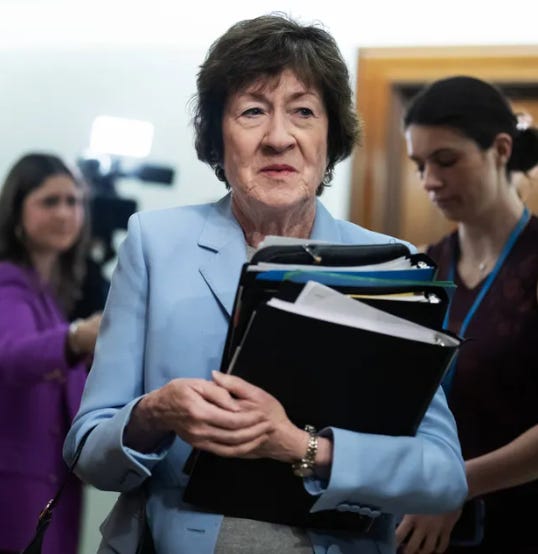
The episode underscores the perils of advancing largely unvetted newcomers and ignoring a plethora of flashing red lights about character. However, the mind-numbing inability to find a viable candidate capable of toppling Platner during the primary race also will likely fuel complaints about sclerotic, incompetent Democratic leadership.
Taking a step back, the Platner debacle also reminds us of the critical role party grownups (regardless of ideology) play if Democrats and democracy itself are to prevail in 2026 and beyond. When episodes such as the Platner fiasco pop up, or the legacy media fan flames of socialist bogeymen, or another Donald Trump outrage comes to light, Democrats with 2028 aspirations have the chance to preview their political skills and test-run their messages. How have they been doing?
In the immediate aftermath of the most recent and far more devastating Platner outrage, his most important backer, Sen. Bernie Sanders (I-VT), was oddly silent until Tuesday afternoon, after virtually all other Democrats had weighed in. Fortunately, other Democrats showed swift, proactive leadership skills. On Monday, the Maine Democratic Party told Platner to get out and rebuffed any delusion that he could play kingmaker.
Most impressive were some prominent progressive voices such as Sen. Elizabeth Warren (D-MA). “There can be no tolerance for sexual assault. With so much at stake, the best path forward is for Graham Platner to step aside as the Democratic nominee and address these serious allegations outside this Senate race.” Rep. Ro Khanna (D-CA) called the allegations “serious and credible” and pulled his support, as did Sen. Ruben Gallego (D-AZ). Rising Texas star and Senate nominee James Talarico put out a succinct statement as well: “The credible allegations against Graham Platner cannot be ignored — he should withdraw from the race immediately.”
A willingness to promptly and unequivocally “police your own side” (an anathema in MAGA circles, where nothing outweighs cultist loyalty) will help distinguish real leaders from the perennially timid pols forever looking over their shoulders. Likewise, defending a transparent replacement process and eschewing anything that smacks of a “party insider backroom deal,” as Sen. Chris Murphy (D-CN) did, shows a needed level of self-awareness about the shaky credibility of establishment leadership.
When it comes to leading a big-tent party, Rep. Alexandria Ocasio-Cortez (D-NY) has become a savvy progressive voice striving to keep the broad-based pro-democracy coalition intact. Interestingly, she never backed Platner. In the wake of two Democratic socialists’ victories in New York, she advised her colleagues not to “create a self-fulfilling prophecy by deciding who these young women are before you’ve met them.” She added, “If you are already panicking and sending little messages in your group chats about how these people need to be reined in and tamped down and shown their place, you are creating the antagonistic dynamic that we do not need.” Whether she stays in the House or runs for Senate or president, she is modeling how to lead a diverse, contentious party that should stop panicking at the first signs of healthy internal debate.
By contrast, there are the compulsive attention grabbers who cannot resist scratching the “socialist vs. center-left” Democratic itch that guarantees legacy media attention. Pennsylvania Gov. Josh Shapiro seemed oblivious to the “don’t take the bait” option when he insisted on needling Darializa Avila Chevalier, the upset winner in New York’s 13th Congressional District. Why should anyone care that the governor of Pennsylvania has policy disagreements with a deep-blue Manhattan congressional nominee, an utter newcomer with whom he hastens to assure us he has unspecified differences on “values?”
Needling one faction of the party (thereby feeding the right-wing talking points about Democrats’ supposed extremism) does nothing to elevate a 2028 Democratic hopeful’s standing. Someone who sees himself as leader of the party and of a vast pro-democracy coalition should have bigger fish to fry.
In contrast to the small-tent-pick-a-fight crowd, California Gov. Gavin Newsom has matured as a coalition builder, with a laser-like focus on successful governance, a willingness to combat Trump’s unconstitutional overreach, and a tenacious wit when mocking the decrepit president. Newsom has admonished progressives to deliver pragmatic results and advised grouchy quadrants of the party to learn from New York Mayor Zohran Mamdani on how to connect with the base and build a brand on economic populism.
Newsom’s July 4 speech was presidential in tone and scope:
Our corrupt and unstable President is forcing us to ask a once-unimaginable question: Do we still have a government that belongs to the people? The core of our democracy, the thing that separates us from a monarchy or a dictatorship, is the fundamental right to vote. If we lose that, we lose everything.
That’s why, on America’s 250th birthday, we need a declaration of election independence — a proclamation of freedom from the manipulators and deniers, from the threat of imprisonment for refusing to go along with Trump’s schemes.
Then there is the breakthrough candidate of the 2026 primary season, Sen. Jon Ossoff (D-GA), who — like former President Barack Obama — exudes confidence that voters are entirely capable of absorbing a fact-based, serious discussion about democratic values, policy, and reform.
Ossoff’s easy command of facts to expose the egregious, stomach-turning corruption at the heart of the MAGA canard has focused the public’s ire against a regime delegitimized by its own excessive self-dealing. (Consider how well this approach worked for the pro-democracy coalition that took down Hungary’s Viktor Orbán.) Moreover, Ossoff has been able to make the critical connection between the Epstein elite’s “coin-operated” corruption — where dollars paid are returned in favors, crony capitalism, tax breaks, and impunity from the law — and the withering of economic opportunity for average Americans.
In sum, there is no single Democratic standout or formula for success beyond the midterms. Moreover, not a lot of what these Democrats have said to date will make or break their post-2026 ambitions. However, taking a definitive role in preventing party train wrecks, refusing to engage in internecine party fights in the run-up to the most important midterm election in memory, and sketching out big-tent themes that make the case for radical progressive reform will hold 2028 aspirants in good stead.
In particular, those who can connect the dots between gangster government and the economic plight of ordinary Americans and offer a positive, alternative vision of competent and responsive government will be well positioned when it comes time to throw their hat in the 2028 ring.
" [Platner] announced he would pull out of the race, allowing the state party to devise a process for filling the vacancy".
Yes.
That's it.
He's out and now get someone better and get going to win this race.
Exactly what should have happened after the Access Hollywood comment came out in 2016.
I never supported him and this does not surprise me in the least. And, the very idea that he would think he could choose his replacement. As Maya Angelou said, “when someone shows you who they are, believe them.”