


Election Day is here, and if you are looking for some music to inspire you as you head to the polls, or keep you energized while you wait for results, Will Kaufman has a few suggestions.
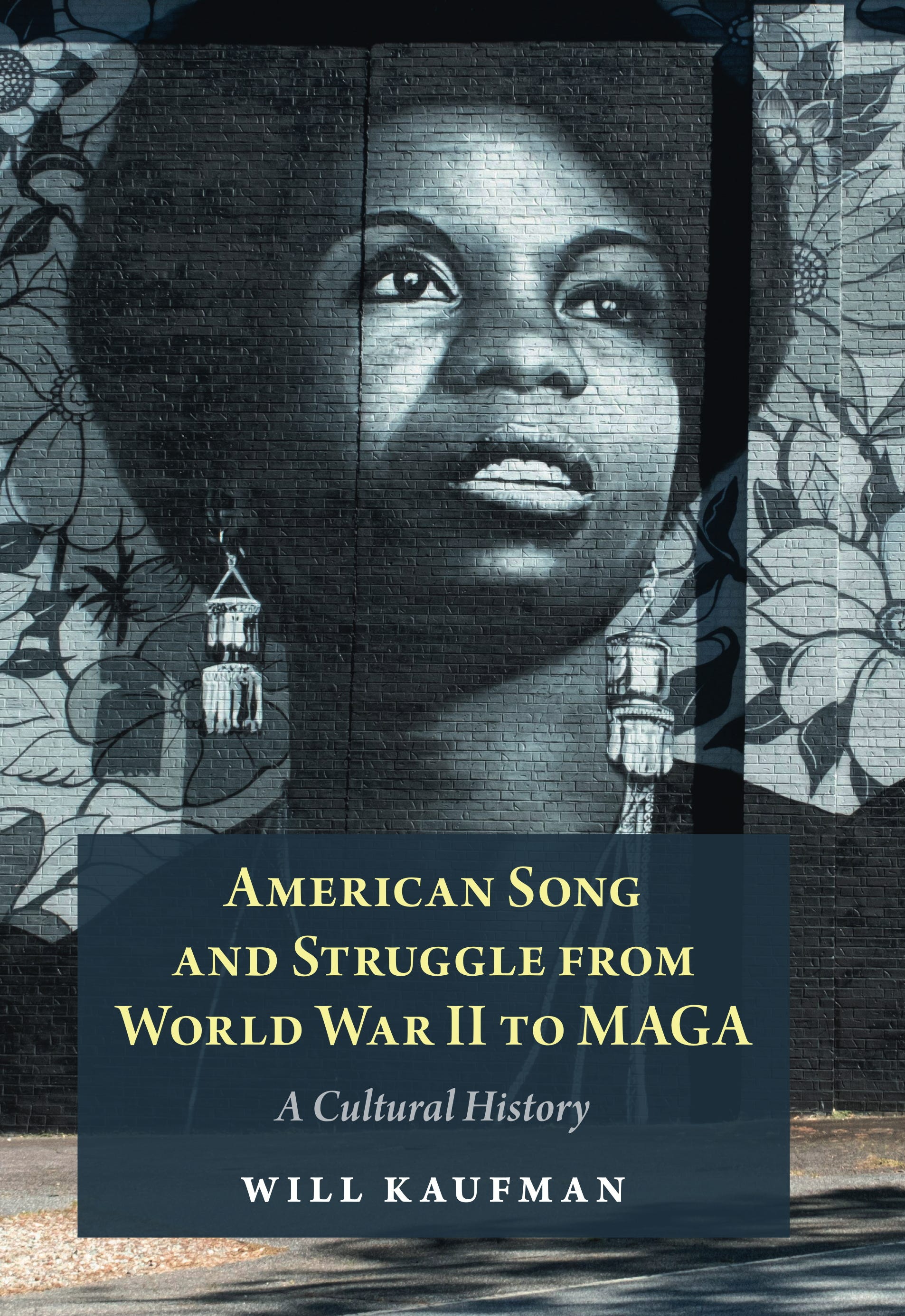
The author, retired professor, and Woody Guthrie scholar is an expert in what people commonly refer to as “protest songs” — a term he doesn’t actually like to use. He has written two books about the history of political music in the United States: American Song and Struggle from Columbus to World War II, released in 2022, and the follow-up, American Song and Struggle from World II to MAGA, which will be published November 19.
In fact, Kaufman balks at the term: “there’s no actual agreement as to what a ‘protest song’ is,” and it conjures up a specific caricature of “somebody standing behind an acoustic guitar, or maybe a long-necked banjo, pointing fingers.”
Instead, Kaufman prefers to talk about “songs of struggle,” music that deals with what it means to be “a social being imprisoned in history, to have to wake up in the morning and get through the day,” he says.
“We all struggle, and we need help in our struggles. That’s what struggle songs do — they let us articulate our struggles and also let us know that we’re not alone as we struggle.”
Whereas protest songs typically have a specific target — perhaps an unjust war, a corrupt president, or a greedy corporation — “songs of struggle” can be more abstract, but therefore more transcendent.
Kaufman points to “Blowin’ in the Wind,” which was adopted as a Civil Rights anthem even though it “doesn’t say a damn thing” about the movement. “Yet they picked it up and ran with it, and it was ‘Blowin’ in the Wind’ that got Sam Cooke to write ‘A Change is Gonna Come,’” Kaufman says.
American Song and Struggle From World War II to MAGA traces 80+ years of cultural history, from Guthrie’s “This Land Is Your Land” in 1940 to Bruce Springsteen’s “Streets of Minneapolis” in 2026. The sprawling book looks at not only pop music but gospel, folk, jazz, bebop, blues, country, hip-hop, disco, punk, Broadway showtunes, and opera. As Kaufman puts it, these are “songs of all genres responding to war, racism, sexism, terrorist attacks, political oppression, homophobia, police violence, colonialism, censorship, mass shootings, migration, environmental crisis, and the Israel-Palestine conflict.”
Kaufman looks into some of the best-known protest anthems of the ‘60s and ‘70s, but also examines how music has given voice to the fight for racial equality, LGBTQ+ rights, and women’s liberation. The book is full of fascinating anecdotes about the surprising political and cultural ramifications of popular music (like how Frank Loesser’s creepy hit “Baby, It’s Cold Outside” inspired a leader in the Muslim Brotherhood).
Kaufman’s central image for the book is Orpheus, the legendary Greek hero whose severed but still-singing head floated down the river Hebrus after he was murdered. It proved “that song is stronger than death. We can sing the truth and name the liars,” he says, a reference to comments made by Salman Rushdie.
Kaufman was inspired to document this history to counter the simplistic notion that American protest music began with Woody Guthrie.
“I’ve heard so many references to Woody as ‘the father of American protest music.’ Even people like Billy Bragg have said that, and I’m like, ‘No, he’s not, actually,’” says Kaufman, who has written three books about the folk music legend. “And Woody himself would be the first to deny that.”
The first volume of American Song and Struggle went back hundreds of years, chronicling what may be the earliest known example of “struggle songs” in the Americas: Cantares Mexicanos, which were written by Indigenous people after the Spanish conquest of the fifteenth century. “We don’t know what they sounded like, but we know what they expressed, and that was the desolation in the wake of the virtual wiping out of the entire Aztec civilization,” he says.
The United States (and North America in general) has a rich history of this type of music because “it is a land of extreme struggles,” Kaufman says. “The United States is an empire, right? It colonizes internally as well as externally, and these struggles are going to give rise to songs.”
Kaufman disputes the idea that, unlike in the ‘60s and ‘70s, today’s popular music is no longer politically charged. While the charts might not be dominated by overtly political anthems like “Born in the USA,” the Trump era has given rise to a whole new wave of struggle music. Young artists like Jesse Welles are bringing traditional folk music to TikTok, while artists like Bad Bunny and Kendrick Lamar have inserted radical political imagery into the most commercial venue on the planet: the Super Bowl halftime show.
Music can help convey a specific political message; it can also galvanize communities, create visibility for marginalized groups, and provide a kind of sonic solidarity. Kaufman recalls a story about how singer Bernice Johnson Reagon and other activists responded when a menacing sheriff showed up at a SNCC rally at a Georgia church in the early ‘60s
The police “stood at the door, making sure everyone knew they were there,” Reagon once said. “Then a song began. And the song made sure that the sheriff and his deputies knew we were there. We became visible, our image was enlarged, when the sound of the freedom songs filled all the space in that church.”
“What music and song does in bringing people together and giving them strength and solidarity, I think is its greatest benefit,” Kaufman says. “That and, of course, leaving the evidence.”
He sees struggle music as not just a galvanizing force, but also a kind of historical record — one that’s especially important during the Trump era. He wrote much of the second volume of American Song and Struggle during a time of “serious attempts to erase history and demonize DEI” by undermining institutions like the Smithsonian Museum.
Thankfully, “Orpheus’s head is still singing,” Kaufman says, “and we have it on tape.”
Kaufman’s Midterm Mixtape:
“People Get Ready,” by Curtis Mayfield and the Impressions
“A Change Is Gonna Come,” by Sam Cooke
“Take Care of This House,” from the musical 1600 Pennsylvania Avenue by Leonard Bernstein
“The Lighthouse,” by Stevie Nicks
“Eyes on the Prize,” especially the version by Mavis Staples
“Ain’t Gonna Let Nobody Turn Me Around,” by the Freedom Singers
“DonaldTrumpMakesMeWannaSmokeCrack,” by Daniel Ledinsky
“People Have the Power,” by Patti Smith
“All You Fascists Born to Lose,” by Woody Guthrie
Enjoy our Contrarian Solidarity playlist!
Please share in the comments what songs are getting you through the day.
Meredith Blake is the culture columnist for The Contrarian