

Spring is the time of plans and projects. ― Leo Tolstoy, Anna Karenina
Doomscrolling, sanewashing, gaslighting, debunking and prebunking, stagflation and whataboutism—we are absolutely bombarded with a new set of buzzwords that define today’s political energy and establish our social mindset. We are overwhelmed with negativity, chaos, and anger.
Remember when the zeitgeist was hope and change?
We’re slowly moving out of our winter of discontent, from the election, through the inauguration, to the first weeks and months of this administration, and into spring. The rain and snow clear to make way for sunshine; the warmth brings the first buds, the pink magnolias, the yellow daffodils and jonquils. Spring is a moment of transformation, a period of rebirth. We try to gather our strength and look ahead with renewed hope.
We are all tired of the toxic vibes of a dystopian nightmare. Early on, we turned to the calming qualities of comfort food. Even now, we still seek out ways to alleviate our stress, often turning to the kitchen. But now we need to take a cue from the new season and focus on restoring and recharging our bodies and our spirits.
As Voltaire wrote: “The longer we dwell on our misfortunes, the greater is their power to harm us.” Two centuries later, Canadian author Gabrielle Roy wrote, “Never say that hope is dead. Hope never dies.” Our own actions and the pushback demonstrated by some of our politicians might sometimes seem haphazard and ineffective, but neither is true. Loud voices, honest journalism, demonstrations, and lawsuits work, even if just to create roadblocks and slow the crumbling of our democracy. In November 2016, I wrote a piece for another publication about the then-incoming administration, the elevation of a man who stoked fear, encouraged violence, and created racist, discriminatory, harmful policy. I talked about how Americans responded, with acts of kindness, protecting the vulnerable, and taking to the streets; compassion and generosity toward others had become acts of defiance and courage, behavior that had once been considered normal were considered extraordinary and heroic. Though it infuriated me, it also gave me hope that together we could outlast that man and overcome those troubling times.
And we did. For a while. But here we are again.
Those loud voices, the honest journalism, and the lawsuits don’t only slow the crumbling of our democracy, they also show the world that we are still who we have always been at heart. That we aren’t okay with what’s happening, and we deserve better. Speaking out, supporting free and independent journalism, boycotting companies and taking to the streets, protecting those attacked by the administration are not only necessary acts of bravery but also unify us and revitalize us all.
Food can be a transformative force. We need to shed the comfort of heavy foods. Spring calls for sustenance that reinforces, reinvigorates, and lightens both body and spirit. Salade Niçoise, a traditional dish from the south of France, is the very essence of spring. Fava or broad beans, a main ingredient in this Mediterranean salad, “soften the bitterness of moods, relieve migraine headaches, nourish and cleanse the body,” according to Louis Lémery in his 1705 book Traité des Aliments (Treatise on Food). “Tuna,” he claims, “is very nourishing; it is considered suitable for resisting venom, and for curing the bite of vipers and rabid dogs,” which, these days, is exactly what we need.
A traditional, authentic salade niçoise contains only raw vegetables, straight from the garden or market, tomatoes, fava or broad beans, bell peppers, artichokes, spring onions—the hard-boiled eggs being the only cooked ingredient other than the anchovies or lightly grilled fish. And tiny, sharply flavorful black niçoise olives mark this salad as something truly Mediterranean. And a classic salade niçoise is layered, never tossed. As this is served as a main course, it is always served abundantly.
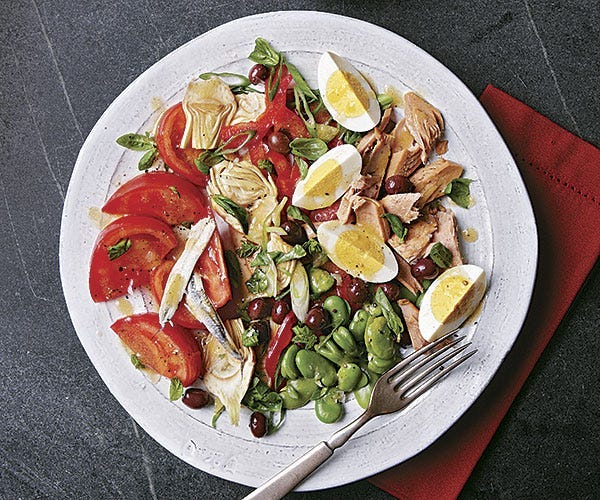
(Photo from Fine Cooking magazine for author’s summer 2016 Salade niçoise recipe)
Salade niçoise
Serves 6
Notes: Fresh tuna can be replaced with high-quality, oil-packed canned tuna; you could also replace the anchovies and the tuna for grilled sardines or red mullet, both Mediterranean fish.
Fresh favettes or young, tender, fava or broad beans, which are eaten raw, are traditional in Nice for this salad, but if only the more mature beans are available, simply drop the shelled beans into boiling salted water and cook for not more than one minute; drain the beans and quickly cool under running water then slip the beans out of the outer skins, discarding the skins. Frozen fava or broad beans can also be used, just follow the cooking directions on the package.
If you can’t get fresh small violet artichokes, you can use well-drained, oil-packed jarred grilled artichokes.
4 - 6 eggs
1 inch-thick (2 cm) sliced fresh tuna, about 7 ounces (200 grams), or 1 can high-quality oil-packed canned tuna
8 - 10 ripe but firm tomatoes
4 spring onions, scallions, or small radishes
1 green or red bell pepper
4 small violet artichokes, violet de provence or poivrade
1 clove garlic, peeled and halved
1 ½ cups shelled fresh tender, early broad beans or fava beans, the bean slipped out of the thin skin that might cover it, from about 2 pounds of pods (see notes above)
1 cup unpitted black olives, preferably small Niçoise olives or Greek olives
6 oil-packed anchovy filets
Salt and pepper
8 - 10 tender basil leaves
Best-quality extra-virgin olive oil + 1 lemon or red wine vinegar or Mustard Vinaigrette (recipe below)
Fill a saucepan big enough to hold all the eggs in one layer with enough water to just cover the eggs. Bring the water to a rolling boil and carefully slip the eggs into the water. Reduce slightly to a low boil and cook the eggs for 10-12 minutes, depending on how well boiled you like them. Immediately transfer the eggs to a colander and run them under cold water until cool enough to handle. Peel the eggs under cold running water and set aside.
If using fresh tuna, pat the fish dry on both sides while you heat up a grill or skillet. Brush one side of the tuna with olive oil then lightly salt and pepper; when the skillet is very hot, place the tuna, oiled side down, on the grill and cook for 3 minutes. While the first side of the tuna cooks, brush the top side with olive oil and dust lightly with salt and pepper. Carefully flip the fish over and cook for another 3 minutes. Lift the tuna onto a plate or cutting surface and cut into thin slices.
Rinse and pat dry the tomatoes and cut each into 8 wedges from top to bottom along the core, cutting out and discarding any hard core. Place the tomato wedges in a large colander and dust lightly with salt. Leave the tomatoes to drain off their excess water for the time it takes to prepare the rest of the ingredients.
Trim and thinly slice the spring onions, both the white bulb and the pale greens, or trim and very thinly slice the radishes. Remove and discard the stem from the bell pepper, slice in half lengthwise and cut out and discard the white ribs and the seeds. Slice each bell pepper half into thin strips.
Remove and discard the tough outer leaves of 4 artichokes. Slice off the top point of each artichoke, about half an inch, and then cut off the stem. Using a sharp paring knife, pare down and trim off the tough outer covering of the base until you are left with only the tender base and leaves of the artichokes. Slice each artichoke in half lengthwise down the center and cut or scoop out any fuzzy choke. Very thinly slice the artichokes.
Slice the clove of garlic in half lengthwise and rub the serving platter generously with the garlic to perfume the dish; discard the clove. Arrange the tomato wedges in a circular pattern on the platter followed by the artichoke slices, green pepper, the spring onions or radishes, and finally the beans. Slice the eggs from top to bottom into four wedges and place the wedges around the tomatoes.
Distribute the olives and drape the anchovies across the top of the salad. If using fresh grilled tuna, slice in thin strips and place the strips between and around the anchovies; if adding canned tuna, separate the fish into chunks and arrange on the salad.
Lightly salt the salad and add a couple of grindings of black peppercorns. Drizzle the olive oil and either lemon juice or a tablespoon or two of red wine vinegar over the salad; alternately drizzle with a good vinaigrette (recipe below). Rip or snip the basil leaves into pieces and scatter over the salad.
Carry the platter to the table and serve, placing extra olive oil and vinegar or vinaigrette on the table. Serve with crusty bread and a good, chilled provençale wine.
Mustard vinaigrette
1 ½ teaspoons Dijon-style mustard
2 tablespoons red wine vinegar
Salt and pepper
5 tablespoons high-quality extra-virgin olive oil
Place the mustard in a bowl and add the vinegar, add salt and freshly ground black pepper and whisk until smooth. Continue whisking as you add the olive oil in a slow, steady stream until well blended, smooth, and creamy. Taste and add more mustard, vinegar, salt or pepper as desired.
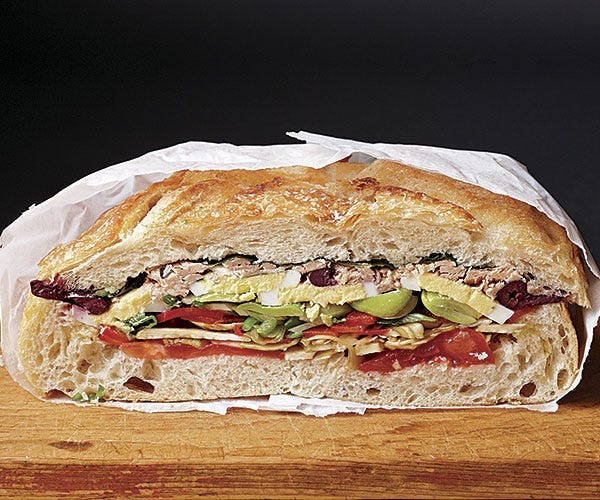
(Photo from Fine Cooking magazine for authors 2016 recipe)
Pan bagnat
Pan bagnat, niçoise dialect for the French pain baigné or mouillé, bathed or wet bread, is the traditional sandwich version of the salade niçoise, originally a carry-along meal for fishermen or those working in the fields. A round, crusty bread roll is sliced almost but not quite through the center (leaving the two halves attached on one side, a way to catch the filling from falling out). The inside halves of the roll are rubbed with a crushed garlic clove, which is then discarded, and then the bread is “bathed” - drizzled or spooned - with olive oil, allowing the oil to soak into the bread and softening it. Slices of ripe tomato, hard-boiled eggs, thin strips of green or red bell pepper, red or spring onion or radishes are all layered into the roll. Sliced, pitted black olives and a couple of anchovy filets or some sliced or crumbled tuna are then stuffed into the bread on top of the vegetables. More olive oil is then drizzled on. Add some vinegar or the mustardy vinaigrette and a few basil leaves if you like. Then the roll is closed and pressed tightly. The Pan Bagnat is always prepared in advance to allow the ingredients to marinate, the bread to moisten, and the flavors to blend.
Jamie Schler is an American food writer living in France. She owns a hotel and writes the Substack Life’s a Feast.
Best recipe ever! I say we try not to 'dwell on misfortune' as Voltaire said, but simply understand it. I love recipes that will slow the crumbling of democracy in general. And one that calls for us to 'soften the bitterness of our moods'? I will probably screw it up because I'm a bad philosophical cook! :) But honestly, I will try the recipe! :)
Saveur had a version of Nicoise a while back that we make about once a week during tomato season. These look very beautiful, too. The dressing is the key! The Saveur version appears to be freely available, still: https://www.saveur.com/article/Recipes/Rte-7-Salade-Nicoise/