

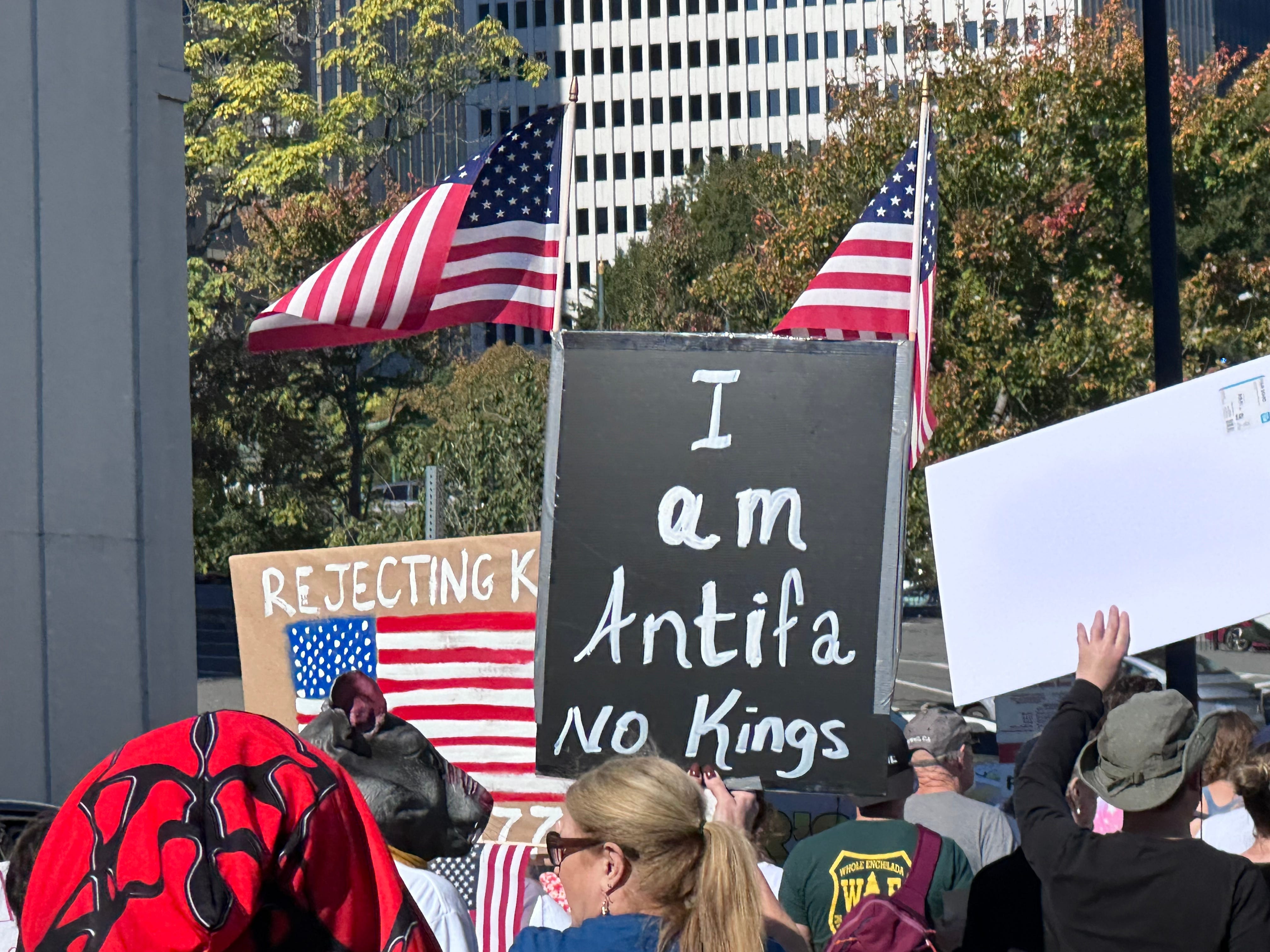
By Jeff Nesbit
In its escalating war on dissent, the Trump administration has finally conjured the enemy it always wanted. With the stroke of a pen on Sept. 22, President Donald Trump issued an executive order designating “Antifa” a “domestic terrorist organization.”
This action, coupled with directives to the Justice Department to explore using the formidable Racketeer Influenced and Corrupt Organizations (RICO) Act against the movement, is not a serious attempt to ensure public safety.
It is a dangerous act of political theater, designed to weaponize the state against a phantom menace and, in the process, chill the very concept of protest in America.
The administration’s entire strategy rests on a deliberate, foundational falsehood: that antifa is a singular, hierarchical organization. It is a fiction that crumbles under the slightest scrutiny.
Even the president’s first-term FBI Director, Christopher Wray, has testified that antifa is “a movement or an ideology,” not an organization.
Historian Mark Bray, author of “Antifa: The Anti-Fascist Handbook,” offers an even clearer analogy. “Sometimes there are feminist groups, but feminism itself is not a group,” Bray explains. “There are antifa groups, but antifa itself is not a group.”
Antifa—shorthand for anti-fascist—is a political ideology and a mode of protest adopted by a decentralized, leaderless, and loosely affiliated network of activists who oppose far-right extremism. To designate it a terrorist organization is as legally absurd as designating “socialism” or “libertarianism.” You cannot prosecute an idea.
Which brings us to the Trump executive order itself. Stripped of its inflammatory rhetoric about a “militarist, anarchist enterprise,” the order is legally worthless. There is no statute that grants a president the power to formally designate a domestic group as a terrorist organization.
The robust legal framework for proscribing Foreign Terrorist Organizations simply has no domestic parallel, a deliberate choice by Congress to avoid the profound First Amendment problems that would come with outlawing ideologies. The order’s own fine print even concedes it “is not intended to, and does not, create any right or benefit … enforceable at law”.
So, what is it? It’s a policy directive. It is the president using his authority not to enforce the law but to aim the entire federal law enforcement and intelligence apparatus—the FBI, the Treasury, the IRS—at a movement he finds politically inconvenient (and a useful target).
The goal isn’t conviction; it’s intimidation. The order serves as a pretext to justify surveillance, launch investigations, and create a climate of fear that could ensnare activists, donors, and non-profits in a web of federal scrutiny for constitutionally protected activities.
This is where the threat of a RICO prosecution becomes so potent. Though the “terrorist” designation is legally hollow, the RICO Act is a very real and powerful weapon.
Originally designed to dismantle the mafia, the statute’s broad language has allowed prosecutors to target a wide range of criminal enterprises, from street gangs to corrupt police departments. And, make no mistake, a determined prosecutor could try to build a case against antifa activists.
The legal theory would be audacious. Prosecutors would argue that the disparate antifa adherents across the country constitute a single “association-in-fact enterprise” under RICO’s expansive definition.
They would lean on a key legal precedent, United States v. Nascimento, which said a RICO enterprise does not need an economic motive, neatly sidestepping the fact that antifa is an ideological movement, not a financial one.
From there, they would attempt to stitch together sporadic, unrelated criminal acts—property damage in Portland, an assault in Berkeley—and label them a “pattern of racketeering activity.” This would be test of the statute’s outer limits, attempting to prove that shared ideology and tactics are enough to constitute a nationwide criminal conspiracy.
Such a prosecution would face immense legal hurdles. Proving a coherent “enterprise” among leaderless activists who have never met would be an evidentiary nightmare. Establishing the “continuity” required for a “pattern” from reactive and often spontaneous acts of protest would be even more difficult.
But, in many ways, winning in court is not the point. The true victory for the Trump administration would be in the prosecution itself.
The threat of a RICO indictment—with its terrifying penalties of 20 years in prison and asset forfeiture—is a tool of suppression in itself. It sends a clear message: Oppose this administration, and you could find yourself fighting a federal racketeering case.
This entire effort is a dangerous distraction. While the administration manufactures a conspiracy, its own intelligence agencies have repeatedly identified white supremacist groups as the most persistent and lethal domestic terror threat in the United States.
The data is unequivocal: The overwhelming majority of fatalities from domestic terrorism are caused by far-right extremists. Yet the full weight of the executive branch is being brought to bear on their opponents, and the regime in March scaled back the FBI’s Domestic Terrorism Operations Section, which investigated, among other things, right-wing extremism, and disappeared a database on symbols of extremism.
This isn’t about law and order. It is the cynical weaponization of our legal system to silence dissent. By creating a fictional enemy and targeting it with the most powerful tools of state, the administration is not just attacking a political movement; it is attacking the fundamental right of Americans to protest, to associate, and to speak out against those in power.
Jeff Nesbit was the public affairs chief for five Cabinet departments or agencies under four presidents.
Another great post. Thanks.
Reminded me to check on the status of the case against Wisconsin Judge Hannah Dugan. Suspended as a judge, indicted by a grand jury, denied dismissal on grounds of judicial immunity, to be tried in December. All because she didn't give into bully ICE agents trying to disrupt her courtroom.
As you write, the threat of prosecution is the point.
And the reason I checked on this case is because I was embarrassed to have forgotten about her. Also ashamed to think that I might not have had the courage to do what Judge Dugan did.
Right on Jeff!