

By Carron J. Phillips
The establishment demands challengers because favorites need competitors. And because competition breeds excellence, sports requires rivalries. University of Connecticut Women’s Basketball Coach Geno Auriemma has been without a consistent, worthy adversary since Tennessee’s Pat Summitt and Notre Dame’s Muffet McGraw left the game.
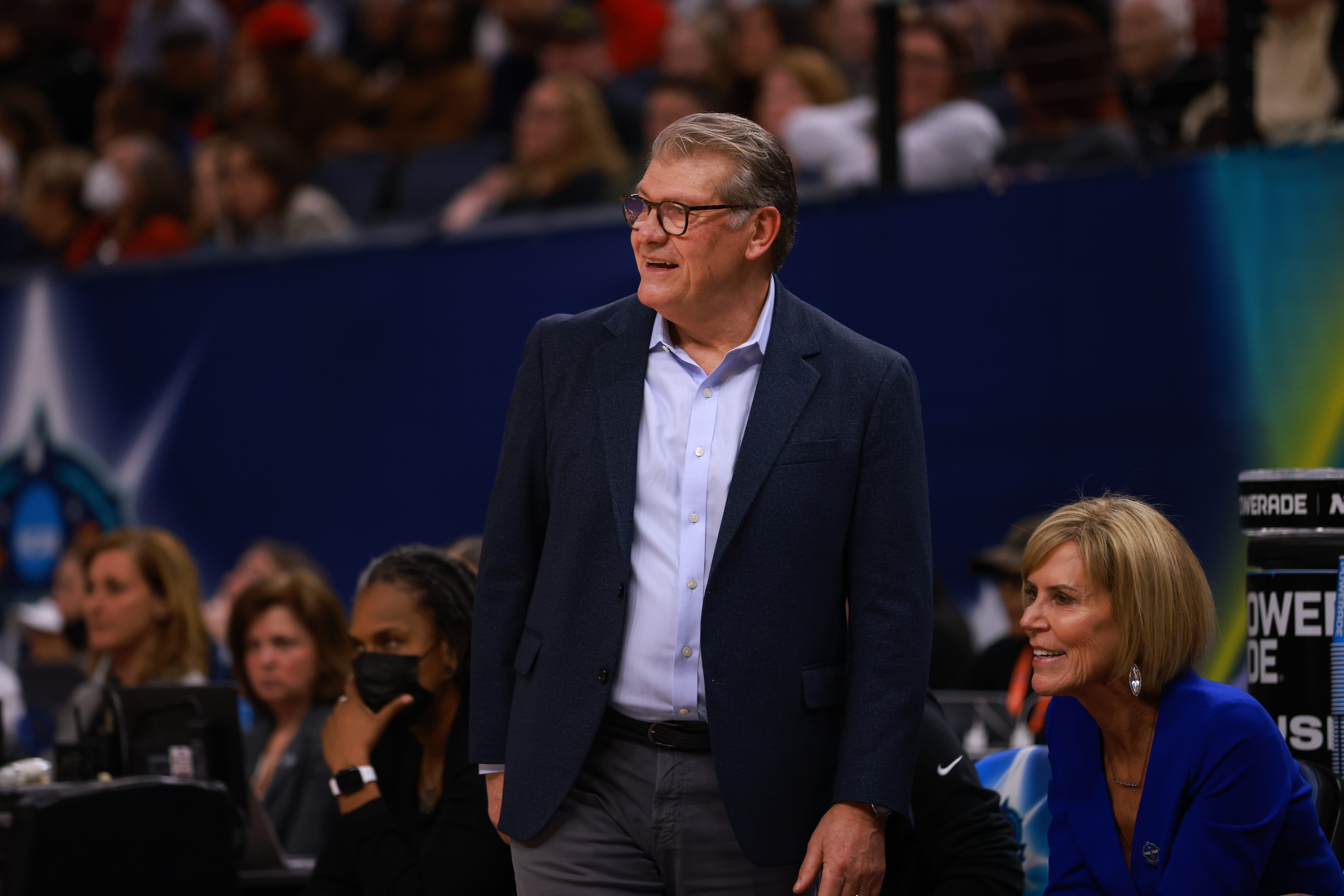
But never fear. South Carolina’s Dawn Staley is here.
“I will beat Geno’s ass!”
The declaration that came out of Staley’s mouth during the national semifinals of the NCAA Tournament after her inescapable sideline confrontation with Auriemma — which he started and apologized for — was not a threat or “aggressive” or “unladylike” because of her race and gender. The North Philly girl was simply informing the Italian kid from the Philly metro area that, if need be, she would triumph in mankind’s oldest tradition of settling disputes: fisticuffs.
It was dramatic. It was uncomfortable. It was the kind of stuff that social media lives for. But, most important, it was exactly what this sport needed. After a season that lacked the kind of storylines that casual fans have come to expect over the past few years, Auriemma’s and Staley’s “kerfuffle” put the sport back on the front page of the newspaper (if they still print those).
“You have two coaches [who’re] used to winning; it can get feisty a little bit,” South Carolina guard Raven Johnson said.
Auriemma went after the referees and Staley in his sideline interview with ESPN’s Holly Rowe after the third quarter. When it was time for Staley and Auriemma to meet for the postgame handshake, all hell broke loose. Auriemma was upset about the loss, the officiating, and Staley’s antics with the referees, and he apparently felt slighted that Staley didn’t participate in a customary second pregame handshake. His behavior was unbecoming, immature, and childish. It was the conduct of a sore loser, which is odd for a coach who has led his program to 12 national titles and 25 Final Fours.
ESPN’s Chiney Ogwumike addressed Auriemma’s problematic actions during his post-game broadcast: “Normally, in these circumstances, I understand emotions are flying through, but he’s putting Dawn in a position where she constantly has to take the high road…. I know it was a tough night, but overall, that shouldn’t happen.”
After the game, Auriemma told reporters that he and Staley don’t really have a relationship off the court as he believes the two “don’t have a lot in common,” despite Staley facing Auriemma during her collegiate playing days and serving on his coaching staff during the Olympics. “There’s no excuse for how I handled the end of the game vs. South Carolina. It’s unlike what I do and what our standard is here at Connecticut,” he wrote a day later in a statement. “I want to apologize to the staff and the team at South Carolina. It was uncalled for in how I reacted. The story should be how well South Carolina played, and I don’t want my actions to detract from that. I’ve had a great relationship with their staff, and I sincerely want to apologize to them.”
Coming into Friday night’s national semifinal in Phoenix, the previously undefeated Huskies were riding a 54-game winning streak — until Staley’s squad ended UConn’s season and Auriemma’s chance at claiming his 13th national title. In the 2024-2025 season, UConn traveled to Colombia and beat South Carolina by 29 points on their home floor. And when the two teams met again in the national championship Game, UConn won by 23.
The stakes between these two programs and these two coaches had been rising for years. According to ESPN’s Sam Block, before Sunday’s season finale, since 2017, UConn had won 297 games and suffered only 31 losses, advancing to seven Final Fours and winning one national championship. South Carolina had gone 290-33 with six Final Fours and two national titles on their resume. UConn and Auriemma represent the old guard that has owned the sport since their first national championship in 1995. Staley and South Carolina are the new kids on the block who’ve disrupted everything. So when UConn’s Kayleigh Heckel missed a wide-open layup in her first UConn/South Carolina game with 1:09 left - that basket would have cut the margin to nine — she immediately started crying. It was a reminder of how cruel the NCAA Tournament can be and how intense this matchup is.
“They were in our way to a championship,” South Carolina’s Tessa Johnson said about the Huskies.
UCLA, however, wound up being the roadblock.
South Carolina got their doors blown off by the Bruins in Sunday’s national championship, suffering a 28-point loss. All the energy and intensity we saw from Staley’s team against UConn disappeared. UCLA proved they were the best team. But, though the spoils go to the victors, the attention is sold separately. The 2026 Women’s Final Four will be remembered for Auriemma and Staley. Sorry, UCLA, you’re a footnote in history.
And that itself is a reminder of the role the “isms” play in the popularity of American sports. The Auriemma-Staley spat gave the sports world and beyond something to talk about — even after a week in which the antics of the president and his regime overwhelmed us with senseless incidents of turmoil.
Women’s college basketball is a treasure with a solid foundation. As it continues to grow, it will learn what other sports in this country have realized when it comes to expanding its footprint: drama is necessary. Stop the pearl-clutching, because in this country, we prefer it when our athletic competitions include a pinch of racism, sexism, or classism. When Jackie Robinson broke the color barrier, it inspired just as many as it enraged. The same thing happened when Magic Johnson and Larry Bird entered the NBA.
The alliances people have with teams aren’t solely based on where they’re from or where they went to school. Who you are, what you look like, and how you view yourself play huge roles in determining whom you root for. People feel a certain way about those who cheer for Duke basketball, the New England Patriots, the New York Yankees, Notre Dame football — and UConn and South Carolina.
Sports are more enjoyable when what’s at stake is more than the final score. The two best programs in women’s college basketball played an unforgettably intense game that produced an explosive moment that we’ll never forget — despite both teams leaving Phoenix empty-handed.
It was everything this sport needs, while also being something that it will never admit to wanting.
Carron J. Phillips is an award-winning journalist who writes on race, culture, social issues, politics, and sports. He hails from Saginaw, Michigan, and is a graduate of Morehouse College and Syracuse University. Follow his personal Substack to keep up with more of his work.
Geno did not apologize to Dawn. He apologized to “the staff.” And. He did not apologize to our Gamecock FAMs for ruining our moment of joy.
I agree that his actions took away the joy of the moment. I can also see that it could have had an impact on the UCLA game affecting our players and coach, but Dawn Staley would never make excuses. I admire her even more for her actions to try to move on. The team has given us much joy this year. They should be proud of their accomplishments. As for Geno he should call and give her a personal apology. There is absolutely no excuse for his actions!