

By Carron J. Phillips
Thank God for Black women.
In a year when this country celebrated its 250th birthday, women from diverse backgrounds emerged as the distinguished guests of honor. New Mexico’s Deb Haaland became the United States’ first elected Native American woman governor. In Texas, Gina Hinojosa became the state’s first Latina governor. In Georgia, Keisha Lance Bottoms became the first Black woman elected to lead a state.
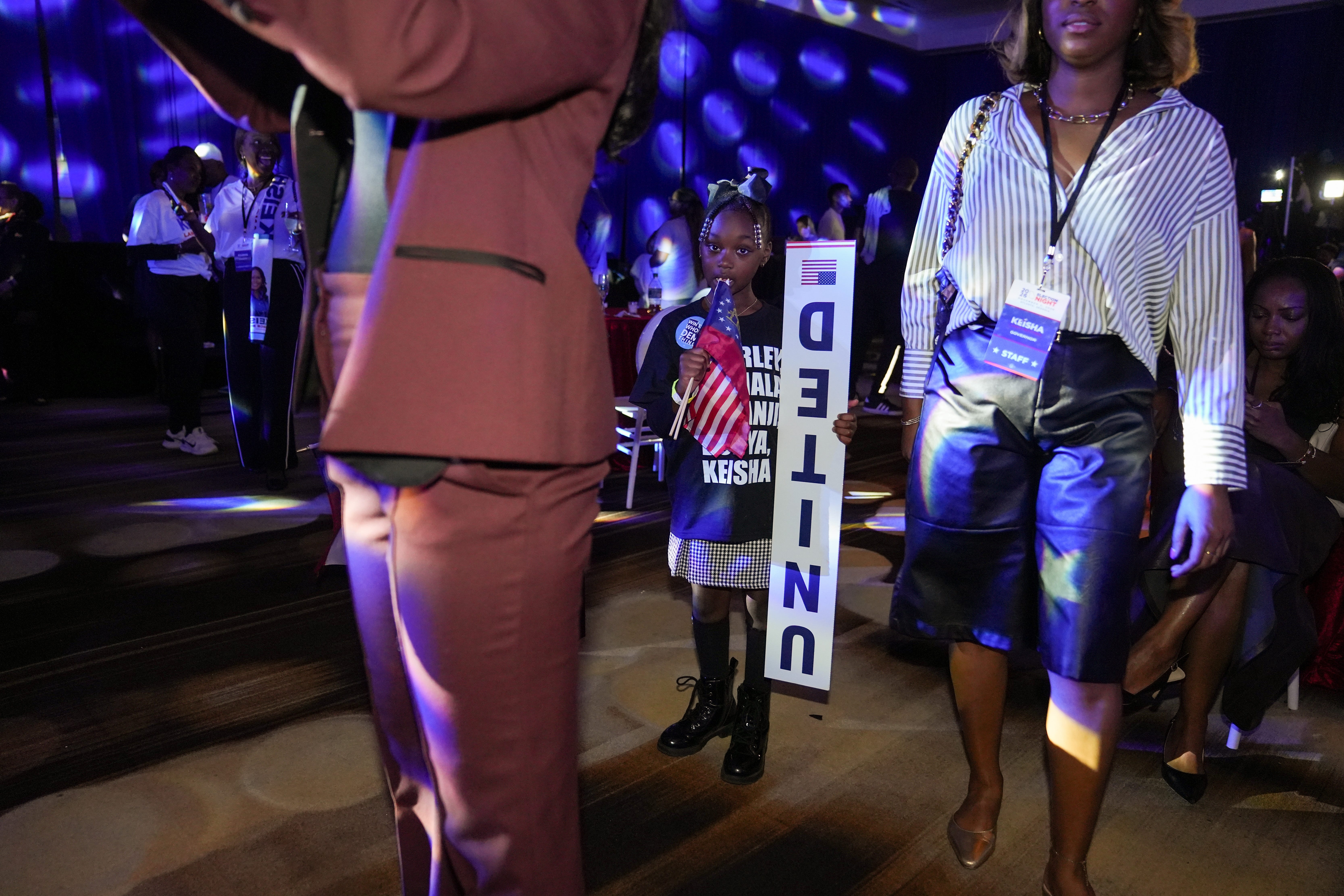
“I think people saw a politics of division and hate, and responded with hope, possibility, and leadership,” Fatima Goss Graves, president of the National Women’s Law Center Action Fund, explained to Forbes. “And voters matched that energy. They wanted folks to focus on the problems in front of us, but they also rejected the idea that this country isn’t for all of us. They rejected the idea that only a few people can benefit. Instead, how wonderful to watch campaign after campaign that ran on the promise of America for all of us affirmed by voters.”
Joining Bottoms in leadership in Georgia will be Penny Brown Reynolds (secretary of state), Tanya Miller (attorney general), Lydia Powell (state schools superintendent), Katherine Juhan-Arnold (agriculture commissioner), Keisha Sean Waites (insurance commissioner), Nikki Porcher (labor commissioner), and Sheila Edwards (public service commissioner). All eight of these Black women will replace white Republican men after an election that proved just how much change is taking place in the Deep South. Soon, ten of Georgia’s top 15 statewide elected officials will be Black.
This is why Atlanta was the only choice for the 2028 Democratic National Convention. The Democratic National Committee now faces the challenge of explaining why a region and state that brought the party such success and progress is being overlooked in favor of cities like Boston, Denver, and Philadelphia.
“Most votes come from Black women and, to some extent, these are women getting behind other women. Black women have never had this much influence on a state in the history of the United States, up until this point,” Charles Bullock, a political science professor at the University of Georgia, recently expressed to USA Today. “Many people have said for years that Black women are the lifeblood of the Democratic Party, whether they are candidates, activists, or volunteers. And now they are becoming officeholders,” he added.
The 2026 Midterm Elections will be remembered for what the Democrats accomplished, but it was the women who were the deciding factor, as they led from the background and the front to deliver change. And though the idea of election results may still be a sore subject for Hillary Clinton and Kamala Harris, somewhere the duo must be taking solace in knowing that their defeats were not in vain. Because as crucial as the female vote has become in America, it’s important to recognize that securing it has always been a two-step process: the 19th Amendment was incomplete without the Voting Rights Act.
America would not be enjoying this liberating moment without the combination of the suffrage movement and the civil rights movement, just as Democrats wouldn’t be basking in glory without Black women’s consistency at the polls. Since 2008, at least 92 percent of the Black women who cast a ballot in presidential elections voted for the Democratic candidate. Probably not coincidentally, this group of women have been targeted by this administration: at least 300,000 Black women left the workforce last year, many forced out of federal government jobs. According to the 19th* — a news publication that focuses on gender, politics, policy, and power — a recent study by the University of Maryland found that DOGE cuts “disproportionately affected” the federal employment of Black women. The study estimated that though DOGE “did not have statistically significant effects for any other race, gender, education, or age group,” it reduced Black women’s federal employment by 25 percent.
And on November 3, they understood what was at stake.
“I think it’s a lesson for all of us, because this moment was really about who we wanted to be as a country, and what we were willing to do to save our country and save our democracy,” Niambi Carter, public policy professor at the University of Maryland, explained to NBC.
Stacey Abrams knows about saving our country and our democracy. She lost her gubernatorial bids in Georgia to Brian Kemp by just one percentage point in 2018 and by seven points in 2022. But something significant changed. After her initial defeat, Abrams focused on mobilizing and energizing voters in a state that has become emblematic of voter suppression. Her efforts sparked a movement that rapidly gained momentum across the country, ultimately helping to turn Georgia blue in the 2020 presidential election. I was in the room when she lost in 2018, and it was evident even then that America needed Abrams more than she needed us.
Eight years later, the fruits of her labor bloomed nationally, but especially in Georgia.
“For the 92% [of Black women voted Democratically] out there that were feeling like, ‘maybe the country just doesn’t want us.’ Georgia wanted Keisha.” NOW’s Symone Sanders-Townsend said.
This is the only country on Earth in which its most disrespected group also serves as its savior. It’s a blessing and a curse that long deserves to be rectified.
Carron J. Phillips is an award-winning journalist who writes on race, culture, social issues, politics, and sports. He hails from Saginaw, Michigan, and is a graduate of Morehouse College and Syracuse University. Follow his personal Substack to keep up with more of his work.