



Last month, President Donald Trump took the extraordinary step of firing Erika McEntarfer, the head of the Bureau of Labor Statistics (BLS) after the monthly jobs report (more formally, The Employment Situation) showed a labor market that appeared to be treading water and getting worse.
Trump’s “shoot the messenger” firing of McEntarfer for giving him bad news about his own economy has raised concerns about whether the jobs numbers—and other economic statistics produced by the BLS, such as inflation—could be manipulated. Compounding these concerns: Trump’s nominee to replace McEntarfer, E.J. Antoni, has been widely criticized among conservative and liberal economists for consistently producing extremely poor, error-ridden data analysis.
But there’s good news on that front: For now, the jobs numbers are safe from manipulation thanks to the outstanding 2,000+ civil servants whose devotion to the mission of the BLS has resulted in U.S. economic statistics being the envy of the world.
More specifically, the process by which the BLS calculates the jobs numbers involves meticulously collecting and quality checking data sampled from over 100,000 firms in the economy. This input data is then adjusted to account for things like sampling error, seasonality, and firms opening and going out of business over the course of the month. This process is not a secret, as both collection and the analysis of the data are discussed in painstaking detail by the BLS on its website. Once the data has been gathered and analyzed, it is reviewed by senior staff, and, importantly, presented to the commissioner after it has been finalized. That is, the commissioner never actually touches the data or the analysis used in creating any of the economic statistics.
As a result, to change the jobs numbers, one would have to go through several levels of management staffed by dedicated, non-partisan career civil servants who would almost certainly refuse to do anything unscientific or politically motivated to the data. In addition, the acting commissioner of the BLS is Bill Wiatrowski, a dedicated career civil servant who, by all appearances, would never ask the staff below him to manipulate numbers to keep the president happy.
With that being said, Antoni’s nomination is still in progress, and the administration’s comments about the Friday release suggests it is convinced that what’s driving the jobs numbers isn’t the president’s failing economic strategy but, instead, a conspiracy among “people who are just trying to create noise against the president.”
So, what would some signs be that the numbers are actually being manipulated?
Rather than suspect numbers, the first thing to look for wouldn’t be in the data, it would be in the people. That is, Centers for Disease Control and Prevention-style mass resignations of career staff at the BLS. As discussed above, their dedication to the mission of producing accurate, impartial, and timely economic data is absolute. Resignations of management in response to being asked to manipulate the data would indicate that the administration is determined to torture the data until it says what the administration wants it to say.
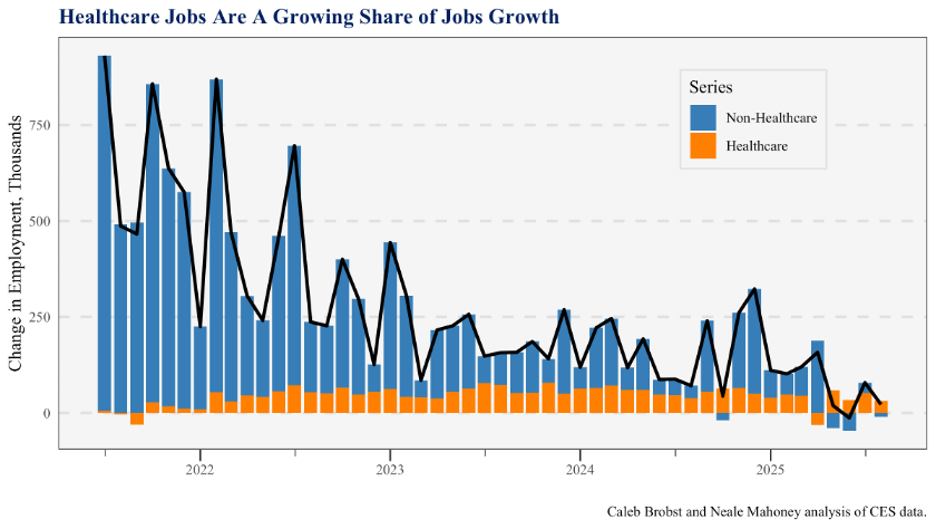
And after the jobs report on Friday, the administration indeed might have something to fear from hearing the truth. Mark Zandi, one of the most respected macroeconomic forecasters and analysts, reacted to the jobs report by stating that the United States is now in a labor-market recession, where the labor market (but not necessarily the entire economy) is shrinking. Part of what’s driving Zandi’s diagnosis is the collapse of widespread job growth. My Stanford colleagues Neale Mahoney and Caleb Brobst show in the figure below that without health care—a sector that continues to secularly grow no matter what’s happening with the economy--the economy would have lost jobs the past four months.
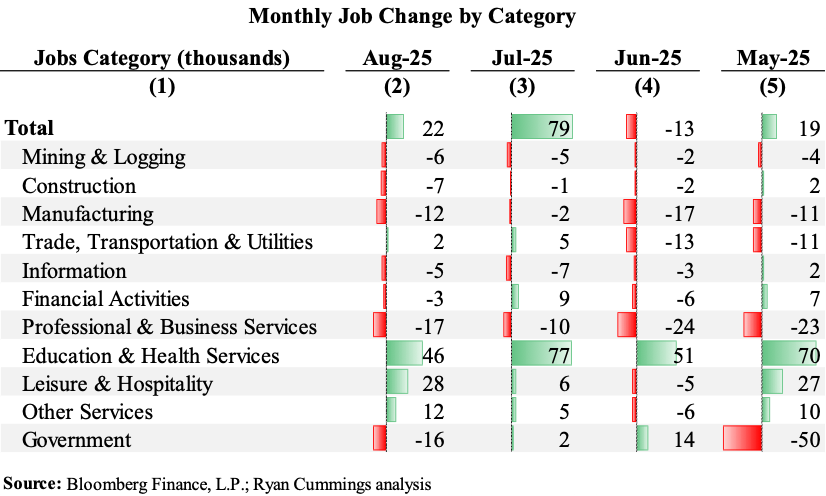
To make matters worse, Trump’s immigration crackdown—which was nominally designed to enable Americans to fill jobs previously held by immigrants—is unsurprisingly not successful at any of its economic aims. The table below shows that industries that Trump claims to want to help—such as manufacturing and construction—have lost jobs for at least three consecutive months. To be clear, the manufacturing industry has largely been losing jobs for the past two years, but Trump doesn’t appear to close to reversing that trend or even slowing it; the past four months of declines are the largest since Trump’s presidency began.
The good news for the president is that if he wants to reverse this decline, his best bet is to declare the trade war a success, reset tariff rates, and stop creating a workforce crisis through a counterproductive and inhumane immigration policy. But doing that would be a recognition that his entire economic agenda to date has failed—another harsh truth Trump isn’t ready to hear, no matter who the messenger.
Ryan Cummings is chief of staff at the Stanford Institute for Economic Policy Research.

Well said! They could cook the books, as you say, though it will take some work. Or, their new, corrupt commissioner, should he get confirmed, could say “because of the poor quality of the data [total BS of course] we are no longer going to release it.”
That would be a page from China’s playbook when they don’t like the numbers.
Of course, if they go there, we will all know what they’re hiding.
Let us praise and be thankful for the "deep state," which was always doing a conscientious job for the American people, and resisting the corrupting influence of politics.