

Americans should be alarmed by the nearly $111 billion merger between Paramount and Warner Bros. Discovery that allies of the Trump administration are currently rushing to the finish line. If the merger goes through, Americans will pay more for less, thousands of workers will likely lose their jobs, and two of the country’s most important newsrooms will fall under the control of a billionaire who has already begun censoring journalists on behalf of the Trump White House. State attorneys general have the power to stop it—and they should.
Consider just the economic case against the deal. Three months after the Ellisons officially took over Paramount, the company announced it would hike subscription prices by as much as 50% on Paramount+, its flagship streaming service. If Paramount is allowed to acquire Warner Bros., too—the owner of HBO Max, CNN, and a massive content library—the resulting mega-corporation will likely have the market power to increase prices even further, lay off workers at these services, and force streamers everywhere to accept fewer options and worse programming.
And it’s not just streaming. This deal would cut the number of major film studios from five to four and bring two of America’s major news properties, CNN and Paramount subsidiary CBS News, under the same roof. Under 2023 federal guidelines, mergers that significantly increase concentration in already concentrated markets are presumed illegal. This one would do just that—twice over.
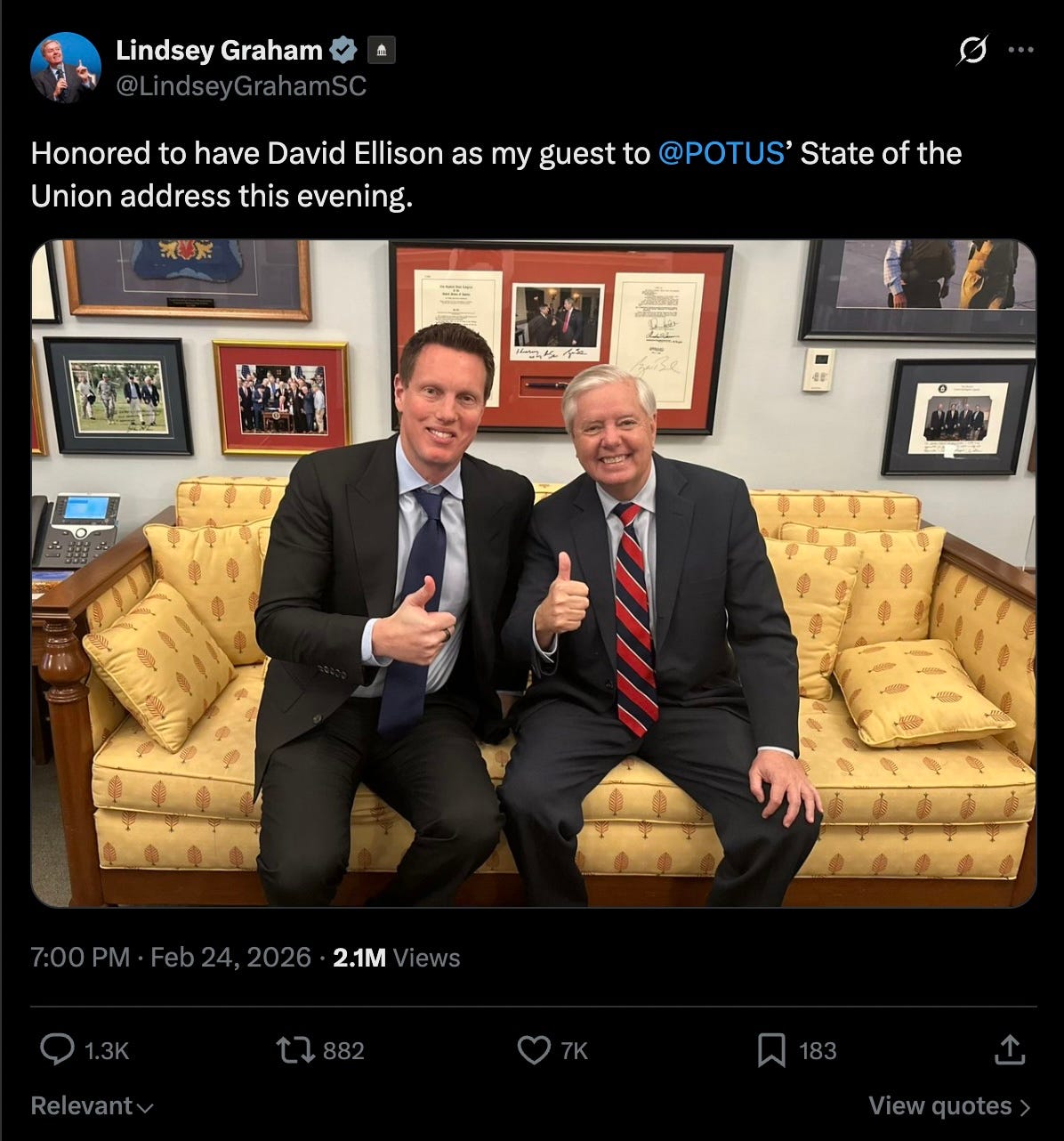
The antitrust concerns with the Paramount/Warner Bros. deal also have grave implications for our democracy. Paramount’s CEO, David Ellison, and his billionaire father, Larry Ellison, are close to the Trump White House and to President Trump personally. David Ellison attended the State of the Union as a guest of Trump stalwart Lindsey Graham. Trump has indicated that he backed Paramount’s acquisition bid (without mentioning the company by name) and that he wants CNN sold and its leadership changed. And the Ellisons have already demonstrated exactly what they are willing to do with the media properties they control.
After acquiring CBS News, David Ellison installed conservative pundit Bari Weiss as the editor-in-chief, where she promptly began gutting stories critical of the administration. Weiss forced 60 Minutes, one of the most trusted investigative programs in the country, to delay a segment investigating the administration’s deportation regime. As the Ellisons prepared to take operational control over Paramount, the Trump administration approved the sale after the company paid $16 million to settle a legally dubious lawsuit brought by Trump himself. And, during the same period, the company canceled The Late Show with Stephen Colbert—one of Trump’s most prominent critics—just two days after Ellison met with FCC Chair Brendan Carr, who has openly weaponized his agency’s power to target Colbert specifically.
The Trump administration, and President Trump individually, are bent on exercising more control over CNN. The Wall Street Journal reported last December that David Ellison promised administration officials he would make “sweeping changes” to CNN if his takeover bid succeeded—and Larry Ellison even talked to the White House about firing CNN hosts Erin Burnett and Brianna Keilar, “whom Donald Trump is said to loathe”. Trump met privately with Ellison twice in February; days after one of those meetings, the Department of Justice began an investigation into Netflix, Paramount’s chief rival for the Warner Bros. acquisition, for alleged anticompetitive practices. And, in December, Bloomberg reported that Ellison’s bid is being financed with billions from investment funds in Saudi Arabia, Qatar, and Abu Dhabi—all countries that would happily use their leverage over an American news organization to gain favor with the Trump administration.
If the deal goes through, two pillars of American journalism will be controlled by a hard-right billionaire who already has a track record of suppressing credible reporting, silencing dissent, and slanting the news at media properties he owns. That’s not a free press; that’s a media working in service of the state. Nor can we count on federal regulators to scrutinize the deal for either its effects on competition or on freedom of speech. Under this administration, independent agencies and antitrust enforcers work to protect Trump, not consumers.
When, in another country, the leader’s closest political allies buy up media properties that then became less critical of the leader, we recognize that for what it is: crony capitalism and corruption.
Thankfully, the Paramount/Warner Bros. deal isn’t just a federal question. The states, via state attorneys general, have the authority to challenge anti-competitive mergers like this one. This state-level approach has real precedent: In 2024, Washington State sued to block the Kroger-Albertsons merger, winning an injunction from a state court. If state AGs can stand up to two of the country’s largest grocery chains to protect consumers, they can certainly do the same for two of the country’s largest media and entertainment corporations.
This is a precarious moment for American democracy and the free press it relies on. The Trump administration and its allies are willing to use the heavy hand of government to further their political, economic, and cultural goals, and the usual checks-and-balances of our federal system have proven unable to stop them. That’s why state attorneys general need to step up, use every legal tool they have, and scrutinize this deal. Both a free market—one without monopolies—and our democracy depend on it.
Neera Tanden is the president and CEO of the Center for American Progress and the CEO of the Center for American Progress Action Fund. She was previously the Domestic Policy Advisor to President Joe Biden and director of the Domestic Policy Council, overseeing some of the administration’s signature achievements, including efforts to lower the cost of prescription drugs and expand health insurance coverage.
"That’s why state attorneys general need to step up, use every legal tool they have, and scrutinize this deal. Both a free market—one without monopolies—and our democracy depend on it."
Agreed, in the interim I will continue to rely on indepdent journalism like the Contrarian for my source of news. Sincerely, One seriously concerned and grateful citizen.
This merger should not be allowed.