


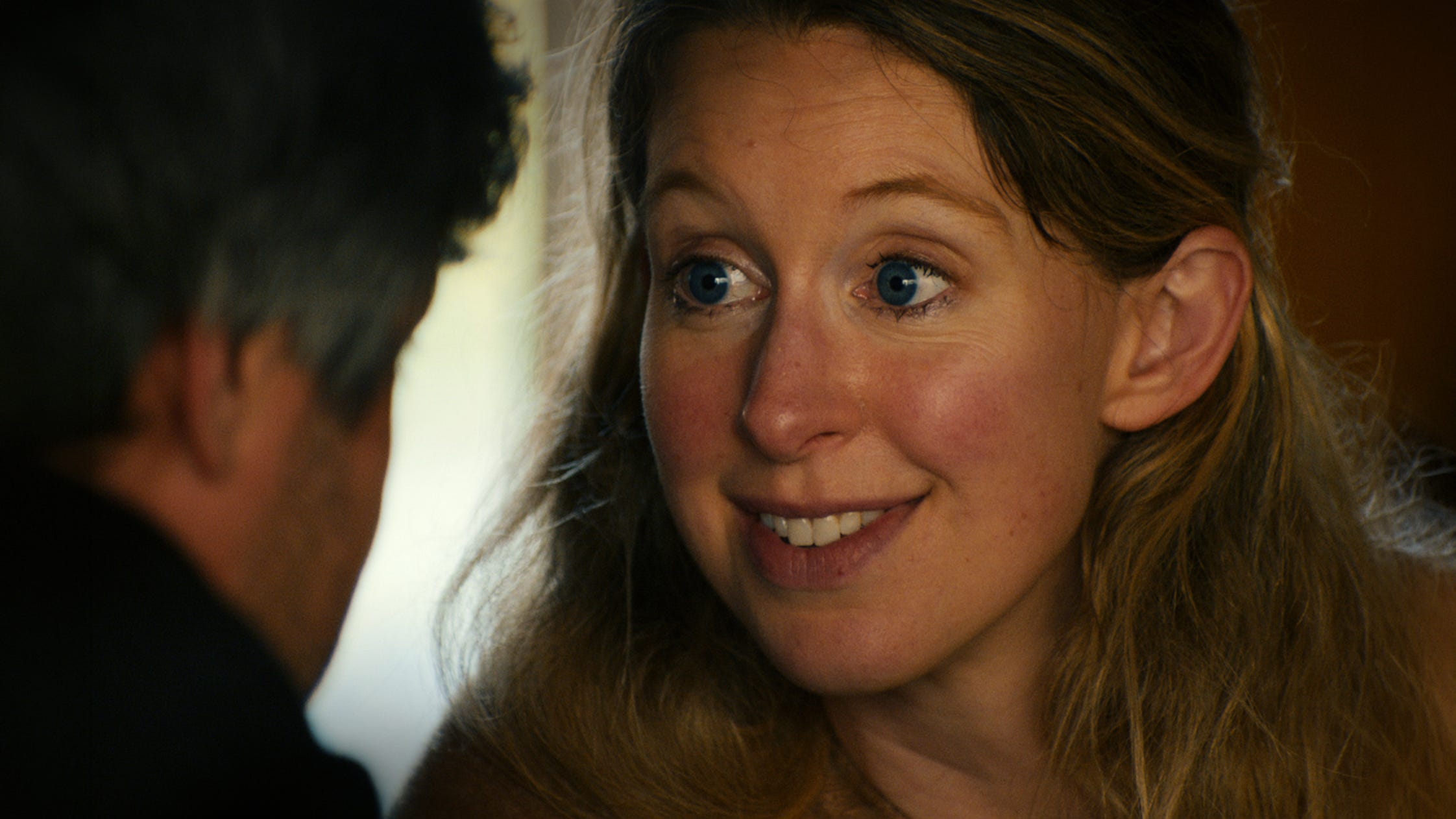
Two months ago, almost no one outside of A24 knew that Nathan Fielder and Lance Oppenheim were making a documentary about Theranos founder Elizabeth Holmes, who was convicted of fraud in 2022 and is currently serving time at a federal prison camp alongside Ghislaine Maxwell.
But since You Can See Everything was unveiled at a surprise screening at the Telluride Film Festival in September, followed days later by a deeply WTF trailer (which blew up the internet and launched a million “why would I deceive you?” memes), the documentary has exploded into a full-blown cultural phenomenon.
Since it was released in North American theaters on October 16, the film has raked in more than $45 million at the box office, putting it on track to become one of the highest-grossing non-fiction films of all time. More than 70 percent of the audience on opening weekend was under the age of thirty-five — a demographic that is more prone to consuming bite-sized clips on TikTok than three-hour postmodern documentaries about notorious personalities whose downfalls have been exhaustively chronicled elsewhere.
To offer some perspective, You Can See Everything has already made roughly three times as much as Melania, which received a massive marketing push from Amazon when it was released in January. Far more astonishingly, it has brought in about 70 times as much as Musk, another unusually long, high-profile documentary about a controversial figure in tech. The film is poised to be a major Oscar contender, and could potentially even land a historic nomination for best picture. It has led to a spike in viewership for The Dropout, the 2022 limited series about Holmes, and boosted sales for Bad Blood: Secrets and Lies in a Silicon Valley Startup, John Carreyrou’s definitive journalistic account of the Theranos saga.
The last time a documentary released in movie theaters (rather than on a streaming service or premium cable channel) dominated the cultural conversation in this manner was Michael Moore’s Fahrenheit 9/11 in 2004 — when Lance Oppenheim, the co-director of You Can See Everything, was eight years old.
It’s a shocking feat for any documentary in 2026, much less one that’s as defiantly weird and unsettling as You Can See Everything. With remarkable access and intimacy, the film follows Holmes, her partner Billy Evans, and their two young children in the emotionally fraught weeks before she reported to prison in May 2023. The couple even invited Fielder to live with them at their wood-panelled beachfront home in Del Mar, with Holmes vowing that “you can see everything” — a promise that turns out to be rather literal, given Evans’ penchant for leaving the shower door open. He took them up on the offer and moved into a guest house on the property.
The first half of the film feels like a surreal sitcom — call it The Odd Throuple — about a socially awkward filmmaker attempting to get to know his new roommates, a pair of unrepentant grifters, by asking them pointed questions most people would shy away from. By their own admission, Holmes and Evans knew little about Oppenheimer, a documentarian with a florid filmmaking style, or Fielder, a genre-bending comedian whose shows, including The Rehearsal, explore the line between fiction and reality in discomfiting ways, before they invited the filmmakers to follow them during their last precious weeks together as a family. Ostensibly, they made this decision — inexplicable to any reasonable person — because they hoped to exonerate Holmes in the eyes of the public. (Fielder even asks if they chose to work with him, instead of a health or tech reporter, specifically because he’s “uneducated on science and scientific things.”)
Throughout You Can See Everything, Holmes denies any wrongdoing at Theranos; absurdly claims she has never told a consequential lie in her life; and reveals plans for relaunching the company. When, near the beginning of the film, Fielder says he is pretty convinced that she defrauded investors, her response is evasive:
“All I know is my truth.”
While no one in the film uses the word “autistic,” there seems to be a concerted effort to portray Holmes as neurodivergent, rather than sociopathic. “She just thinks differently,” claims Evans. Holmes doesn’t exactly come across as innocent, but she certainly seems more human. Instead of the icy blonde in Steve Jobs’ drag of 2014, we get the frazzled new mom who can’t stop crying and can’t bear the thought of being separated from her babies — a far more sympathetic persona than Holmes 1.0. Evans, by contrast, emerges as the clear villain of the film, a manipulative control freak who interrupts his partner while she’s whisking eggs because apparently she’s not doing it right. (Once Holmes goes to prison, Evans takes over her X account and even makes an AI avatar of her that he can program to say whatever he likes.)
The success of You Can See Everything has, understandably, inspired a wave of think pieces about the public’s seemingly insatiable curiosity about Holmes. Why can’t we get enough of this woman, who has already been the subject of numerous podcasts, TV shows, documentaries, and bestselling books?
Why are millions of people willing to sit through a three-hour movie about Holmes, who — unlike virtually any other current or former tech billionaire — has actually been held accountable for the harm she caused society? At least when it comes to Theranos, there is no mystery to solve: A federal jury found that Holmes defrauded investors in the blood-testing company by falsely claiming that the company’s analyzer produced “results that were better, cheaper, and more accurate than existing methods.”
By making exaggerated claims about what Theranos could do, Holmes put the health of millions of Americans at risk, but thankfully she was stopped before anyone died as a direct result of faulty test results. (If only we could say the same of Musk’s DOGE cuts or his supposedly “self-driving” cars.)
Maybe it’s because Holmes is a woman who cynically used her gender to propel Theranos’s rise, and whose downfall, however well-deserved, has been celebrated with a level of Schadenfreude that seems out of proportion to her crimes.
The film offers two competing theories about its inscrutable subject: Holmes is either “the most manipulative person that’s ever lived,” as one person puts it, a schemer who lets her romantic/business partners do the dirty work while she keeps her hands clean, or an idealistic, woefully naive oddball with catastrophic taste in men. Fielder and Oppenheim never really come down on one side or the other, ending the film on a decidedly ambiguous note. By the end of the mind-bending three-hour journey, viewers may not actually understand Holmes any better than they did when they entered the theater.
That unknowability might ultimately be the point of You Can See Everything — and the reason the movie has captured the zeitgeist so powerfully. Our collective fascination with Holmes is part of why this film has become such a phenomenon, but it doesn’t tell the whole story. She goes to prison about halfway through You Can See Everything, at which point you might think the film would lose steam. Instead, things only get weirder, and arguably more interesting.
(If you haven’t seen the movie yet and are concerned about spoilers, now’s the time to stop reading.)

With Holmes no longer available to participate in the documentary, Fielder turns to Amanda Seyfried, the actor who won an Emmy for her portrayal of Holmes in The Dropout. In one absurdly meta moment, she watches footage of Holmes watching her in the Hulu series that we’ve seen earlier in the film. She says she feels “haunted” by Holmes and admits that she has fantasized about playing her again post-trial. Fielder enlists her to star in reenactments of incidents that took place off-camera, including a tense meeting with Holmes in a prison visitors room.
Seyfried becomes more than a mere co-star, and something closer to an expert witness. In long conversations at her upstate New York farm, she and Fielder analyze Holmes’s behavior and speculate about her motives (while her horses audibly pass gas). She even meets with Evans, who has relocated to Texas and transformed into a gun-toting manosphere type who scolds Seyfried for her response to Charlie Kirk’s death (which prompted the loudest reaction of the entire movie in the theater where I saw it) and brags unconvincingly about his sexual prowess.
In its final third, the film morphs into something like Vertigo meets The Thin Blue Line — a riff on the subjectivity of all experiences, which suggests that every identity is, to some extent, a performance. Evans denounces Seyfried as “a fucking actress who played my wife with zero research,” while she thinks he’s a creep for taking over Holmes’s social media accounts.
But everyone in this movie is, to some extent, putting on an act.
Just as Holmes cultivated a persona as a green juice-swilling eccentric during her Theranos days and later adopted the more relatable guise of Overwhelmed Mom, Evans transforms into a red-pilled tech bro while Seyfried leans into her “down-to-earth A-lister” image. Even Fielder’s socially awkward schtick feels like a canny bit of performance art rather than an organic personality quirk.
Throughout You Can See Everything, Oppenheim and Fielder film their subjects using intense, claustrophobic close-ups. These shots create an illusion of intimacy that is wildly disorienting. We may be able to see the clogged pores on Fielder’s chin or the clumps of mascara in Holmes’s eyelashes in microscopic detail, but we don’t necessarily know who else is in the room with them, why they’re there, or what room they’re in at any given moment. You may find yourself focusing more on Holmes’s lip hydration routine than the word salad coming out of her mouth. We are entirely too close to these people, yet also fundamentally lack perspective.
“You can see everything,” the movie seems to be saying, “but opening up for the cameras isn’t the same thing as being honest or authentic.” The documentary has caught on with the public not just because Holmes, like other female scammers, is an object of endless fascination to many people. It also speaks to a generation that has grown up in the shadow of reality TV and social media, understands innately how we all perform in a million different ways every day — and that accurately parsing what’s real from what’s fake is about as plausible as running 240 medical tests from a single drop of blood.
Meredith Blake is the culture columnist for The Contrarian.