


In Roald Dahl’s Charlie and the Chocolate Factory, the greedy and demanding Veruca Salt wants it all and wants it now—and the adults keep saying yes. The point is simple: Indulgence dressed up as strategy invites only more demands.
U.S. allies seem to have missed the moral of Dahl’s story.
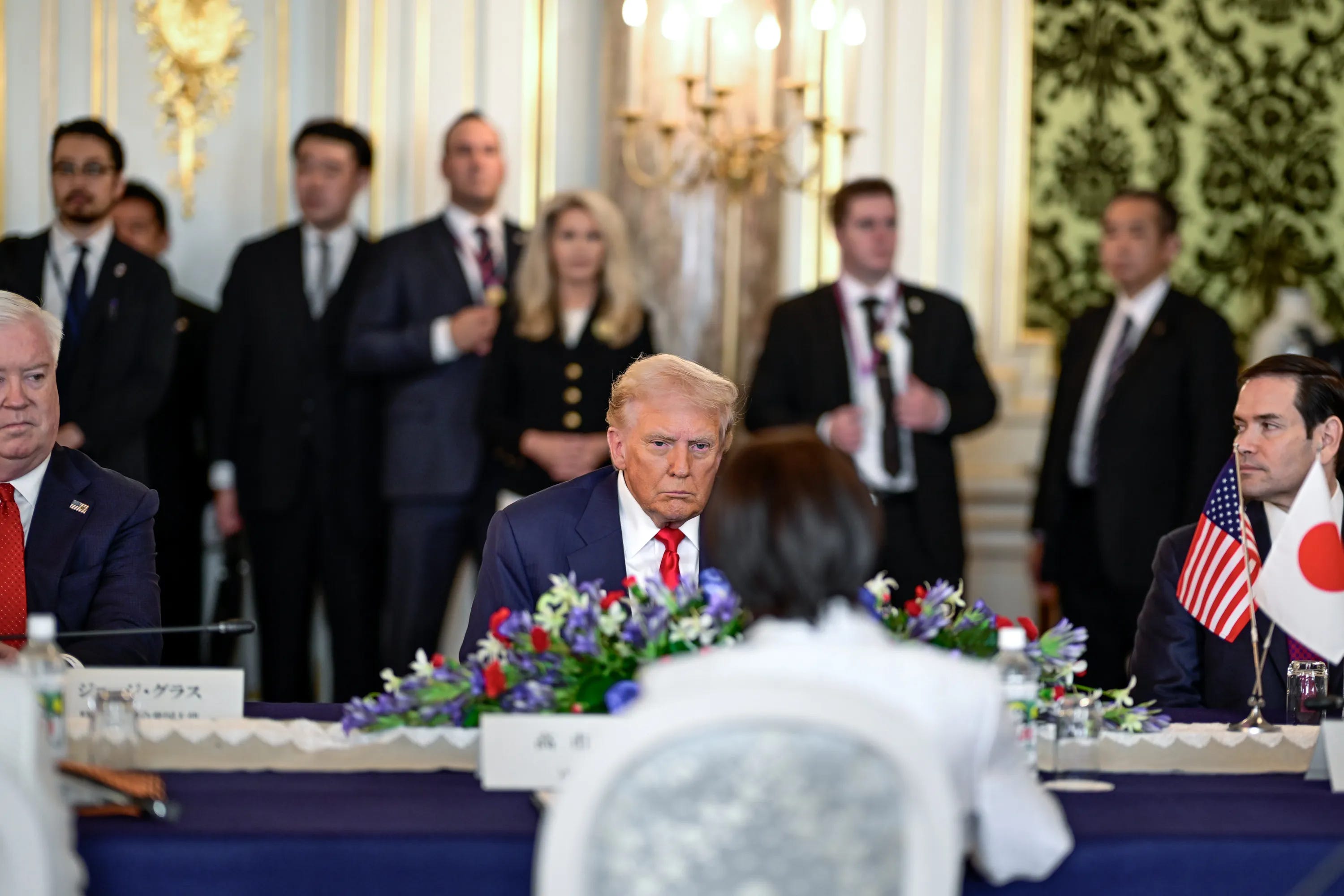
Nowhere was this more visible than on the flight deck of the USS George Washington in Tokyo Bay on Tuesday. Newly elected Japanese Prime Minister Sanae Takaichi stood beside U.S. President Donald Trump, who promised a “new golden age” for the alliance while he praised her as “one of the great prime ministers.” The stagecraft was deliberate: announce rare-earths cooperation, speed up defense spending, float a Nobel nomination, and build a news cycle around harmony.
Takaichi seemed unbothered by any symbolism of deference—standing on a U.S. warship in the same waters where Japan signed its surrender 80 years ago. The tableau was one of subordination, not equality: the American president at center stage, the Japanese leader offering praise from his flank. For a nation that has spent decades defining partnership as parity, the image was jarring. The message to her own public was sharper still—reassurance abroad now requires ritual submission at home.
The same choreography unfolded days earlier in Kuala Lumpur, where the summit of the Association of Southeast Asian Nations became another exercise in appeasement. Leaders signed framework deals heavy on platitudes, photo ops and vague tariff promises but thin on enforceable trade terms—leaving most members wondering what, if anything, they had gained once Trump’s plane departed.
But that is the play: flatter, pre-agree, keep him calm. It buys time. It also puts credit in Trump’s account and strengthens his incentive to ask for more.
What transpired in Asia this week brings the pattern full circle. Allies clearly believe they’ve cracked the code. Across the Atlantic and the Pacific, leaders now design encounters to prevent friction. What began as damage control now resembles Dahl’s parable: grown-ups indulging the tantrum and mistaking it for strategy.
But the political math runs one way. The day looks calm; the balance sheet does not.
Optics don’t fix policy risk. The trade frameworks many partners are signing leave wide space for one-sided enforcement—especially on tariffs tied to “national security” and new “economic security” rules. Key terms are elastic. When discretion sits in the White House, predictability sits on the edge of a pen. A calm press conference today can become a tariff shock tomorrow.
Public opinion makes this brittle. Outside the state rooms and flight decks, confidence in Trump’s handling of world affairs is low in many allied countries. Majorities in key nations see him as a risk to peace, not a guarantor of it. That gap matters. The more leaders rely on deference, the more they spend political capital they will need when the costs arrive—higher prices, forced purchases, or new conditions on local industries.
“Wait him out” isn’t a plan either. In 2005, patience had logic: U.S. power set the rules more predictably, alliances absorbed shocks, and China was still consolidating. But this is 2025. China is the rising counterweight, building alternatives—trade upgrades, supply-chain ties, financing—that don’t depend on U.S. calm. And on Jan. 20, 2029, Chinese President Xi Jinping will likely still be in office. Betting on a quick reversion to the old normal is nostalgia, not strategy.
The mistake is to think this theater has no cost here at home. What looks like discipline abroad—leaders smiling through their discomfort—feeds volatility in the system Americans depend on. Every show of harmony gives Trump more leverage to govern through impulse rather than principle. That volatility becomes policy: tariffs that shift overnight, retaliation that hits U.S. exporters, sudden demands on allies that rebound as uncertainty for American workers and consumers. A world built around improvisation, not rules, always turns against those who built the rules first.
Russia and China don’t need to out-maneuver the United States militarily when Washington’s partners perform restraint instead of resistance. Moscow sees a West busy managing moods instead of building or reinforcing coalitions. Beijing sees proof that alliances once anchored in law and predictability are now bound by personal temperament. Both profit from the message that U.S. power is conditional—something to be pleased, not trusted. That impression won’t vanish with a change of administration; it’s cumulative.
The effect on allies is subtler but just as corrosive. When leaders learn that flattery buys calm, they stop pressing for reciprocity. They build policy around his preferences rather than their own national interest, weakening the cooperative muscle memory that sustained the post-war order. This isn’t appeasement in the old sense—it’s habituation. The danger for the United States isn’t that partners will bolt; it’s that they’ll adjust to permanent volatility by planning around it. That means shorter trade horizons, looser defense integration, and more hedging toward non-U.S. options.
For the American public, indulgence diplomacy drains value from every alliance that once kept costs low and crises contained. The more foreign partners hedge, the less predictable the economic environment becomes—raising prices, limiting export markets, and increasing the odds that Washington faces future conflicts without full coalition backing.
The Veruca Salt strategy ends the same way it did in Dahl’s story: with collapse, not reward. When the tantrum stops producing treats, what’s left is resentment, not respect.
Brian O’Neill, a retired senior executive from the CIA and National Counterterrorism Center, is an instructor on strategic intelligence at Georgia Tech. His Safehouse Briefing Substack looks at what’s ahead in global security, geopolitics, and national strategy.

"When discretion sits in the White House, predictability sits on the edge of a pen. "
"Discretion" is a generous term; "whim" would be more apt regarding Mister Narcissist. And we can extrapolate O'Neill's insights to U.S. law firms, universities, media co.s, and anyone else targeted on a butthurt whim.
Veruca Salt forcibly learned her lesson. Time to teach Mister his.
Thank you Professor O'Neill. A very disquieting post. Alerts us that behind the fun in watching clips of Japan's PM rescuing the US President, there are serious consequences from these appeasement policies from US allies.
As you write, "Russia and China don't need to out-maneuver the US militarily when Washington's partners perform restraint instead of resistance."
Any US allies out there not bending the knee?