


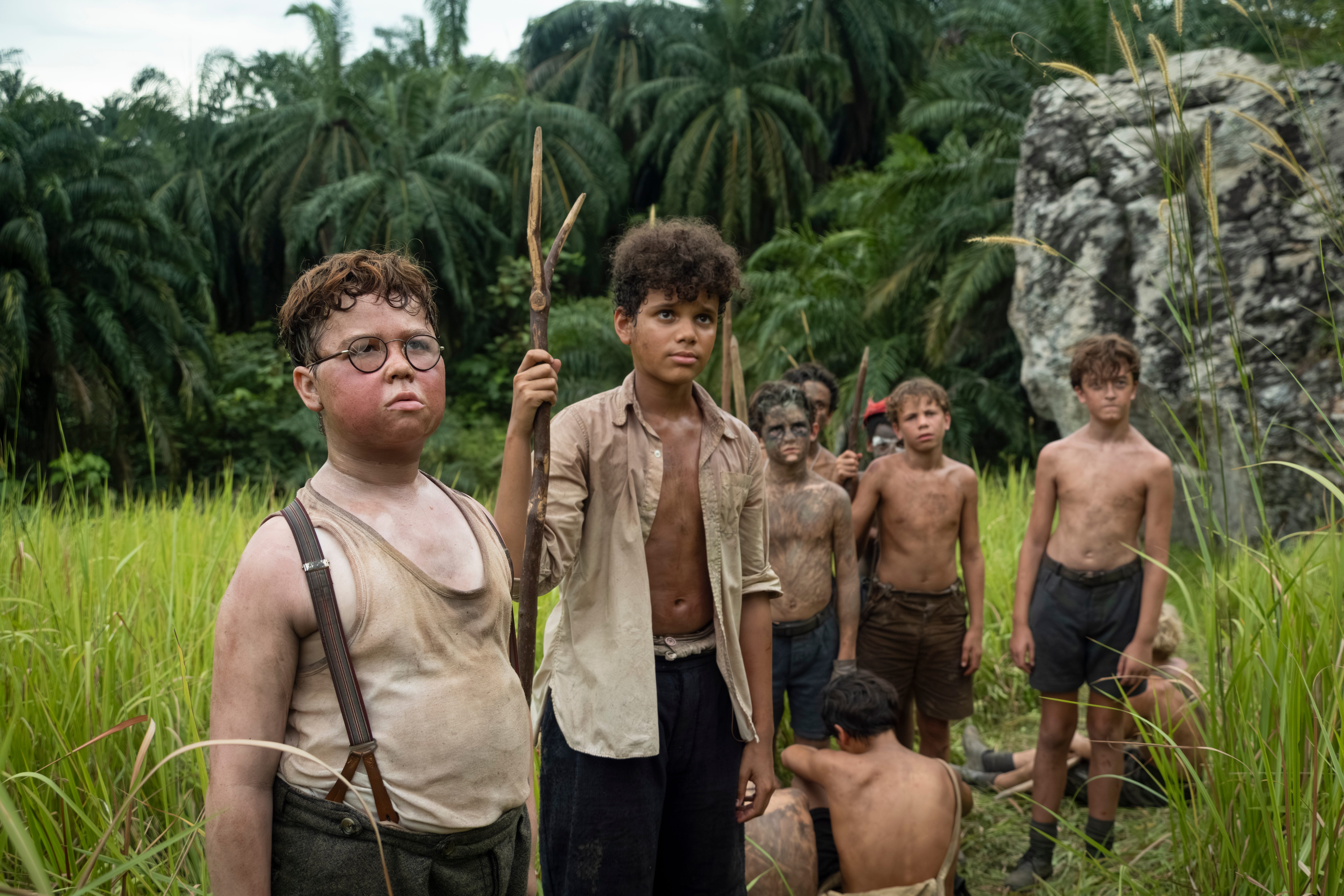
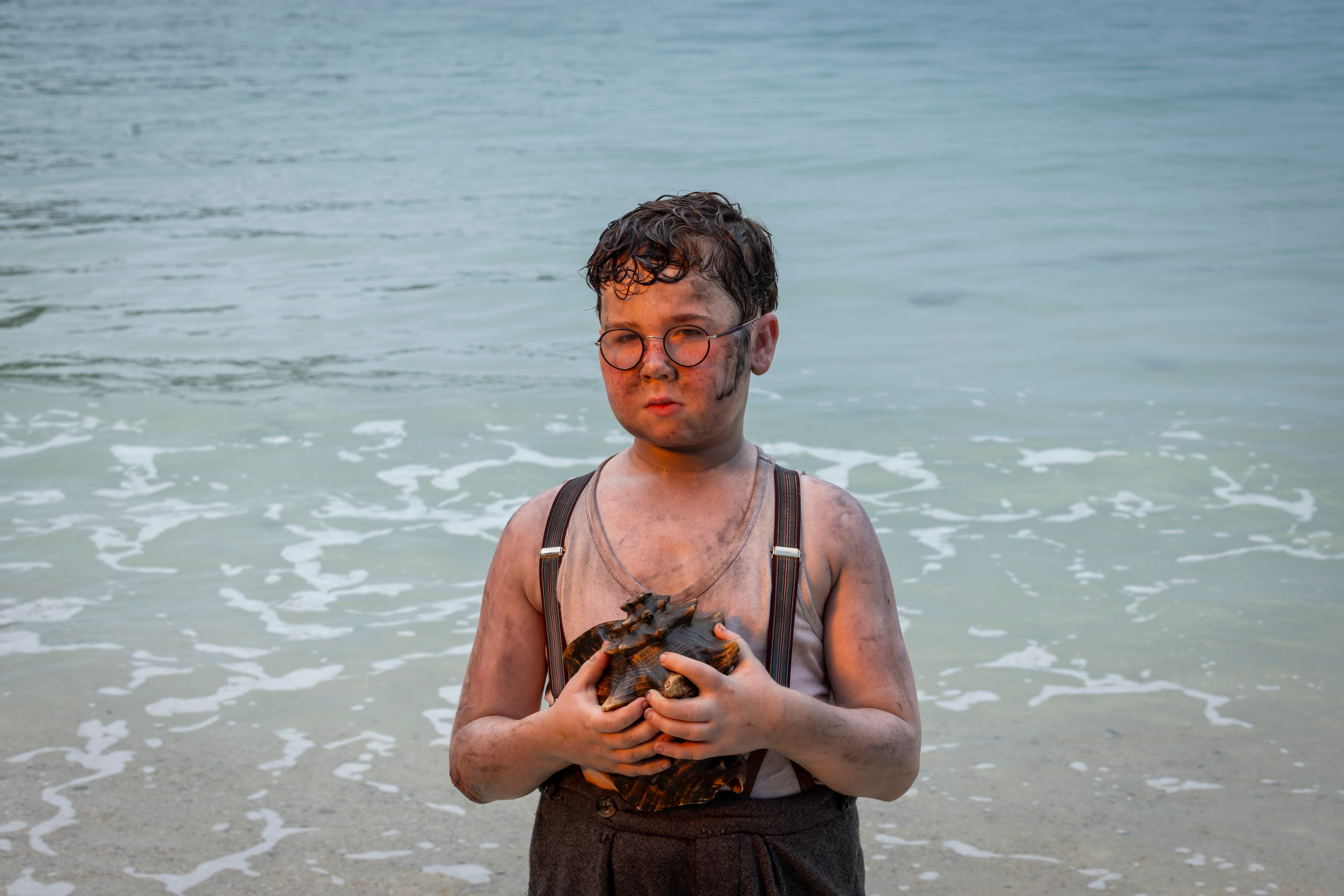
Anyone who ever read Lord of the Flies as an adolescent (or otherwise) is hard-pressed to forget its imagery: the conch, the signal fire, the beast in the forest, Piggy’s broken specs. First published in 1954, William Golding’s dystopian novel about a group of British schoolboys stranded on an uninhabited island has resonated with readers for more than 70 years.
It has also inspired numerous film and TV adaptations, including a Netflix series released earlier this month. At a time when less-than-faithful literary interpretations are all the rage, this latest version of Lord of the Flies is noteworthy for just how closely it hews to the source material, down to the midcentury wartime setting and famous lines of dialogue.
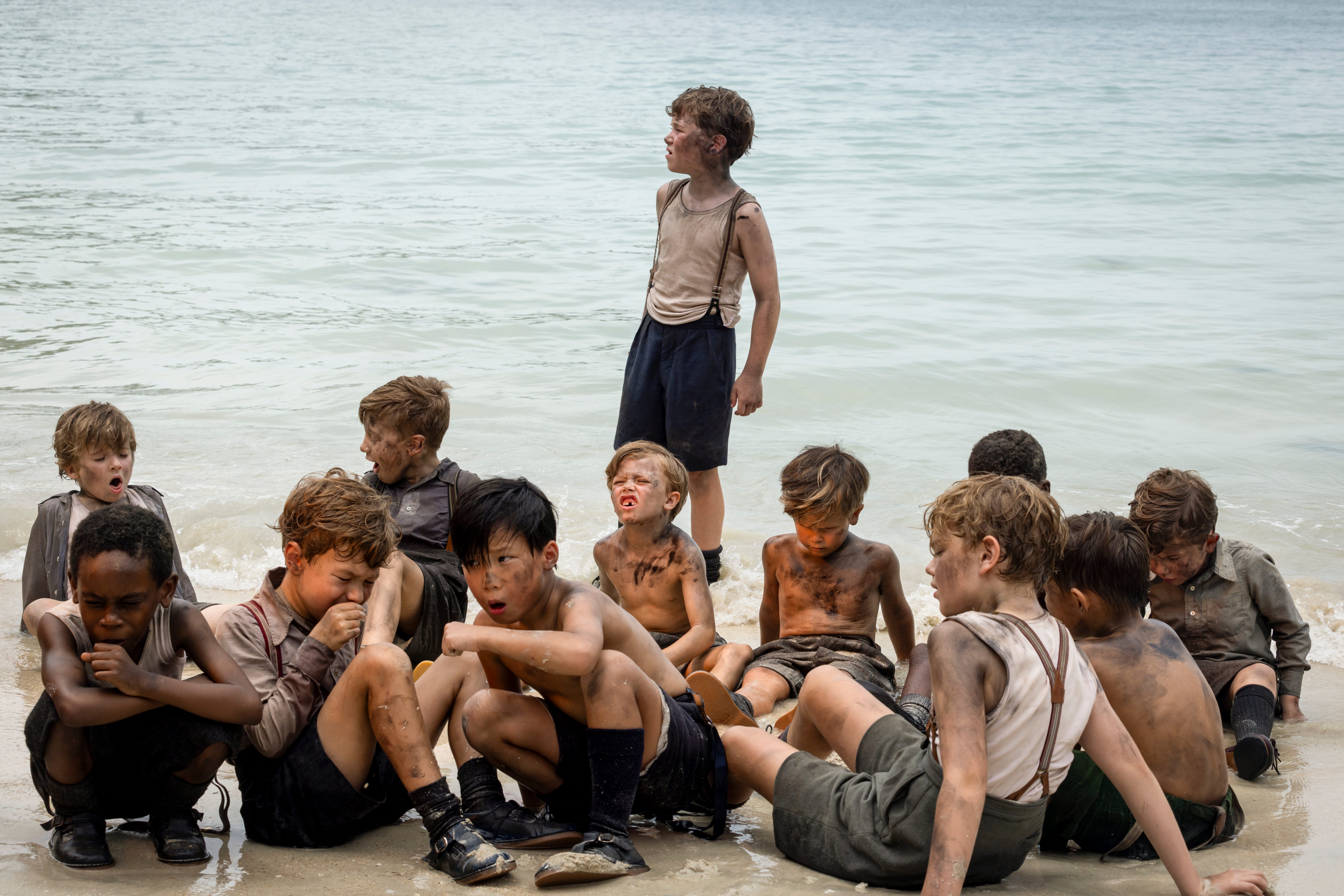
Written by Jack Thorne and directed by Marc Munden, the four-part drama opens on a lush tropical island where a few dozen prepubescent boys have landed following a plane crash. With no surviving adults to care for them, the children must attempt to govern themselves and establish their own civilization — with disastrous results.
Ralph (Winston Sawyers) is elected leader, with support from the intellectual Piggy (David McKenna), who is focused on practical concerns like shelter and sanitation. They clash with the egomaniacal Jack (Lox Pratt), leader of the school choir, who is more interested in hunting pigs. The ethereal Simon (Ike Talbut) floats between the two groups. Tensions quickly boil over, suggesting that humans, even seemingly innocent children, are inherently prone to violence.
Thorne and Munden have created an adaptation that feels relevant at a moment of heightened concern about the social and emotional struggles of boys and young men — at a time when democracy is under threat across the globe.
“I would have made this show at any time, but there is something about this moment that feels like it fits Lord of the Flies,” Thorne said in a recent video interview with Munden.
It feels like right and left are unable to see each other anymore, I don’t think this is just about the rise of rise of a powerful right wing. I think this is also about the way that the left wing behaves towards that right wing and the inability of two sides to see each other clearly, and the way in which it feels like it’s easier to be defined by what you hate right now than what you love. It feels like we are in an age where shouting about what you don’t like has become a major preoccupation in a way that is obviously incredibly damaging.
Thorne made small but meaningful changes to Golding’s novel. In the series, unlike the book, Piggy is given a real name, Nicky — a thoughtful gesture that imbues the character (and the young actor playing him) with greater dignity. Thorne also makes judicious use of flashbacks to flesh out the characters’ backstories and show that these boys are very much a product of the society in which they were raised.
Thorne notes that Golding wrote the novel at the dawn of the Cold War — when the horrors of World War II remained fresh in the collective memory. “These are kids that are made by damaged people, that’s why they behave this way on an island,” said the English writer, whose credits include the play Harry Potter and the Cursed Child. “He writes it with great specificity, and that thing of ‘what we give, they inherit’ feels like a very important lesson to be talking about right now.”
Coincidentally, Thorne was working on this project at the same time as Adolescence, the Emmy-winning limited series which explored similar themes. Released last year, the drama followed a thirteen-year-old boy accused of murdering a classmate and was inspired by real-life incidents of violence in the U.K.
“The deterioration of the society that the boys form on the island is not inevitable,” Munden said. “It’s an accumulation of all these fractures, the hero worship, and all those things that everyone can understand as one’s baser instincts.”
Thorne’s interest in Lord of the Flies dates back to when he was eleven and plucked the book from his mother’s shelf one night when he was unable to sleep. Though it’s unlikely the book helped him get much rest, it was a revelation. “Within about 40 pages, I was like, ‘I’m Simon,’” Thorne recalled. “Those moments in literature, film, or TV where you see yourself reflected back at you are extraordinary.” Later, Thorne reread the book several times as an adult, and was forced to reconsider his connection to Simon and his opinion on Jack, a character he’d always despised.
Thorne’s evolving take on the characters speaks to just how fully formed and deeply human they are. Each embodies a different leadership style: Piggy is pragmatic, empathetic, and concerned with protecting the most vulnerable. Ralph is charismatic and naturally popular but dislikes confrontation. Jack is arrogant and cruel but also offers the boys something in short supply on the island: fun. Simon is the spiritual one, guided by a strong sense of morality and self-sacrifice.
Lord of the Flies is frequently interpreted as a political allegory about democracy versus authoritarianism. It’s tempting to look at the current state of the world and conclude that we live in an era when too many Jacks are in positions of authority, and not enough Ralphs, Piggies, or Simons.
But that’s not really the point, Thorne said: “I think that what the book is about is you need to be part of a collective. One chief is not the answer to any problem, and any society which thinks it is is going to do damage to itself.” Munden thinks that while Piggy would be an ideal “spad” — a Britishism for “special adviser” — none of the characters would necessarily be a great leader in their own right. “They’ve all got their piece of the puzzle that they put together in their society,” he said, “and it could have worked so well.”
Given that there are almost no adults in the series, casting the right young performers was crucial. Remarkably, virtually none of the cast had professional acting experience prior to Lord of the Flies, but they are uniformly superb. (And McKenna is especially heartbreaking as Piggy/Nicky.) Casting directors Martin Ware and Nina Gold “scoured the U.K, seeing thousands of boys and getting them to tell them what they would do if they were stranded on a desert island,” Munden said. On set, the ensemble faced a steep learning curve, but intuitively connected to their characters. “They understood the instincts of those boys, just from the playground, as it were,” Munden said.
Video clip of Meredith Blake interviewing series creator Jack Thorne and director Marc Munden.
Filmed on location in Malaysia, Lord of the Flies is gorgeous to behold, with breathtaking shots of the dense rainforest and turquoise waters, which remind us that terrible human violence is possible even — perhaps especially — in the most stunning natural settings. (It’s reminiscent of The Thin Red Line, Terrence Malick’s gorgeous, harrowing 1998 film set during the Battle of Guadalcanal.)
Making the series on actual uninhabited islands with a cast of untrained children was a difficult process, but one that gave Munden and Thorne greater faith in the young people with whom they were working. (In other words, Lord of the Flies did not descend into Lord of the Flies behind the scenes.) Safeguards were put in place to protect the actors who played the “littluns,” the youngest characters in the series. They were kept away from set during the most violent sequences, and unable to hear the older actors chant variations of “Kill the beast! Cut his throat! Spill his blood.”
Rather than going feral, the boys spent their spare time playing silly games in the hotel pool and squirting one another with sunblock. “They understood what they were doing, but they also treated it with great joy,” Thorne said. “If you ask them what they kept from the filming process, it’ll be the moments when one of them ate sand and everyone laughed… They really do give you great optimism, because they’re wonderful.”
Meredith Blake is the culture columnist for The Contrarian
The best thing about Lord of the flies is its portrayal of what will happen when a bunch of kids are dumped on an island is completely inconsistent with what actually happened when this occurred. Far from the vicious and dictatorial devolution portrayed in the book, when several school boys were marooned on an island in the South Pacific, they actually banded together, shared responsibility, and helped each other. Over 15 months six school boys cared for each other survived and built a culture that we all could learn from. https://www.theguardian.com/books/2020/may/09/the-real-lord-of-the-flies-what-happened-when-six-boys-were-shipwrecked-for-15-months?CMP=Share_iOSApp_Other
I have read the book many, many times over my life and I was very surprised how closely the series followed the book. It was just outstanding. Great book and I think it is a great series. Those young actors, wow. Thanks for the really interesting perspective on the series Meredith.