

By Shalise Manza Young
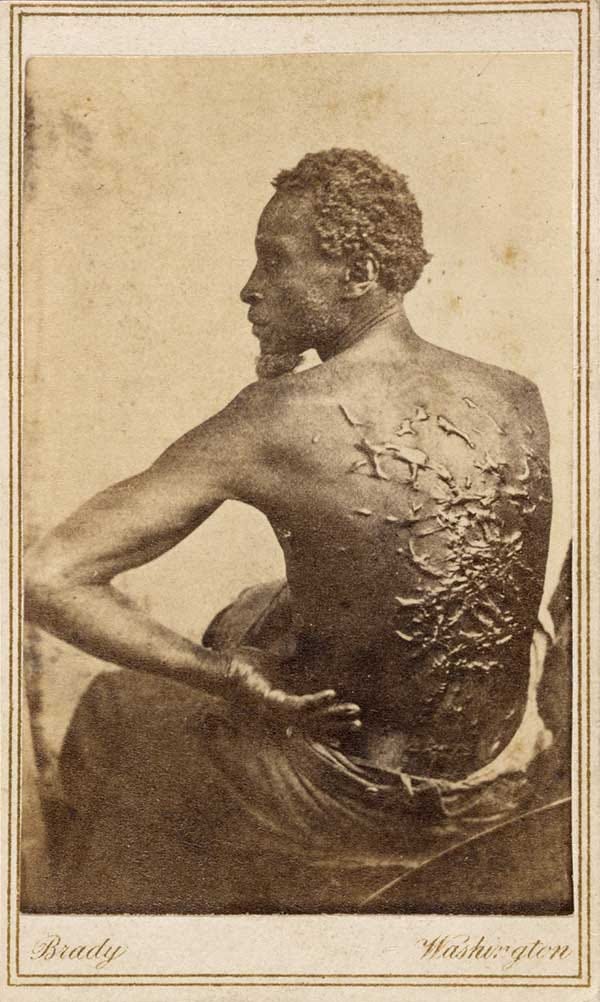
The man sits, his back to the camera, his beard nearly brushing his left shoulder. His long, muscled arm is bent at the elbow, left hand at his waist, his fingers thick and weathered. His curled hair is a little matted after wearing a hat for hours.
There’s a quiet resignation in his posture.
These are the things you notice if you study the picture of Peter long enough. Long enough to look beyond the labyrinthine, keloided scars on his back, stretching from his shoulders to the top of his buttocks. Across the middle of his back the scars are thick, some appearing as wide as his ring finger, a mass of intertwined markings not unlike the dozens of arteries and veins that start at the heart and spread through the body.
If you study the photo long enough to see a man.
Peter arrived at a Union encampment in Baton Rouge, La., in March 1863, having traveled some 40 harrowing miles, running barefoot through the night, from the plantation he had escaped with three others, evading slave catchers and bloodhounds and rubbing onion on themselves to throw the dogs off their scent.
One of the men was captured and killed. Peter and the others barely survived.
From what we know, Peter was nothing if not a survivor. He had received those scars on John Lyons’ cotton plantation along the Atchafalaya River, viciously whipped by an overseer and then doused in salt brine, at the time a common additional torture. He told the soldiers at the camp that Lyons, the man who had enslaved Peter and 37 others, fired the overseer who had whipped him so brutally that Peter needed weeks to heal.
As he recovered, Peter decided he was going to escape.
He and the other men he fled with enlisted in the Union army, joining other Black men in that regiment. It was during a health check that Peter’s scars were discovered, shocking all of the white men who saw them.
Photographers William McPherson and J. Oliver, who had been documenting the war from the Confederate side until the Union seized Baton Rouge, captured pictures of Peter, first in the tattered, mud-stained clothes he was wearing when he arrived at the camp, and then of his back. They used the second photo to make carte de visites, small cards that were inexpensive to produce.
As the cards spread across the warring country, it opened the eyes of many to the true horrors of what enslaved Blacks were enduring. Publication on the widely read “Harper’s Weekly” magazine fortified the fight of abolitionists and led to more people speaking out about ending the practice.
Particularly for white northerners, plantations were far-off places, but the visual of Peter proved that any assertion that enslaved people were treated well was a fallacy.
In the long-mythologized version of America, Peter is a shining example of what an American is supposed to be. He was rugged, a hard worker who made something of a life from nothing, and fought for his country.
That myth reads more and more like satire with each passing day, and especially now that the Trump regime wants to erase Peter from the public memory, dictating that photos of him be removed from taxpayer-funded sites like the National Portrait Gallery and national parks.
An Interior Department statement said displays and images like “Scourged Back,” as the photo of Peter has become known, “that focus solely on challenging aspects of U.S. history, without acknowledging broader context or national progress, may unintentionally provide an incomplete understanding rather than enrich it.”
But Peter created national progress. His photo strengthened the resolve of white men of good conscience to fight for the end of chattel slavery, the scourge of a nation intent on branding itself as one built on democracy and liberty for all its people.
And perhaps that’s the broader point. Trump and his cadre of clowns don’t want progress; they want regression. If they can blind enough people to the sins of the past, they won’t see the sinister pursuit of something resembling that era.
Because if you study the photo of Peter long enough, you see a man, one who somehow survived, who sat straight even after being whipped down, one man among millions of enslaved people who made a way out of no way.
You see the thing they don’t want you to see: his humanity.
Shalise Manza Young was most recently a columnist at Yahoo Sports, focusing on the intersection of race, gender and culture in sports. The Associated Press Sports Editors named her one of the 10 best columnists in the country in 2020. She has also written for the Boston Globe and Providence Journal. Find her on Bluesky @shalisemyoung.
How does Trump explain those scars! Has Trump ever bothered to go to the African American Museum & read the stories or talk to Michele Obama about her ancestors history?
This should be on the front page of the Times.
Message: Trump is trying to remove this from OUR museum.