

By Megan Armstrong
Rob Huebel walks into a conference room. He’s coughing his brains out and tells everyone he has COVID. “Nobody shake my hand,” he says.
Everyone else moans in disgust. “Oh, get over it! It’s 2026,” Huebel says.
“Just stay over there,” Kate Hudson says.
As Huebel keeps coughing, Drew Tarver passes around hand sanitizer, as if that will protect them from an airborne pathogen. There are no masks in sight.
That was a scene in the second episode of the second season of Running Point. As someone who suffers from long COVID, I felt exasperated watching it. I didn’t expect a sucker punch, a reminder of otherness, while casually watching Running Point. I imagine this is how cancer patients — or sufferers of anything — have felt whenever Hollywood takes creative liberties with their medical conditions, their struggle, their everyday realities.
While it’s always harmful to perpetuate misinformation, Running Point is a feel-good sports comedy. Its purpose is to entertain, not inform. Everyone understands it’s fiction. You’re not supposed to tune into the news, however, and struggle to discern between fact and fiction. But that’s America now—a reality that was put on egregious display last week.
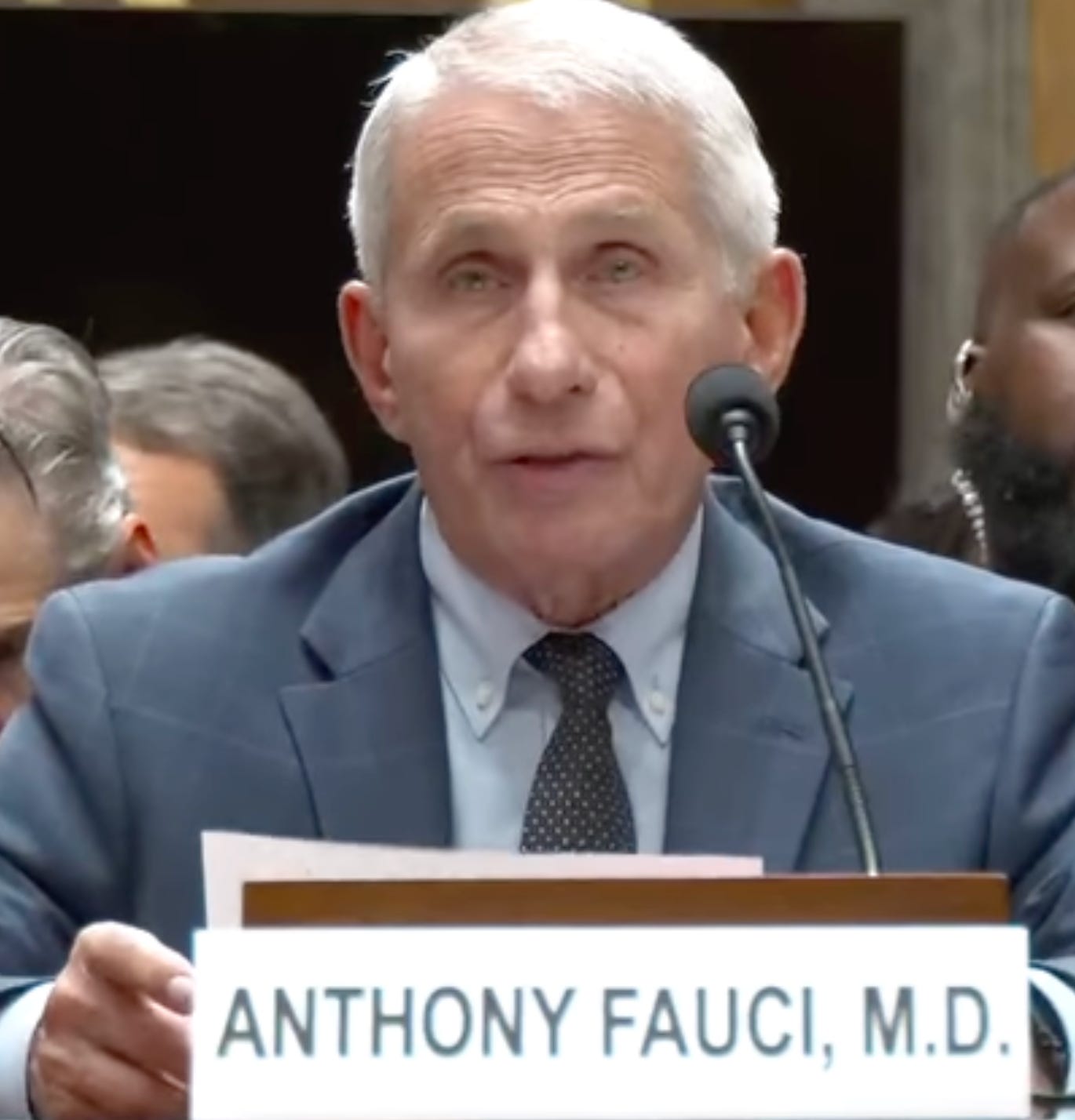
Dr. Anthony Fauci, the renowned physician-scientist who led responses to the AIDS epidemic and the COVID-19 pandemic, sat for a Senate committee hearing on Wednesday, supposedly about the origins of COVID-19. As malicious and, at times, odd accusations and dangerous, outlandish conspiracy theories rained down, Dr. Fauci had to invoke the Fifth Amendment over 100 times.
The COVID-19 pandemic has been handled miserably in the United States from the beginning, by multiple parties. This administration’s reckless, ongoing refusal to acknowledge that COVID-19 continues to pose a threat ensures that it remains one. The fixation on Fauci and COVID-19’s origin, likely a coordinated distraction tactic, continues to delay an end to the virus altogether.
And what better illustration of our times, really? The U.S. government has launched a full-fledged, grave attack on medicine, science, and the leading experts in both fields, while COVID-19, measles, cyclospora, and Legionnaires’ disease (to name just a few) spread across the nation, encouraged by public misinformation like the “Unvaccinated” trend on Twitter.
This should distress every American, regardless of political persuasion. Unless you have the luxury of blissful ignorance, that is. I lost that luxury when I lost pretty much everything.
I have endured two known COVID-19 infections, first in February 2021 and again in February 2024, and I continue to suffer from long COVID. I was a perfectly healthy person — fit, even — before the infections, but now have several COVID-induced chronic conditions that have reduced my functionality and zapped my quality of life. I haven’t had a symptom-free day since September 25, 2024.
The physical suffering from my body-wide, COVID-induced conditions is immense, but the true heartbreak is the mental and emotional toll of being made to feel like an alien.
Because society has decided to move on from COVID-19 (except for occasional hearings that do precisely nothing to further effective treatment or prevention), the burden falls on me to protect myself. I wear a mask in the rare instances I’m able to venture out, and people look at me and treat me drastically differently than before. Most of my relationships have been altered and, in some cases, broken. Some people aren’t sure what to say to someone who never gets better and can’t “go back to normal”; others have stopped reaching out altogether. And whenever another symptom-storm hits, I’m reminded that my own body feels alien, too. My body no longer feels safe. Nowhere feels safe.
Take it from me: It’s bizarre, demeaning, and devastating to watch people politicize and even joke about the virus that ravaged your body and ruined your life.
And it hurts.
It hurts that the government suppresses information critical to advancing research and protecting against COVID-19 infections. It hurts that people believe the lies. It hurts that people don’t care enough to participate in the basic social contract so that we all have access to a full life. It hurts to be left behind. It hurts to know that the people who are supposed to care the most about changing our fate evidently couldn’t care less.
It hurts when they treat immunology and epidemiology like new denominations in their Church of Delusion — because it affects all of us, even if it hasn’t affected you yet. It hurts to see examples of how easy this all could be. If only, if only, if only. It hurts for my present condition to be dishonestly framed in the past tense. It hurts to carry the knowledge that I, and millions of people who are similarly afflicted, are no closer to effective treatment than we would have been in 2021. If anything, the potential for relief is drifting further and further away.
These all double as things Dr. Fauci could have been questioned about legitimately. There are plenty of questions lacking definitive answers around a sterilizing vaccine, effective treatment, and air purification policies. His expertise and experience could be invaluable in the quest for improved public health. But the intent of his interrogation wasn’t to learn; it was to hypocritically harass and humiliate him.
At Wednesday’s wasted hearing, Sen. Bernie Moreno (R-OH), whose political career sprouted from outrage that a woman was arrested for refusing to wear a mask at a high school football game at the height of the pandemic, was among those who chose to score social media views by berating Dr. Fauci: “Who the f*ck do you think you were for doing that? It’s a total disgrace what you did to this country,” he said, later claiming that Fauci is “more interested in being a celebrity than saving American people,” which is ironic coming from someone actively clip-farming at the expense of the public.
It didn’t end there, what with the likes of President Donald Trump’s Truth Social post reigniting tired myths, Katie Miller falsely accusing Dr. Fauci of “weapon[izing] my pregnancy and child” because he merely suggested isolating while sick, and Sen. Tommy Tuberville (R-Alabama) grossly misplacing blame for COVID-19-induced death.
“This type of political theater is not going to help anybody because it’s not actually getting to the root of the issues here,” said Dr. Zachary Rubin, a pediatric allergist and immunologist viewing the spectacle. “We need to be looking at evidence and not trying to score political points.”
For the better part of the past decade, U.S. politics have been defined by an obsession with spectacle that supersedes devotion to public service. In the context of COVID-19, those skewed priorities resulted in excess deaths in red states compared to blue states. And while they continue to shout and shitpost, millions of people like me are exiled to the land of the invisible. Or, at least, that’s how they want the story to end.
“We are told by leaders that we are the future, but when it comes to the ongoing pandemic, our present is being stolen right in front of our eyes,” a then-nineteen-year-old Violet Affleck said in a speech at the United Nations last September, while wearing an N95 mask. “For adults, the relentless beat of ‘back to normal’ — ignoring, downplaying, and concealing both the prevalence of airborne transmission and the threat of long COVID — manifested in a series of choices.”
“We can recognize filtered air as a human right as intuitively as we do filtered water,” Affleck added. “We can create clean-air infrastructure that is so ubiquitous and so obviously necessary [that] tomorrow’s children don’t even know why we need it. We need the people who remember 2020 [...] to be loud about the world that we were promised at the onset of the pandemic, when we and our institutions promised each other that if we only got out of that desperate acute phase, we would do everything we could to protect our communities going forward.”
Ever since getting sick, I’ve thought often of my late uncle, an AIDS pioneer. He journaled incessantly. He wrote so much, it was as if he believed writing was his last shot at willing it true.
“Relax and calm down when attracted by fantasies that seem unlikely though possible — stop acting as if wishing them to happen should make them so — decide if you really want to expend some energy and risk failure for this.”
Finally, he wrote to the Assistant Secretary for Health in Washington D.C. on August 11, 1989: “I feel fairly sure, however, that I will probably die within the next few months without some form of anti-HIV treatment.”
He died five months later. He was a world-renowned radiation oncologist, and even he couldn’t save himself. He tried to positively-think his way out of it, a popular piece of advice regularly aimed at the long COVID community, and he died anyway. People did not stop dying of AIDS until it went from a taboo hot topic of gossip to a medical condition that demanded an effective treatment.
Then-President Joe Biden may have declared the pandemic over four years ago, but it cannot be over until COVID-19 is treated like nothing more and nothing less than a dangerous virus. It may be easier to pretend the pandemic was nothing more than a fever dream, but it’s still here. I’m still here. We’re still here.
Sham hearings that platform the loudest politicians and antagonists to compel doctors into silence are forums of cruelty. Instead of shallow soundbites delivered for supposed politicians to receive their moment in the spotlight, we deserve to hear the whir of air purifiers and a collective sigh of relief as COVID-19 is eradicated.
I have come to rely upon Matt Haig’s Notes on a Nervous Planet — more specifically, his passage on awareness, which reads, in part, “Illness has a lot to teach wellness.” But what if wellness refuses to listen to illness? What if those who are well believe that what happened to me can’t possibly happen to them? What if the expert is forced to invoke the Fifth Amendment?
Well, then, we have a choice. And we could choose to consider what my uncle wrote over three decades ago: “Stop acting as if wishing them to happen should make them so — decide if you really want to expend some energy and risk failure for this.” We can decide to care, risking failure in pursuit of collective prosperity. We can ask committees who choose to either call Dr. Fauci to the stand or grandstand on their own one simple question: Do you want to be on the right side of history?
Megan Armstrong is a freelance journalist, podcast producer, and perpetual content consumer. Her work has appeared in Billboard, Boardroom, Esquire, GQ, GRAMMY.com, NYLON, Teen Vogue, The Kansas City Star, The Hollywood Reporter, UPROXX, and elsewhere.
Dr Fauci is a hero & Health Secy RFK Jr is a dangerous nut job spreading anti-science falsehoods & misinformation: https://www.youtube.com/watch?v=VblRI0suQuM
Trump admin's corruption & incompetence is beyond shocking. If Trump’s corrupted DOJ can use fake evidence to frame any critic… https://www.northcountrypublicradio.org/news/npr/nx-s1-5886263/she-protested-ice-raids-then-agents-showed-up-at-her-door
Bring on a Blue Tsunami! https://www.youtube.com/watch?v=07EuAKSf2IU
This column speaks to me loudly. My husband died of the effects of covid and its destructive effect on his neuromuscular system. When I have mentioned this to medical personnel they have waved it aside as something that is already known, but if it's so well-known why haven't we been more proactive in controlling it?