


My pop music-obsessed seven-year-old daughter recently made a playlist on my iPad. Along with a slew of recent hits from female pop stars identifiable by their first names—Taylor, Billie, Dua, Chappell, Olivia, Sabrina—there was one major outlier: “Silver Springs” by Fleetwood Mac.
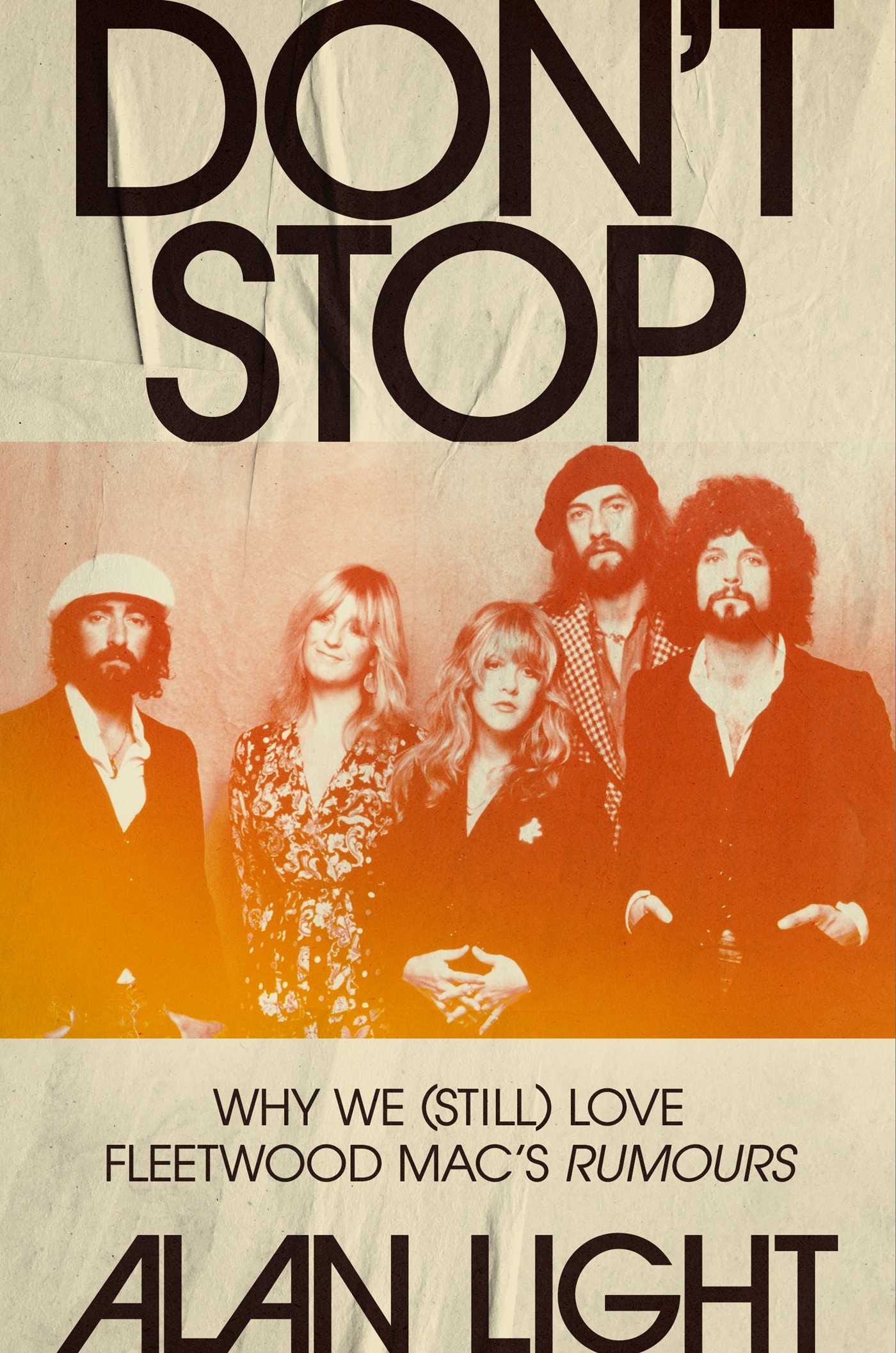
The fact that my second grader appreciates a song released 41 years before she was born is but one small example of a phenomenon Alan Light explores in Don’t Stop: Why We (Still) Love Fleetwood Mac’s Rumours.
The book examines the enduring popularity of the Grammy-winning album, which spawned four top-10 singles and has sold more than 40 million copies worldwide.
Yet unlike so many monster hits from the classic rock era that are now considered dusty, old Boomer relics as relevant as a rotary phone, Rumours continues to resonate with younger listeners and inspire artists in every medium. It’s on the Broadway stage (in thinly veiled form), in bestselling books, highly-anticipated documentaries. and TikTok trends. Somehow, a quintessentially 1970s album remains utterly ubiquitous in the 2020s.
“It really is extraordinary and—I’m scared to say—unprecedented what the continuing afterlife, momentum, popularity, and legacy for this album is,” said Light in a recent chat over Zoom with The Contrarian. “Forty-eight years after its release, Rumours is in the top 20 of the album chart, in the mix with Taylor Swift and Bad Bunny. It was number 14 on the album chart about a month ago. The magic fairy dust seems to be holding up pretty strong.”
A veteran music journalist who served as editor-in-chief at Spin and Vibe, Light was a preteen when Rumours was released. Already obsessed with pop music. “It was one of the first albums that I bought back then when it when it came out,” he said. “I wasn’t reading Rolling Stone, yet I wasn’t deep in the soap opera of it, but it was a favorite from a young age.”
Ah, yes, the soap opera: it’s impossible to discuss the enduring popularity of Rumours without mentioning the legendarily messy circumstances under which it was made. During the studio sessions in Sausalito and L.A., Lindsey Buckingham and Stevie Nicks’ relationship was on its last legs. John and Christine McVie were in the middle of a divorce precipitated by his alcoholism while she was having an affair with the band’s lighting director. Meanwhile, Mick Fleetwood’s marriage to Jenny Boyd, whom he’d already divorced and remarried once, was falling apart for the second time. Yet instead of disbanding, the group pressed on, channeling their romantic disillusionment into some of the album’s most popular tracks, like “Go Your Own Way.”
Each chapter of Don’t Stop focuses on a track from the album, delving into its backstory and connecting it to a contemporary cultural phenomenon. Light talks to younger fans about their love for Rumours, and to writers, musicians, and content creators who’ve channeled it in their own work. The chapter on “Silver Springs,” for instance, looks at how the B-side, which wasn’t even included on the original album, has lived on thanks to a dramatic YouTube clip from the band’s 1997 special, The Dance, in which Nicks famously stared down Buckingham (a lethal gaze that inspired author Taylor Jenkins Reid to write Daisy Jones & the Six).
Light talked to us about about the surprisingly durable appeal of Rumours. The conversation has been edited and condensed for clarity.
What inspired you to write a book about this album and its continued popularity?
When my son was in high school, I noticed that his friends all had some relationship to this album, some awareness. It was just part of their lives in a way that was not true for anything else from the classic rock canon. Once I started moving from a hunch to looking at stats, I saw that it was the best-selling rock album, old or new, of 2024. Why does this continue to have a pulse in this way, when Born to Run, Led Zeppelin IV, Hotel California or any of its peers, are just considered ancient?
In the course of reporting this book, what’s the strangest or most unexpected way you saw Rumours resonating in the present day?
The most surprising thing for me was what these younger listeners were hearing and reacting to in this album. If you’re somebody who grew up with Rumours, it is so framed by the notion of anger. It tops every “greatest breakup album of all time” list. But when you talk to somebody who grew up many years after [its release], you realize they know that the band went on and made more records, that they broke up and came back together. Many of them looked at this record and said, “I don’t think of it as an angry record or a breakup record at all.” They found life lessons: You can have these relationships and they can fall apart, but life continues. That is really different from the way that it gets framed for those of us who lived through it.
There’s so much about Rumours and Fleetwood Mac that are not really “things” anymore, like rock groups with guitars and even the idea of an album. Are younger people nostalgic for something they never had?
I think the ‘70s aesthetic, the look and feel, the album cover, the clothes, are a big part of it. The cult of Stevie Nicks is also undeniable. I remember going to see Stevie a dozen years ago at the Beacon [in New York], and it was great. Ten years later, she’s headlining the Garden, she’s co-headlining stadiums with Billy Joel. It’s not like there was some big Stevie Nicks hit in those 10 years. What escalated her from selling out a 4,000-seat room to selling out an 18,000- seat room? I found this “Women in Rock” book that Rolling Stone did in 1997. There’s basically a paragraph about Stevie Nicks, and Christine McVie is not mentioned in the book. At that moment, they were almost written out of history. And yet, there’s been this crazy tidal wave resurgence around them.
So much of the contemporary pop music landscape is about diss tracks and songs full of Easter eggs that require prior knowledge of the artist and their personal life. How did Rumours influence that?
We don’t live in an album world anymore. But I think the things that still register as albums, whether it’s Taylor, Beyonce, Sabrina, or Olivia, they register because of the backstory, the narrative, the connection to something larger. Rumours is the blueprint for that.
There were younger people whom I spoke to [for this book], who were super into the Rumours lore, super into the backstory. And there were others who really weren’t. Some of them, interestingly, said, “I’m kind of annoyed by how much music now is taken over by that. I just want to listen to the songs. Leave me alone.”
Each chapter focuses on a song from the album. Did you find that any songs resonated more or less than the others?
It’s a funny bet constructing a book like that. You have to do 12 out of 12. For about half of the songs, it was super obvious [what to do]. “Dreams” is going to be the guy on the skateboard with the cranberry juice. “Silver Springs” is going to be Daisy Jones & the Six. The one that surprised me, for how much it resonated was “Never Going Back Again.” These kids all talked about the production of that song in Glee. That’s one of the small, quiet songs on the record. I didn’t expect as much enthusiasm around that one.
The consensus weakest track on the album is “Oh, Daddy.” With that song, from the name on down, people get a little squirrelly. For me, it was a chance to write about Mick Fleetwood, who is this crazy anchor figure and the glue keeping the band together through an insane roller coaster of a career. He made this absolutely inexplicable choice to invite Lindsey and Stevie into the band on a hunch [on the 1975 album Fleetwood Mac]. Nobody knew who these kids were. They were coming from completely different traditions and places.
You included a chapter on “Silver Springs,” which was cut from the original album and released as a B-side. How did you decide, for the purposes of this book, that it was officially part of Rumours?
As soon as they started making CDs with a longer running time, it was on the album. I would ask people, every one of them, “Is ‘Silver Springs’ on the album or not?” And your answer just depends where you come into the story. I think at this point, it has to be part of looking at this album, because of the TikTok stuff. It’s become an entry point for the album, which is a crazy, fluky thing for something that was a B-side of a single and didn’t fit [on the vinyl release].
Your book touches on some of the pop culture manifestations of Fleetwood Mac and Rumours, like Stereophonic and Daisy Jones. Why is this subject so appealing to storytellers?
Because the story is beyond comprehension. There are three different couples that are breaking up at the same time, all playing in the same band together, and they are committed to the sense that the music is more important than whatever else is going on. We’re not just going to walk away from it. What an incredible dramatic force that is. That’s staggering to think about. How can that not resonate?
Which song on this record do you skip and which do you play on repeat?
it really does change. If you have to distill it to the essence of any one song on there, I think “The Chain” is pretty undeniable. Here are all of the things about this band and about this album and about this sound. There’s no moment where I wouldn’t want to be listening to that. Skip-wise, I like “I Don’t Want to Know,” it’s fun enough. There’s nothing that I would want to take off, but I would probably say that’s okay [to skip]. I was talking with somebody [recently] about how totally weird “Secondhand News“ is as the opening song on this record. Every other album of that magnitude opens with a big mission statement: “Welcome to the Jungle,” “Hell’s Bells,” “Wanna Be Startin’ Somethin’.”
If you sat people down at the end of the 70s and said, “Okay, here are the biggest albums of the decade. It’s Born to Run, Dark Side of the Moon, Hotel California, Rumours. Fifty years from now, which album are kids going to listen to?” Not one person would have said Rumours. Nobody. They would say it’s a great pop record. It’s fun. But those others are serious statements that will live forever. But for the kids I spoke to, the fact that Rumours was not presented as holy scripture meant there could still be some sense of discovery around it.
I wonder how much that changing view of the album’s importance has to do with gender. Was it viewed as less important back then because the group had women in it?
The model of a band being four white guys with guitars and long hair is really outmoded. For listeners today, to see this group with these two women, both of whom are writers and singers, creates a very different model of what a band looks like. It’s the biggest-selling album in American history with majority female voices on it. Two-thirds of the songs are female-fronted and written. So I think that has led to a very striking shift in what the album means and how it’s received.
Every time Rolling Stone does their “Greatest Albums” list, it jumps 20 places. And everything else drops down. Everything else over time either gets replaced by something that’s cooler, or something else that gets discovered. I interned at Rolling Stone and we did the 100 Greatest Albums of the last 20 years for the 20th anniversary of the magazine. Rumours was on the list, but it was number 72 or something. The last time they did the list, it was at number 7.
Meredith Blake is the culture columnist for The Contrarian
Silver Spring is my absolute favorite Fleetwood Mac song.
I've always thought "Songbird" is the great underappreciated song from this album. Overshadowed at the time by all the big hits but a truly transcendently beautiful song and performance. Eva Cassidy did a nice cover in the 90s which brought it back into public consciousness but the original is my favorite.