


President Donald Trump invocation of the Insurrection Act of 1807 to send military troops to Minnesota, as he has threatened to do, would be unwise and illegal, but it is uncertain whether the Supreme Court would stop him from doing so. In December, the Supreme Court decisively rejected Trump’s efforts to federalize state National Guards and to use troops in an American city. But it left open the possibility of his doing this by using the Insurrection Act. If Trump carries through on his threat, courts should quickly declare this illegal.
There is a long tradition in the United States of the military not being used for domestic law enforcement. Military troops roaming cities is familiar in authoritarian countries, but not in the United States. Soldiers are trained for war, not for policing. Police offers are trained and expected to protect constitutional rights and to refrain from the use of deadly force; that, obviously, is not part of the military’s role.
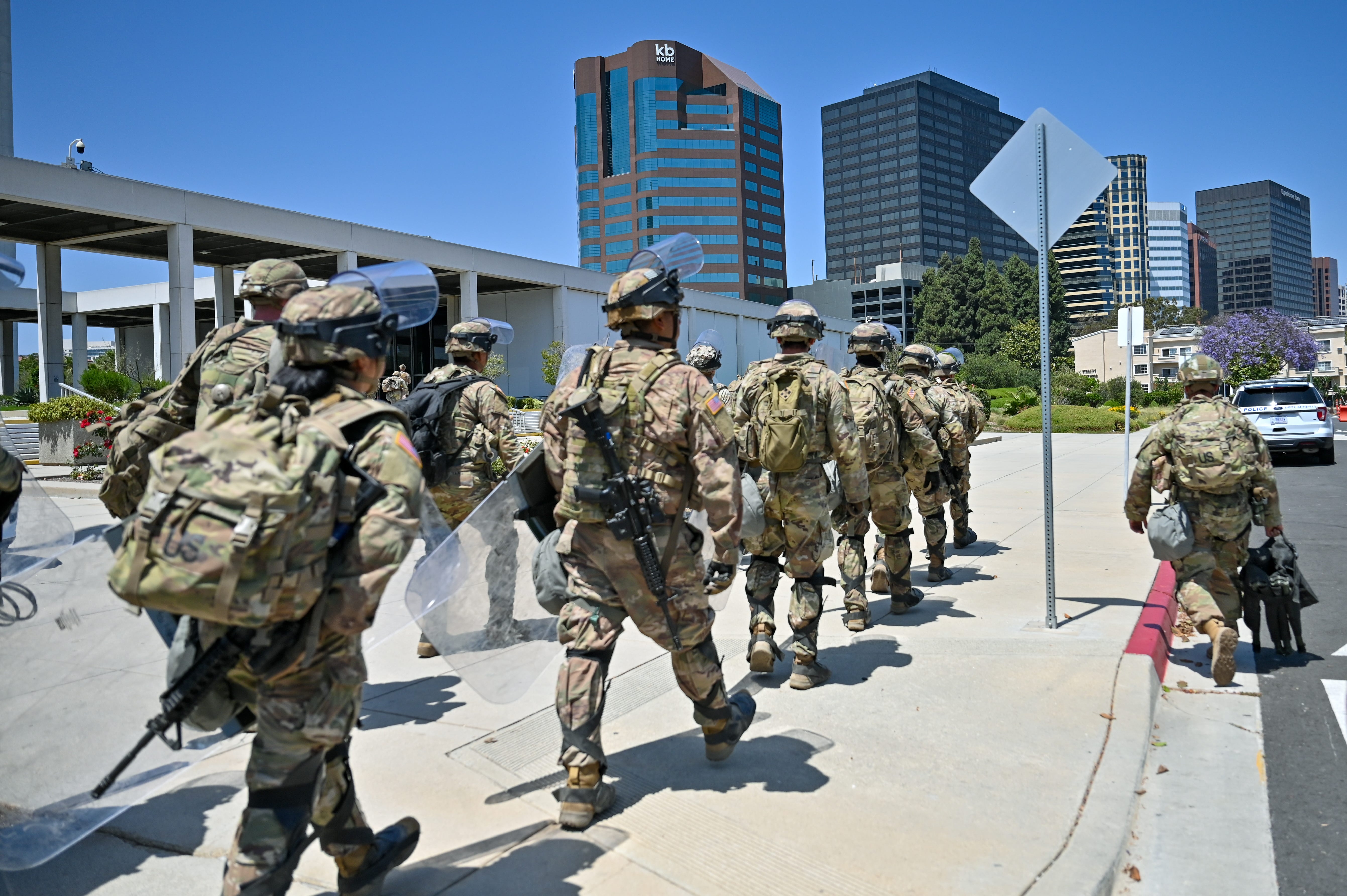
Trump broke this norm in June by federalizing California’s National Guard and deploying them along with marines to Los Angeles. He later tried similar actions in Portland and Chicago.
In Trump v. Illinois, the court ruled 6-3 on Dec. 23 that federalizing the Illinois National Guard was impermissible. The court explained that the federal law empowers the president to federalize members of a state’s national guard if he is “unable with the regular forces to execute the laws of the United States.” The Trump administration claimed it needed to federalize the Illinois National Guard, and similarly those in California and Oregon, because local police were unable to adequately protect immigration agents.
Whether this was needed was much disputed. In fact, federal courts found that there was no such need in Los Angeles, Portland, or Chicago. But the Supreme Court avoided that issue by saying that the statutory provision means that a president can federalize a state’s guard only if it can be shown that the regular forces of the United States cannot provide adequate protection.
This, in itself, is obviously a major limit on the ability of the president to federalize a state’s National Guard. It is hard to imagine situations in which the U.S. military would not be sufficient and would need to assistance of a state’s guard.
But the Supreme Court went even further. It said that for a president to federalize a state’s guard, the situation would have to be such that the U.S. military could be legally used but that it would be insufficient. Here, the court pointed to another federal law. The Posse Comitatus Act, adopted in 1878, prohibits the U.S. military from being used for domestic law enforcement except in very limited circumstances, such as when there is an insurrection in a state. The act makes it a federal crime to use the military within the United States except as expressly authorized by the Constitution or a federal statute.
In other words, the Supreme Court said that a president can federalize a state’s National Guard only in the rare circumstances where the Posse Comitatus Act allows the military to be used for domestic law enforcement and only then if the United States military would be inadequate. The court declared: “So before the President can federalize the Guard under §12406(3), he likely must have statutory or constitutional authority to execute the laws with the regular military and must be ‘unable’ with those forces to perform that function.”
Trump, if he wants to send the military to Minnesota, would say that the Insurrection Act is the statute that provides the authority required under the Posse Comitatus Act for the use of troops for domestic law enforcement. Indeed, the Insurrection Act is the only path the Supreme Court left open for Trump to use the military in cities.
But there is a strong argument that the requirements of the Insurrection Act are not met in the current situation. Under that law, as amended, the Insurrection Act can be invoked in only three situations. One is at a state’s request: If a state’s governor or legislature requests federal assistance to suppress an insurrection or domestic violence that the state’s authorities are unable to control. The Insurrection Act was last used in 1992, when then California Gov. Pete Wilson asked President George H.W. Bush to send troops to Los Angeles to quell riots after police officers were acquitted for beating Rodney King. In the current situation, Minnesota Gov. Tim Walz is not requesting the military; he is asking that federal Immigration and Customs Enforcement and Customs and Border Protection agents leave the state because of the violence they are engendering.
Second, the Insurrection Act can be invoked to uphold federal authority. It can be used when “unlawful obstructions, combinations, or assemblages, or rebellion against the authority of the United States” make it “impracticable to enforce federal law” or court orders through normal judicial proceedings. There is no claim now, though, that court orders through normal judicial proceedings won’t suffice.
Finally, the Insurrection Act can be used to protect the constitutional rights of its inhabitants against an insurrection, domestic violence, or conspiracy, and the situation obstructs federal law enforcement. This is Trump’s likely path for using the Insurrection Act. The last time the Insurrection Act was used without a governor’s request was in 1965, when President Lyndon Johnson invoked it to use the military to protect civil rights demonstrators in Selma, Ala.
This provision requires that the state be unable to protect the constitutional rights of its inhabitants. There is no showing that state and local police in Minnesota cannot adequately safeguard the constitutional rights of the people within the state.
If Trump tries to use the Insurrection Act in Minnesota, the governor and mayors of major cities are sure to sue and argue that he is acting illegally. They already have filed a lawsuit challenging the deployment of large numbers of ICE and CBP agents in Minnesota. Their lawsuit could be easily expanded to challenge the use of the Insurrection Act.
The greatest obstacle to their lawsuit would be a Supreme Court decision from 1827, Martin v. Mott, which said that under the Insurrection Act “the authority to decide whether the exigency has arisen belongs exclusively to the president.” But that cannot be right. The Insurrection Act limits the president to using the military in just three circumstances. It is the role of the court, as in all instances, to interpret the law and decide if the requirements are met. Otherwise, presidents could completely disregard the law and the statutory limits on the use of troops would be rendered meaningless.
Invoking the Insurrection Act would be truly extraordinary, as evidenced by it not having been used over 30 years. Its use in Minnesota is especially inappropriate because it’s the actions of the federal government—of immigration agents—that is leading to the unrest.
The hope must be that the situation in Minnesota deescalates before more lives are lost and people injured. Trump can do this by reducing the presence of immigration agents and stopping their aggressive actions. Invoking the Insurrection Act and sending in troops would have exactly the opposite effect of the law’s intent. It would exacerbate tensions and set a dangerous precedent for using the military in American cities.
Erwin Chemerinsky is dean and Jesse H. Choper Distinguished Professor of Law at the University of California Berkeley School of Law.

Trump knows how slowly lawsuits can achieve justice, and he does not care who sues him--particularly when taxpayers are funding the litigation. He uses the courts to gain time and advantage, full stop. That the supreme court will not acknowledge that makes their majority fully complicit in this underhanded tactic.
This is what happens when a malevolent sociopath pretends to president. Note how Mister is opening a fraud department while pardoning those convicted of fraud—as he was. The “department” will be used to drag his opponents into court and possibly prison.
If we're counting on the Roberts Star Chamber to save us, we are in deep trouble.