

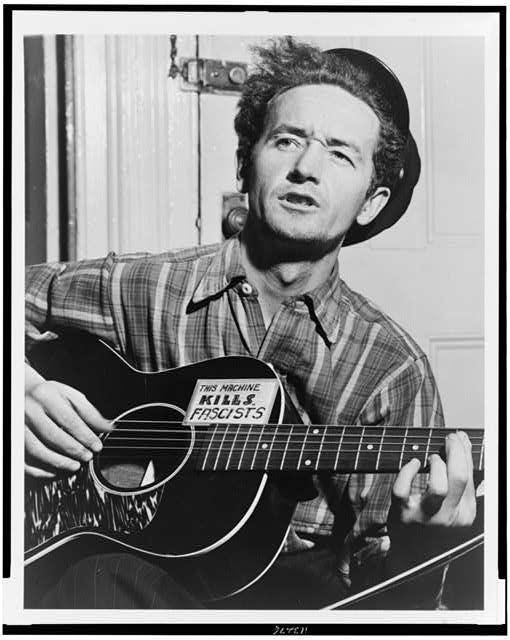
By Alan Light
At Barack Obama’s first inauguration in 2009, Bruce Springsteen was joined by Pete Seeger for a performance of “This Land is Your Land.” Springsteen later recalled asking the folk icon how he wanted to approach the song; “All he said was, ‘Well, I know I want to sing all the verses, I want to sing all the ones that Woody wrote.’”
And so, when their time came that frigid day, the two musicians—backed by a choir, and leading a singalong—made sure to include several verses of Woody Guthrie’s anthem that you probably didn’t learn in school:
A great high wall tried to stop me
A great big sign said, "Private Property"
But on the other side it didn't say nothing
That side was made for you and me
A historic new collection of Guthrie material comes out today, and it includes yet another version of “This Land.” This one is less directly political, more focused on navigating the country’s outdoor wonders (“I’m gonna chase my shadow/All across this roadmap”). The revelation, though, is how America’s archetypal folksinger continually worked and reworked his material, searching for truth.
The new album, Woody at Home—Volume 1 &2, contains 22 previously unreleased recordings that Guthrie made at his family’s Brooklyn apartment in 1951 and 1952. Some are entirely unfamiliar songs; others are new renditions of landmark compositions like “Pastures of Plenty” and “Jesus Christ.” These tapes were made when Guthrie didn’t have a record deal but had signed with a new publishing company, TRO, which sent him a cutting-edge two-track recorder so he could deliver them songs to pitch to other artists.
Most notable is Guthrie’s only known recording of his original song “Deportee (Plane Wreck at Los Gatos)." It was written in 1948 in response to a New York Times article about a plane crash in Los Gatos Canyon, California, that killed 32 people, including 28 migrant farm workers. Guthrie’s insistence on humanizing the victims (news reports named the American crew members but referred to the Mexicans only as “deportees”) is startling for its empathy and current, prescient relevance.
Other songs on Woody at Home touch on racism (“Buoy Bells from Trenton,“ about the case of the Trenton Six, Black men convicted of murder in 1948 by an all-white jury), and combating fascism (“I’m a Child Ta Fight”). Some are barely sketches, while others (“Backdoor Bum and the Big Landlord”) are a bit overdone and obscure. Throughout, Guthrie sings quietly, feeling his way to the right tempo and rhythm.
The home recorder was a perfect device for a writer as obsessive as Woody Guthrie, who composed over 3,000 song lyrics in his life. As Joe Klein put it in his monumental 1980 biography Woody Guthrie: A Life, “he seemed to write the way other people doodled—mindlessly, easily, compulsively.” This compilation conveys that if he had a thought or heard a story or saw something interesting, he turned it into a song.
Nor was a lyric ever permanently finished, even after it had been recorded. “I have never yet put a song on tape,” Guthrie says in one interlude, “that I really thought was a through and finished and a done song and it couldn’t be improved on, couldn’t be changed around, couldn’t be made better.” Elsewhere, he adds that “all of these things are highly gear-shiftable.”
It’s an attitude that applied to his politics, as well. Though Guthrie’s anti-fascist, pro-union beliefs never wavered, his alignment with the Communist Party (he was never a member) dialed up and down, particularly as World War II unfolded and America’s role evolved.
In all, Guthrie sent 32 tapes with more than 300 songs to TRO before the end of 1952. These turned out to be the last recordings he ever made. In July 1952, he was admitted to Brooklyn State Hospital, and, after receiving a diagnosis of Huntington’s chorea (a disease inherited from his mother), he spent his final decade in and out of hospitals before his death in 1967.
As dramatized in last year’s film A Complete Unknown, it was in this final period that Bob Dylan made his way to New York and fulfilled his dream of meeting Guthrie. Guthrie was “the starting place for my identity and my destiny,” Dylan wrote in his 2004 memoir, Chronicles, Volume One. “When I first heard him, it was like a million megaton bomb had dropped on my head.”
What we hear on Woody at Home, though, is that Guthrie’s intentions weren’t anything so dramatic. He set out to tell stories he thought were important, to resist oppression and greed, to use songs as a way to sort out his feelings and ideas, and to build connection.
“The worst thing that can happen to you is to cut yourself loose from people,” he once wrote. “And the best thing is to sort of vaccinate yourself right into the big streams and blood of the people.… There is just one way to save yourself, and that’s to get together and work and fight for everybody.”
Music journalist and author Alan Light is the former editor in chief of Vibe and Spin magazines and a former senior writer for Rolling Stone. A frequent contributor to the New York Times and Esquire, he co-hosts the music news podcast Sound Up! Alan's next book, “Don't Stop: Why We (Still) Love Fleetwood Mac's Rumours,” will be published in November.
"There is just one way to save yourself, and that’s to get together and work and fight for everybody.”
Thank you for this piece. We sure could use a modern day Woody Guthrie.
Pete Seeger did American folk music and protest songs. Those were two of his genres. He wrote the concluding line to Turn Turn Turn made famous by the Byrds. A time for peace I swear it’s not too late.