


“Iran has agreed to never close the Strait of Hormuz again,” Donald Trump declared on Friday. The same day, he announced Iran had “agreed to everything” — even the removal of its enriched uranium. But, to the surprise of no one who appreciates that Iran does not abruptly forfeit its considerable leverage, Iran agreed to no such thing. On Saturday, Iran closed the Strait of Hormuz and fired on two ships. Chances are increasing that Iran won’t agree to much of anything.
Trump lacks skills essential in high-stakes negotiation (grasp of details, understanding of what his opponent needs, appreciation of his opponent’s leverage, awareness of his limited military options, and patience). His equally ill-equipped negotiators — Steve Witkoff and Jared Kushner — seem hopelessly outmatched by the savvy, experienced Iranian negotiators. The Americans show no appreciation for the time, attention to arcane technical detail, tenacity, and hard work it takes to craft even a temporary arrangement.
Moreover, with the Strait of Hormuz under Iranian control, Iran maintains the ultimate bargaining chip (which it played on Saturday) — the ability to open and close the Strait at will and extract tolls from ships seeking passage. (Neither side bothers to mention Iran’s missile program or support for regional terrorist groups, items that Trump once demanded must be part of any deal.)
Trump’s habitual lying about the status of negotiations might be pure market manipulation. (Indeed, the stock market soared on Friday based on Trump’s lies. When will traders learn?) Alternatively, given how comically oblivious he is to his own lack of credibility, Trump may think his imaginary “agreements” put some sort of pressure on Iran to match Trump’s exaggerated claims. The most frightening explanation: Based on snippets of TV coverage and happy talk among his sycophants, Trump may actually believe that Iran is acceding to his demands.
He has no doubt become accustomed to spewing lies to the American press, confident that right-wing media will clean up any discrepancies, while legacy media won’t say flat out that he is lying. Iran does not play along. Instead, the Iranians seem to delight in calling out his lies. On Saturday, the Washington Post reported:
“The President of the United States made seven claims in one hour, all seven of which were false,” chief Iranian negotiator Mohammad Ghalibaf wrote on X late Friday. “They did not win the war with these lies, and they will certainly not get anywhere in negotiations either.”
“Media warfare and engineering public opinion are an important part of war, and the Iranian nation is not affected by these tricks,” Ghalibaf said, adding: “With the continuation of the blockade, the Strait of Hormuz will not remain open.”
A Foreign Ministry statement, posted by state broadcaster IRIB, said: “The Americans talk excessively and create noise around the situation. Do not be misled! There is no new agreement.”
When the Iranians sound like Daniel Dale, CNN’s master fact checker, one must grudgingly acknowledge they are more credible than the Trump regime. Trump, deep into self-delusion, insists Iran’s debunking is simply catering to its domestic audience! He simply will not accept “no” as an answer. So desperate to avoid the economic calamity he unleashed and his plunging poll numbers, his fictional agreements amount to magical thinking (arguably, another sign of his raging narcissism and mental decompensation).
Trump continues to make several fundamental errors, all of which reinforce the Iranians’ view that if they hang tough, Trump will eventually walk away from his pie-in-the-sky demands, maybe even lift sanctions if Iran reopens the Strait of Hormuz. (Yes, that would also be a catastrophic blunder, since after weeks of war, Iran would have obtained the economic relief it desperately wants simply by returning to the pre-war status quo on the Strait of Hormuz.)
First, Trump may be convinced his lies are some clever maneuver to box in the Iranians. To the Iranians, his fantasy deals signal his desperation to reach a deal that he can tout. They could reasonably conclude that to prevail on key issues (e.g., keep its enriched uranium and missiles, gain sanctions relief, achieve diplomatic recognition of a regime led by leadership as fanatical as its predecessor), all they need is some gauzy window-dressing to keep Trump happy.
Second, Trump inadvertently helps the regime gain credibility with its people. Sending Secretary of Defense Pete Hegseth to throw around threats and spout fire and brimstone only convinces Iranians that their despotic government is the only thing standing between them and obliteration. Likewise, Trump’s casual references to returning to his military campaign of civilian destruction (i.e., war crimes) cement Iranians’ conviction that the U.S. poses an existential threat to their country. For this reason (and its experience with decades of war and sanctions), Iran’s ability to absorb economic pain surely exceeds Americans’ willingness to tolerate high gas prices.
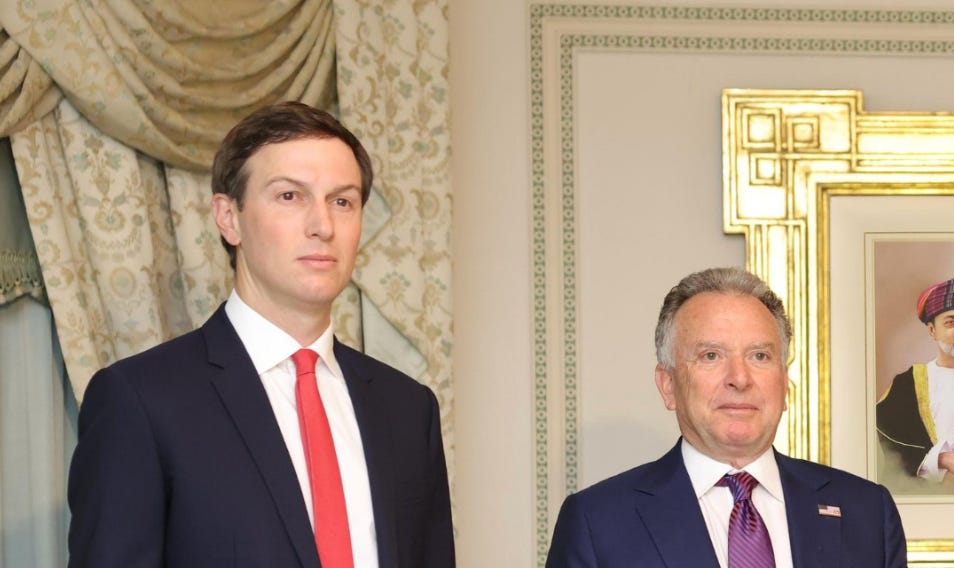
Third, each time Witkoff and Kushner enter the negotiation room, the Iranians must breathe a sigh of relief. The Iranians know the pair lack the background, knowledge, and patience to negotiate a deal that would actually bind Iran to any real restrictions. Any abbreviated “deal sheet” will leave plenty of room for Iran to drag out “technical” negotiations for months, if not years. Empty statements, like “Iran won’t pursue a bomb” (which are identical to the sort of vague promises Iran has made for years), may impress Trump and his negotiators — but the Iranians know it is pure fluff. As with every other policy issue, Trump does not much care what is in the “deal,” so long he can claim he made one. The Iranians undoubtedly have caught on.
In sum, whenever Trump says Iran “agreed” to some amazing concession, you can bet it hasn’t (especially if Trump attaches a telltale absolute that signals he is fabricating: “never,” “everything,” “totally”). As time goes on, the likelihood that Iranians will agree to nothing (or merely approve a list of meaningless generalities) increases. It is certainly reasonable for them to bet Trump will simply pack up and go home rather than restart a hugely unpopular war.
The Iranians won the war by surviving, inflicting damage on its neighbors with cheap drones, and capturing the Strait of Hormuz. They are not about to forfeit their victory to feckless, deluded Americans led by a compulsive liar.
We have many wise negotiators in our country that would have far better success with the Iranians. Unfortunately none of them are members of the official cult. Obama had a deal and Trump trashed it.
It’s a sad state of affairs when the American people believe a foreign government over its own.