


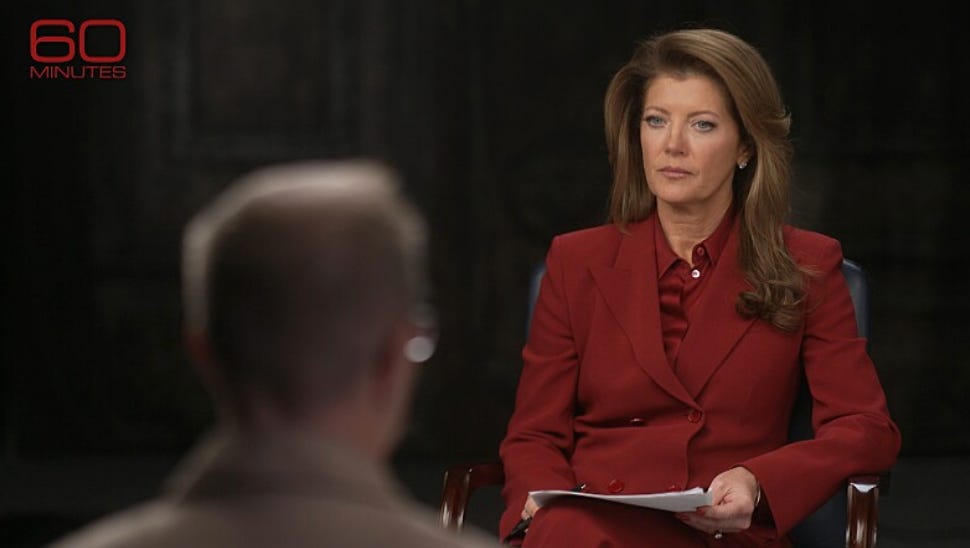
The 59th season of 60 Minutes premiered on CBS Sunday night, three and a half months after a slew of top producers and correspondents, including veteran Scott Pelley, were fired by the network’s controversial editor-in-chief, Bari Weiss.
The bloodbath — which came to be referred to internally as “Black Thursday” — threw the future of the county’s most-watched news program into serious doubt as seasoned journalists with decades of institutional knowledge were replaced by TV neophytes with scant qualifications. Several axed correspondents, including Pelley, Sharyn Alfonsi, and Cecilia Vega, have accused Weiss of attempting to insert political bias into the program. Despite little TV or reporting experience, Weiss was hand-picked by David Ellison to lead the network’s once-esteemed news division last year.
The best that can be said of the new, Weissified 60 Minutes is that the premiere made it to air, which was not a foregone conclusion. According to Pelley, an episode last season came within minutes of missing the deadline for broadcast because of Weiss’s meddling. Superficially, the show mostly looks the same, with a few minor tweaks to the graphics as the only visible signs of the new regime at CBS.
Likewise, when it came to the substance of the broadcast — the reporting — the show maintained a veneer of plausibility, featuring a mix of hard news, investigations, and personality-driven journalism.
But editorially speaking, the broadcast is already showing signs of a rightward shift.
This is not to say that 60 Minutes was ever some “woke” bastion (as I wrote in June, it decidedly wasn’t) or that it has veered into blatant, Fox News-style propagandizing (yet).
But the lead story, Norah O’Donnell’s much-touted interview with an Air Force officer whose plane was shot down in Iran in April, was an undeniable puff piece masquerading as a major scoop.
In the 13-minute segment, the officer, known only as “Bravo” to protect his identity, recounted his ordeal in detail. He told O’Donnell about free-falling into rugged mountainous terrain when his parachute failed, breaking his back and arm as he fell to the ground at 70 miles (or more) per hour, and waiting for more than a day to be rescued by an elite special operations team. Bravo repeatedly framed the mission in religious terms, describing his rescue as a “modern-day miracle” and his survival as “a testament to God’s provision in my life.”
The piece also featured interviews with Adm. Brad Cooper and defense secretary Pete Hegseth. O’Donnell, who was recently promoted to correspondent at 60 Minutes, opted not to ask either man about the dubious rationale for the war in Iran or its already devastating human toll (which the Pentagon has sought to downplay). Instead, she lobbed a vague softball at Hegseth, asking him what went through his mind when he heard the plane had been shot down.
“Whether they’re alive or not, we’re gonna go get them,” he replied.
In her intro, O’Donnell briefly noted that the war has been “costly and unpopular” and has cost 18 American lives, but otherwise her report did not offer a critical perspective on the conflict that has so far killed thousands of Iranians.
The story served no purpose other than bolstering the military’s image and countering the perception that Hegseth has little concern for the well-being of ordinary service members and is stoking needless internal tension at the Pentagon. It allowed him to play the role of a decisive, competent leader on TV and to spin this debacle of a war as a rousing success worthy of a Hollywood adaptation (which, apparently, is already in the works).
More substantive was Lesley Stahl’s report on the growing phenomenon of “pardon brokers,” consultants who claim to be able to help people seeking clemency from the president — for a hefty fee. In hidden camera footage, Jacob Wohl and Jack Burkman, two self-described pardon brokers, told Ammon Covino, a man convicted of illegally transporting animals across state lines, that he could obtain a pardon for $300,000.
Stahl’s piece did not exactly break new ground — Trump’s record of pardoning donors, allies, insurrectionists, and sycophants has been reported on widely, and Wohl and Burkman are well-known MAGA grifters — and it’s not clear that the hidden-camera gimmick added much value to the report. But it was appropriately critical of the administration and its craven lenience toward, as Stahl put it, “unrepentant financial con men.”
The most jarring moment of the broadcast was the debut appearance by Ross Douthat, the conservative former New York Times columnist who was hired as a correspondent in July (even though, much like Weiss, he is an opinion writer with zero TV experience). In a segment called “The Last Minute,” sponsored by United Health, he expounded about artificial intelligence — a vast, thorny subject that cannot be summed up in a 60-second monologue.
“No story looms larger than the latest developments in artificial intelligence,” he intoned. “We may have a narrow window this year, not the next 10, to make artificial intelligence safe for humanity. That clock is ticking, and so is ours. For almost 60 years, it has meant the same thing: journalism you can trust. Where we’re headed, we’re going to need it.”
It was more than a little confusing: Was Douthat trying to make an argument about the dangers of A.I.? Or perhaps teasing coverage on the subject yet to come? It was unclear. Whatever message Douthat was trying to convey got lost in the sheer awkwardness of the scene.
With a face made for radio and a voice made for print, Douthat looked undeniably out of his element at 60 Minutes. Perched precariously on a stool, his hands folded between his legs, Douthat read a script from a teleprompter that (ironically) sounded like it had been written by ChatGPT. His brief but cringy debut is further evidence that Bari Weiss might have a knack for churning out “anti-woke” hot takes that appeal to the Sun Valley crowd, but she fundamentally misunderstands television.
Stahl and fellow correspondents Jon Wertheim and Bill Whitaker released a joint statement in June saying they would return to the show because “we don’t want to see ‘60 Minutes’ die.”
“If we can continue doing the work that made this show what it is — committing acts of independent, fearless journalism and storytelling — we’re here for it. If not, we leave,” it read.
60 Minutes might not be dead yet, but the pulse is growing faint.
Meredith Blake is the culture columnist for The Contrarian
Father Ross has always been an opportunistic and not very bright light whether he was at the NY Times or now on 60 Minutes doing a sort of Andy Rooney bit at the end. I no longer watch the program and I found myself mentally retching whenever I would read Douthat in the Times.
I have not watched “60 Minutes” since Scott Pelley was fired. I have no intention of watching as long as the Ellisons and Bari Weiss are in control.