


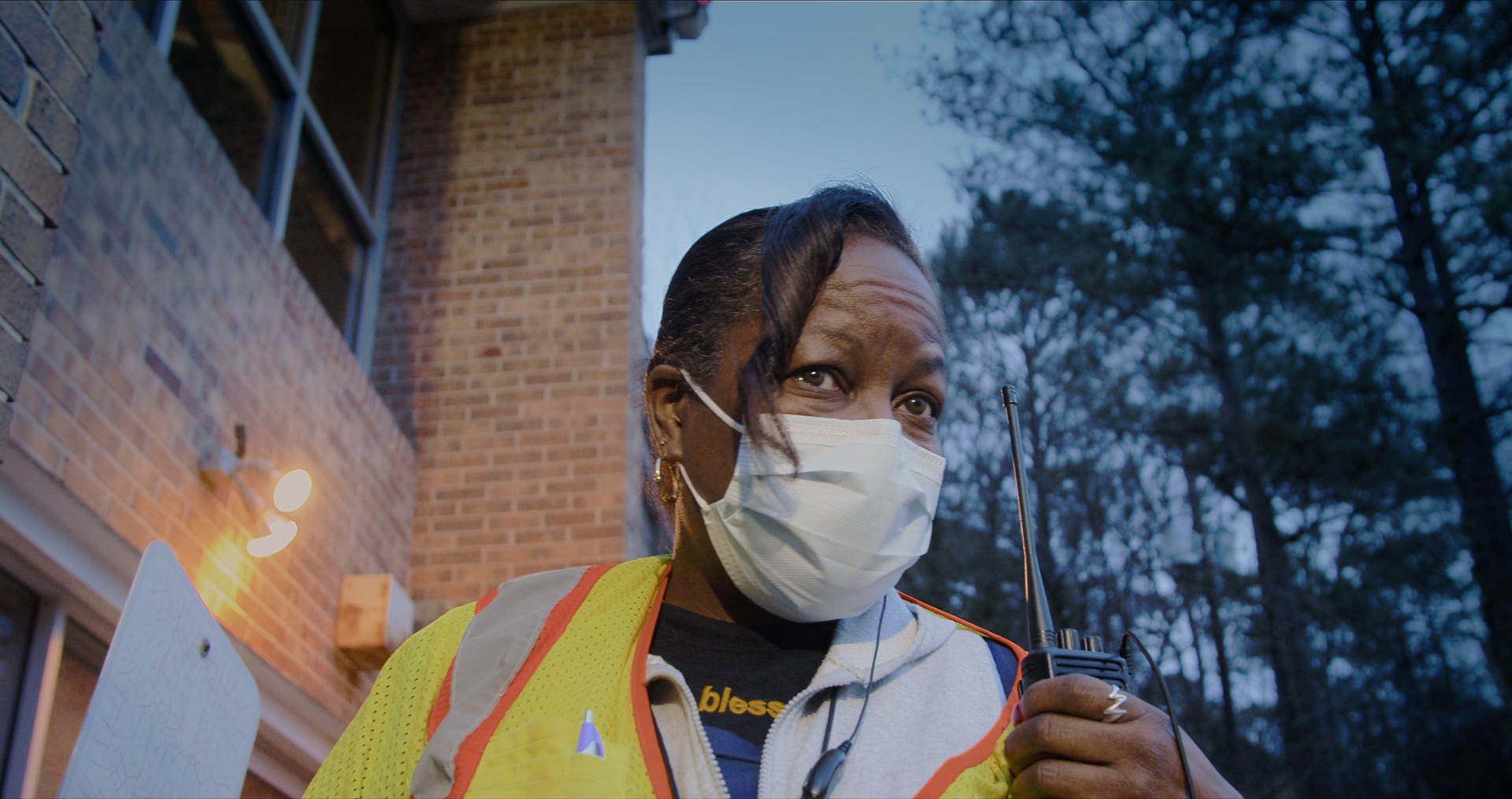
Tracii’s day begins early — before dawn. She arrives at work, turns on the lights, and thoroughly searches the building for intruders. Then she checks outside, where it’s still dark, making sure no one is hiding in the woods or behind a dumpster.
Tracii is the head of security at an abortion clinic in Atlanta, and is also the subject of the Oscar-nominated documentary short, The Devil is Busy. Directed by Christalyn Hampton and Geeta Gandbhir, the film follows Tracii over the course of a long, stressful day at the clinic, as she works tirelessly to ensure not just the safety but the comfort of the women seeking care. (Neither her last name, nor the name of the clinic, gets mentioned in the film.)
Over the constant din of megaphone-wielding protestors, Tracii calmly helps the patients check in. She assures the “guests,” as she likes to call them, that they’re in good hands and provides them with snacks and water, since many have driven overnight to get there. Occasionally, she has to turn women away because they’ve arrived too late. In Georgia, which has one of the most restrictive policies in the nation, abortion is banned after six weeks. (Women there have died after being denied reproductive healthcare.)
Available to stream on HBO Max, The Devil is Busy is a compelling portrait of a deeply compassionate woman on the frontlines of the abortion war. It packs a lot into 31 minutes, exploring not just the precarious status of abortion care post-Roe v. Wade, but also the fraught intersection of race, religion, and women’s health.
Executive producer Soledad O’Brien said the project originated several years ago. As it became increasingly clear that the Supreme Court was going to overturn the historic ruling guaranteeing the right to an abortion, she and the team at her production company began to think about ways of covering the potential ramifications.
“What would be the story that we would want to tell about the aftermath of the end of Roe v. Wade?” she recalled in a recent Zoom chat.
Hampton, who was working in Atlanta, soon identified Tracii and her colleagues as ideal subjects. “Once I saw the dynamics with the protesters and how Tracii managed her team, I felt like there was a story we could tell,” said Hampton, who spent time at the clinic getting to know the women and their routine before filming began. She was impressed by “how caring and sensitive everyone was.”
O’Brien also found Tracii deeply compelling. “You could watch her eat cereal,” she said. “She doesn’t shy away from anything. She doesn’t couch her language. She’s never checking to see what you want to hear.”
After preliminary research at the facility in 2022, Hampton returned in 2024 for an intense day of shooting. By that time, Roe had been overturned and 25 million American women were living in states with abortion bans or severe restrictions. As a result, there was a discernible shift in the atmosphere at the clinic, with more women traveling from places like Texas and Tennessee, and more getting turned away because it was too late.
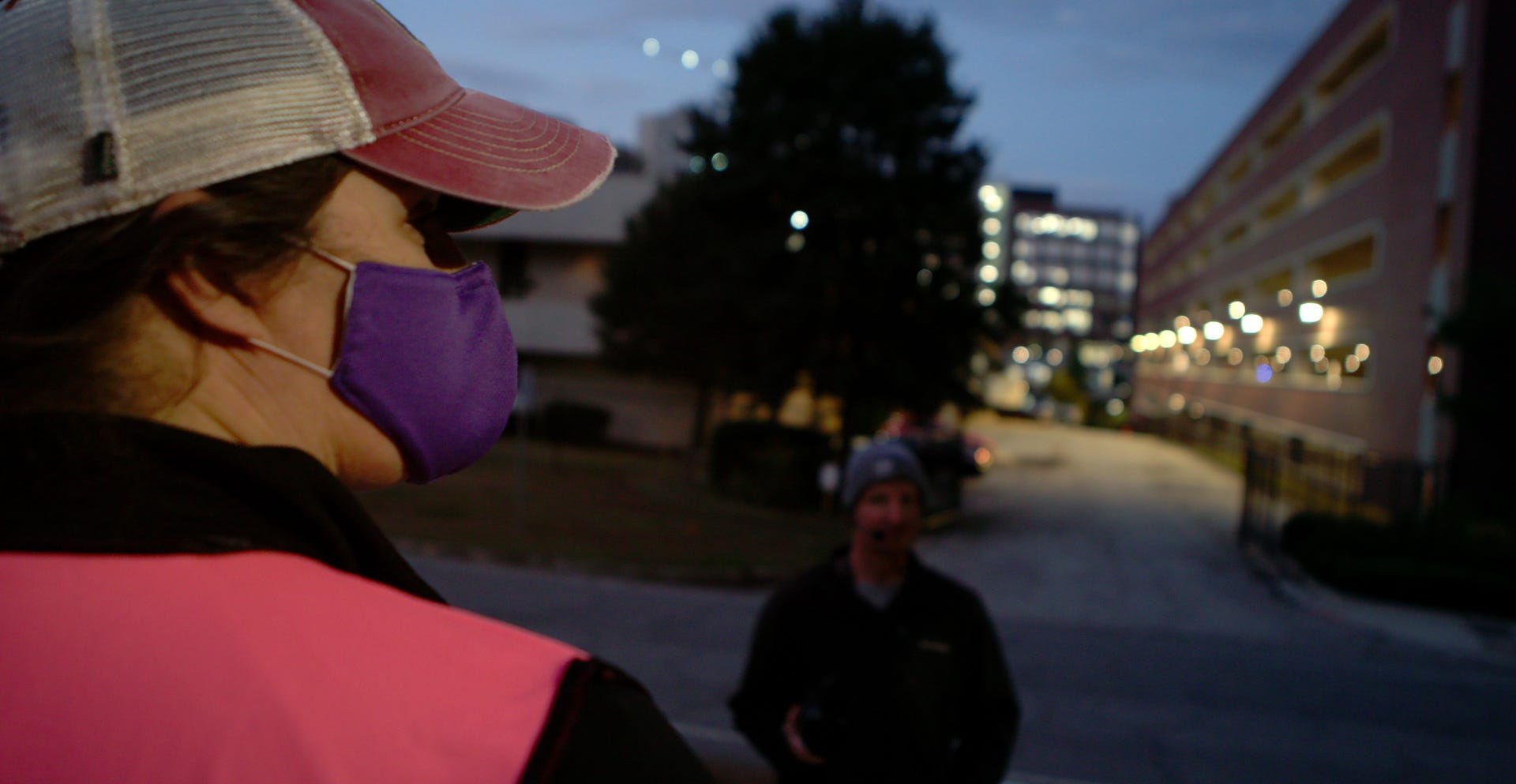
The sense of ever-present danger was very real, Hampton said. “You definitely feel it, because the energy of the protesters is so aggressive… As Tracii says, you have to keep your head on a swivel.”
While most of the employees at the clinic, including Tracii, are Black, seemingly all the protestors are white men, and they use language co-opted from Black Lives Matter as a rhetorical weapon against abortion rights (e.g., a crass sign with a fetus saying “I can’t breathe.”) The documentary reveals that one of the protestors served time in prison for setting fire to a Black church. (But God forgave him for that, or so he claims.)
“You get a very clear sense of the hypocrisy of the debate,” said O’Brien, noting that any time she has done a piece on an abortion clinic, “race is very much intertwined into that story and used as leverage.”
Religion also plays out in surprising ways in the film. While the protestors constantly invoke God and Jesus (“God’s knitting that child together in your womb right now,” one of them shouts), Tracii begins and ends every day with a prayer. She describes her work in almost spiritual terms, saying that her mission is to make every guest feel loved and valued: “That’s the way God blesses me; so that I can bless other people.”
“I rely very heavily on my faith while I’m here,” she says, “because the devil is busy out there.”
O’Brien likes the way the film subverts expectations about religious people and their views on abortion. “It was such an interesting twist to talk very thoughtfully about religion with a deeply religious person who’s also very committed to helping the women in this clinic,” she said.
The title, inspired by Tracii’s quote, is meant to be ironic.
“A lot of people, if they saw the title The Devil is Busy, would think it was about the women in the clinic,” Hampton said. “But we’ve been able to turn that mirror around and say, look at what these [protestors] are doing. Look at how they’re weaponizing and using race and sex against the women who come in here for healthcare services.”
The filmmakers hope that The Devil is Busy brings attention to people like Tracii and the other employees at the clinic, who provide essential services (in addition to abortion).
“People don’t think — or don’t know — that these clinics also provide pap smears and mammograms,” O’Brien said. “So when these clinics disappear or go out of business, understand that all this healthcare for women goes with it.”
“We really do have to get past ‘the A-word,’” said Hampton, “so [clinics] can continue to provide the healthcare that women in these underserved communities need.”
O’Brien has been busy this Oscar season: She also produced this year’s Academy Award-nominated documentary feature The Perfect Neighbor, which looks at the shooting of an unarmed Black woman in Florida by her white neighbor (and was directed by Gandbhir).
Despite the gloomy state of the journalism industry and the documentary marketplace, O’Brien remains optimistic about telling important, politically-charged stories.
“It’s been a very challenging time for [projects] about social issues, and yet, two of the projects that we’re doing are literally about social issues around Black people,” she said. “I like doing this work, and we’re going to continue to do this work and find the places and the people that want to help us do it.”
Meredith Blake is the culture columnist for The Contrarian
As a now retired after working as an OB/Gyn for 34 years I applaud this movie. I would also like to suggest another topic. The fact that the maternal death for white women in Texas increased over 90% and for black women 56% the year after SCOTUS Dobbs ruling. People often tell me when I discuss abortion that they are pro life. I say so am I. I am for the mothers life!
Meredith, thank you so much for another compelling story. It's amazing what supposed "religious" people (men) do to women in need and their healthcare.