


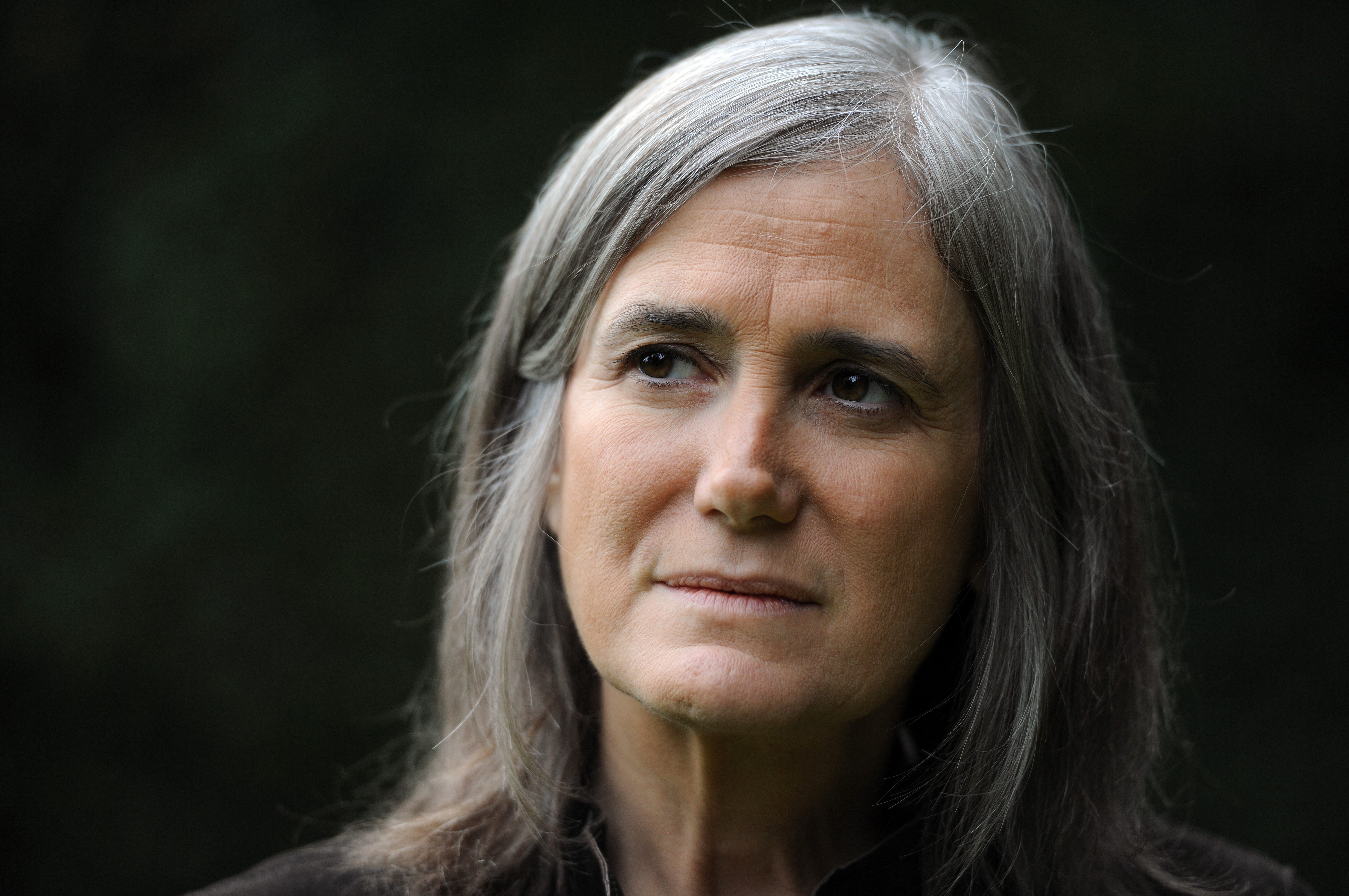
Last month, Amy Goodman hopped on a last-minute flight from Mexico City to Los Angeles to attend the Academy Awards in support of Armed Only With a Camera: The Life and Death of Brent Arnaud, an Oscar-nominated short documentary about a former colleague who was killed in Ukraine. She showed up at the Dolby Theatre in casual attire, and immediately caught the attention of a sharply-dressed man in a three-piece suit.
“He yells to me across the room, ‘You are brave!’” Goodman recalled recently. “And I said, ‘Oh, thank you. Do you know Democracy Now?’ And he said, ‘What’s Democracy Now? I’m talking about what you’re wearing.’”
“Within an hour,” she says, “ I hightailed it out of there in my high-tops.”
Goodman is not usually the type to hightail it out of anywhere, no matter how hostile the terrain. The host and executive producer of Democracy Now! has spent the last three decades asking tough questions of those in power, from oil executives in Nigeria to chronically evasive White House officials. Her fearless work as a journalist is now the focus of Steal This Story, Please!, a documentary currently in select theaters.
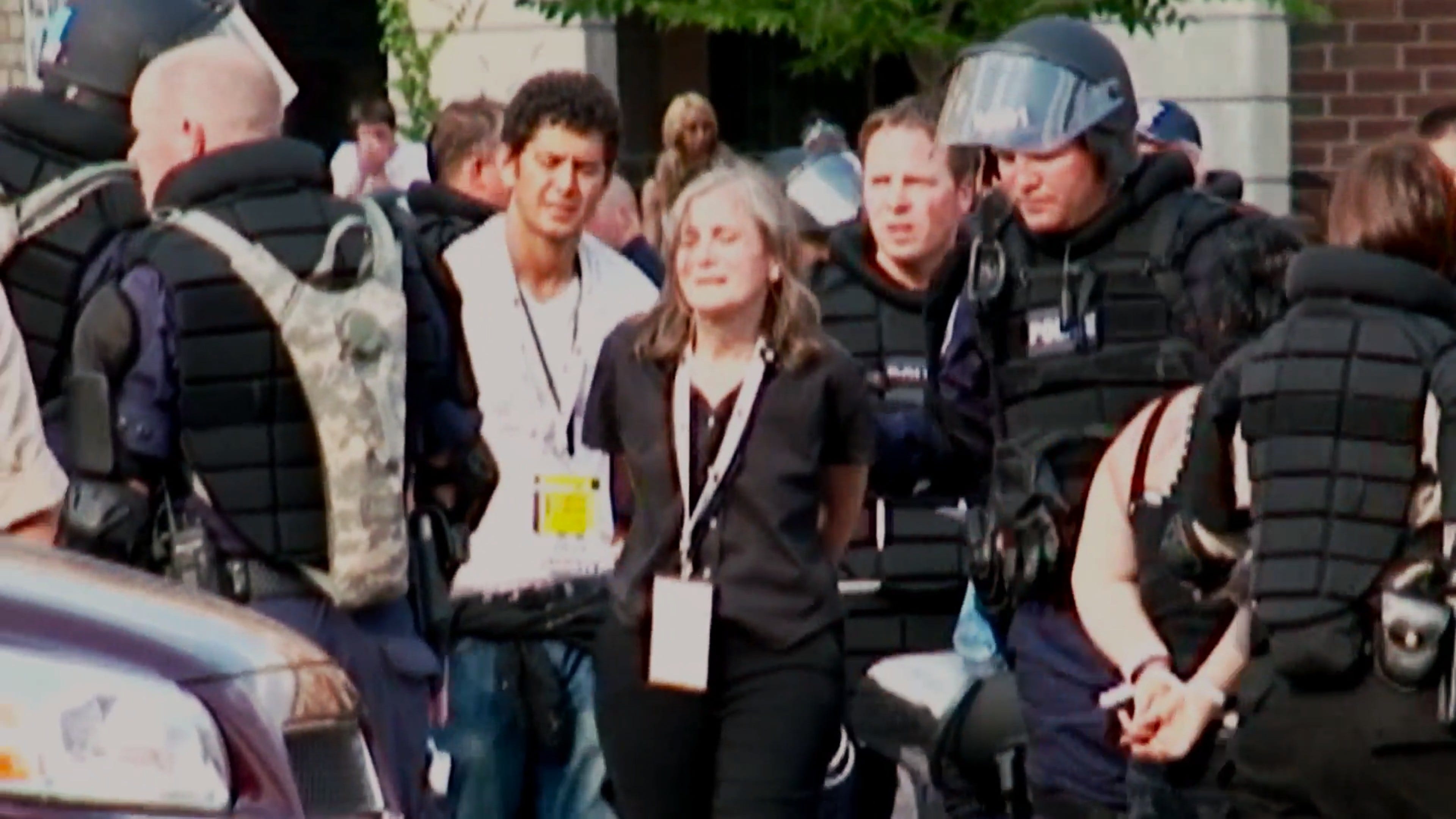
Directed by Tia Lessin and Carl Deal (whose credits include such essential documentaries as Trouble the Water and The Janes), Steal This Story, Please! weaves together highlights from Goodman’s career, including her on-the-ground coverage of a massacre by the Indonesian military in East Timor in 1991 and her legendary grilling of Bill Clinton on election day in 2000.
Released at a moment of unprecedented media consolidation, the film shows just how prescient Goodman was when she launched Democracy Now! in 1996, pioneering a model of independent journalism that many others have since emulated. The program receives no corporate or government funding, currently airs on 1,500 public TV and radio channels worldwide, and just marked its 30th anniversary. (The Boss even showed up to celebrate.)
Steal This Story, Please! also looks at the life experiences that shaped Goodman, particularly her upbringing in a politically engaged Jewish family that thrived on debate (they argued with each other through letters printed in her brother’s homemade newspaper). Goodman says Judaism taught her that “the way you deal with the world is with intense curiosity and not being afraid to stand by your principles.”
After college, Goodman dreamed of becoming a producer on The Phil Donahue Show. Instead, she landed at WBAI, the progressive New York radio station, where she carved out an essential beat covering the people and places too often neglected by corporate media.
Goodman, Lessin, and Deal recently spoke to The Contrarian about making this documentary and its timely message about the importance of independent media.
The following has been edited and condensed for clarity.
How did this project originate?
Deal: Our friend Karen Ranucci, who had worked with Democracy Now! years ago, proposed the idea to us. For us, it was a no-brainer. The only question we had was will Amy, who is so outward-facing, allow us to make it about her? But Amy said yes, and we’re super grateful that she did, because this film gave us something meaningful and purposeful to be doing in a really difficult time in our history.
Amy, you’re used to telling other people’s stories. Was it hard for you to be the subject of someone else’s story and cede that control?
Goodman: I am very private, but I really thought it was worth the price, because the message was about the importance of independent media. Carl and Tia are masters, both as archivists and as artisans of the craft of directing. I just thought it was too important to pass up this chance.
Lessin: Like any documentary participant, Amy was definitely hesitant. Even when she said yes, I think she was still taking a leap of faith, as anyone would, especially someone who knows how to edit and understands that we’re compressing 30 years into 90 minutes. We had final cut, which probably was very hard for Amy, because she is in control of her program from soup to nuts. But she was really gracious and very generous not only with her time, but also with her incredible stash of field tapes and film footage.
It strikes me that revisiting some of this might also have been difficult for you, Amy, particularly the massacre in East Timor in 1991, where you were beaten and witnessed the death of hundreds of people.
Goodman: I live with that every day. East Timor is one of the great genocides of the late 20th century. A third of the population of East Timor was killed by the Indonesian military — armed, trained, and financed by the United States. I survived that particular massacre where more than 270 Timorese were killed — November 12, 1991. In the United States, [East Timor] is hardly known, and yet we’re connected to them through the barrel of a gun. The only way to deal with it is to keep reporting on it and to keep challenging those in power who are making it possible.
You launched Democracy Now! 30 years ago, just after the Telecommunications Act had just been passed and there was a lot of concern about media consolidation. Did you ever expect it could get this bad?
Goodman: We’ve been talking about the corporate media and the danger of corporations running newsrooms for decades. There was always resistance. I’ll never forget Charlie Rose saying, “What do you mean, independent media? What’s that supposed to mean?”
Now those very people who back then were saying, “What are you talking about?” are the ones who are feeling so much pain, and they, too, are sounding the alarm. We can’t sound it loud enough. Independent media is essential to the functioning of a democratic society.
I’ll give one example just from the last few weeks. It looks pretty clear that the US hit this girls’ school in southern Iran, and more than 170 people were killed, the vast majority of them school girls. We had a Washington Post reporter [on the show] who had done an analysis of this whole thing, except that she wasn’t a Washington Post reporter anymore. A week or two before, she had been laid off. Jeff Bezos, the billionaire tech bro who founded Amazon, takes over The Washington Post. They adopt the slogan “Democracy Dies in Darkness,” and he cuts a third of the newsroom, [including] almost the entire Middle East Division, and the US attacks Iran.
Lessin: That was the very same week they put the Melania doc in theaters. Who paid for the Melania doc? Amazon. It was an obscene price tag — $40 million for the film, much of which went into the pockets of the Trumps. So not only was it a bad movie, essentially a commercial about Melania Trump and her fashion sense, but it was basically a bribe to the Trump administration. I think that says it all, yeah, this is where they’re putting their money.

Carl and Tia, media consolidation has also made this a difficult moment for documentary filmmakers. I wonder what challenges you have faced getting your films made and seen?
Deal: It’s never been easy for independent storytellers in the US. Even when we did have public broadcasting money, there wasn’t a lot there. We knew at the outset of this film that we were going to have to do this on our own. We’ve developed and grown a grassroots campaign to support the release of this film. Our campaign right now is all about getting the film seen and trying to maximize its impact. We’re using the theatrical release to organize fundraisers in a lot of the major markets for these [television and radio] stations that are suffering right now.
Lessin: Just a small handful of corporations determine what gets made and what gets distributed. They also determine on what terms, and what they’re paying for these films. As Directors Guild members, we’re seeing the steady erosion of money for our craft. It’s affecting the entire creative community, not just people like us who make these political documentaries.
Goodman: The Corporation for Public Broadcasting was so important for well over half a century. As the media was becoming hyper-commercialized, it was the activists who said that we need to have a nonprofit public space to ensure quality programming. So the Corporation for Public Broadcasting was established. Now the Trump administration has eviscerated it. We’re no longer talking about CPB. We’re talking about CBP: Customs and Border Protection. Rural stations and Native American stations [are] going to feel the brunt of this. Many are going to close right at a time when we need local media to show what’s happening in our communities. It is a serious crisis.
I was really struck by one of the core themes of the film, which is the influence of Amy’s Jewish upbringing on her work.
Goodman: It’s just who I am. My grandfather was an Orthodox rabbi. My great-grandfather on my father’s side was a Hasidic rabbi. As I say in the film, my whole life was infused with those stories — the family members who survived and the family members who didn’t. It was inculcated in me: never again, for anyone, anywhere. I was always amazed, going to Hebrew school, why would people who weren’t Jewish stand up for us, hide kids in barns, put people in their attics, risk their lives to protect Jews? I was so struck by that. That [idea] of “never again, for anyone, anywhere” infuses everything that I do. I thank my parents for teaching me that.
Lessin: I didn’t know Amy’s background before I got to know her through this film. It helped me find a connection with her, because my grandparents were also Eastern European immigrants. My mother was born in Poland in 1933 and came to this country in 1941 with my grandparents. My grandfather was an Auschwitz survivor, and on my father’s side, my grandmother came from the same shtetl as Stephen Miller’s [family].
We’re making this film at a time when Judaism has been hijacked. Our grief around the Holocaust, and maybe even around October 7, has been hijacked by these right-wing forces. We’re telling a different story about Amy’s righteous commitment to social and economic justice. That is not in spite of her Jewish upbringing, it’s because of it. Her extraordinary reporting about Palestine and Israel is not in spite of her Jewish heritage. It’s exactly because of it.
Amy, the film opens with this incredible scene of you trying to get a comment from a Trump official, chasing him up multiple flights of stairs until you are out of breath. We see you put yourself in harm’s way repeatedly throughout the documentary. Where does this determination come from?
Goodman: It’s just following the tenets of good journalism, chasing the story. If someone won’t answer, persist.
Meredith Blake is the culture columnist for The Contrarian.
Amy Goodman is amazing.
Amy is profound and genuine, and the movie is amazing and inspiring. See it!