


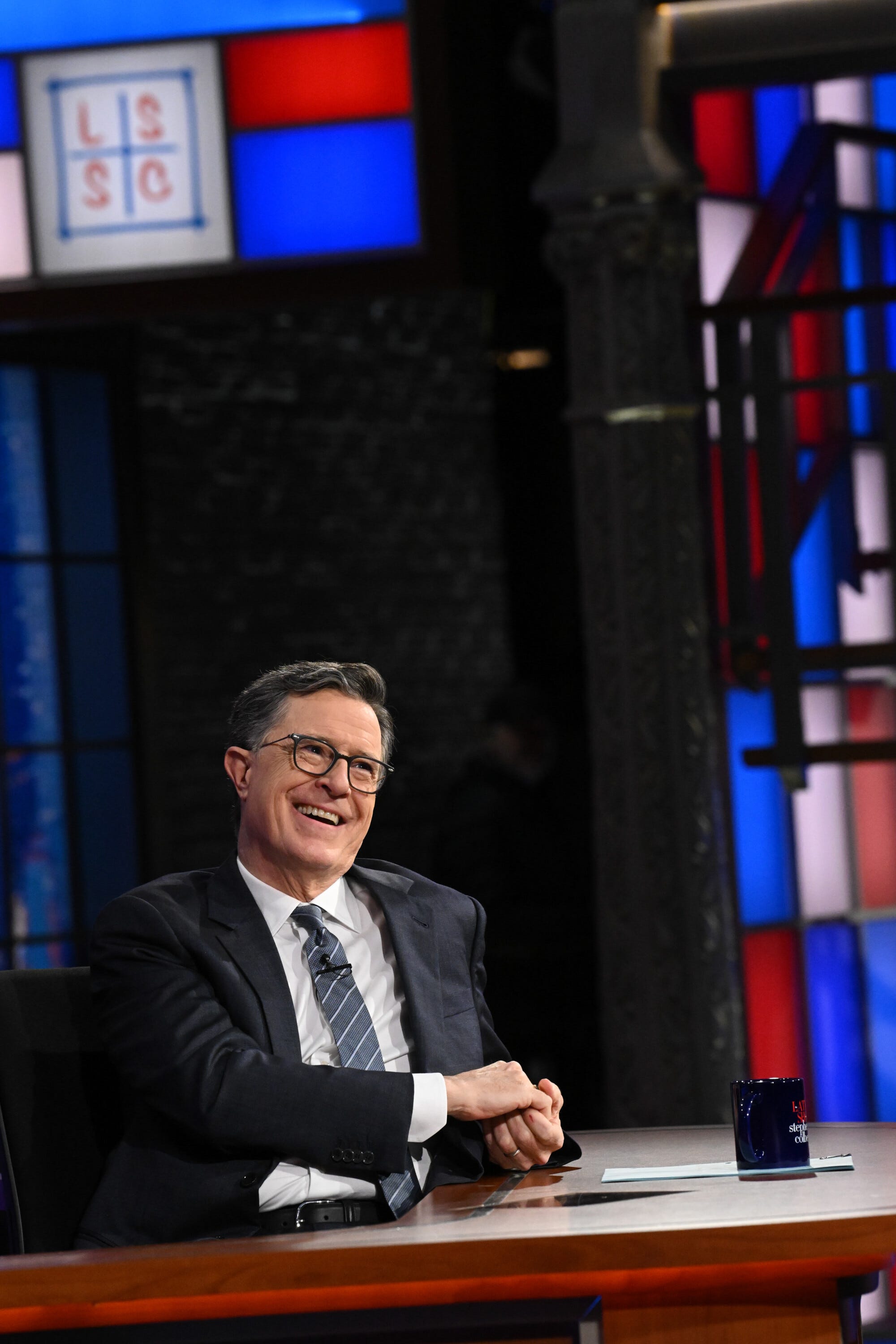
When Stephen Colbert signs off from The Late Show on Thursday after 11 years and 1801 episodes, it will be a loss for comedy fans, for people who believe in free speech, and for the 200 or so writers, staff, and crew members who will be out of a job come Friday morning.
The end of The Late Show will also be a loss for anyone who values thoughtful dialogue about religion, theology, and spirituality, and thinks that liberals of faith have an important role to play in contemporary political discourse.
Colbert is a brilliant satirist and comedian who co-created the cult favorite Strangers With Candy, coined the term “truthiness,” and even formed a super PAC in order to demonstrate the absurdity of our campaign finance laws.
He also happens to be one of the most visible practicing Catholics in the United States. On The Colbert Report, which he hosted from 2005 to 2014, Colbert played a blowhard character who liked to claim he was the most famous Catholic in America. Yet the real-life Colbert has arguably become just that, speaking freely about his beliefs without lecturing or proselytizing. He is also among the most politically influential members of the American church, along with Vice President J.D. Vance and the six Catholics on the Supreme Court.
His voice is much-needed at a time when many so-called faith leaders remain cultishly devoted to the president, even as he posts AI-generated images of himself as Jesus Christ, picks fights with the pope, and threatens to annihilate entire countries. Colbert is a prominent Christian who holds the powerful to account, believes in the separation of church and state, and doesn’t claim that God is on his side, politically speaking.
As he told me in 2018, “You’re only going to corrupt the message of Christ by saying that he likes Republicans more than Democrats. Or he likes Democrats who care for the poor more than Republicans who want to cut taxes. Don’t get your politics in my Jesus, please.”
The youngest of eleven children in a tight-knit Irish Catholic family, Colbert faced unspeakable tragedy at the age of 10, when his father and brothers Peter and Paul — the siblings closest to him in age — died in a plane crash. As he recalled on Father James Martin’s podcast last year, Colbert was suddenly home alone with his grieving mother, a daily communicant who urged him to consider his pain “in the light of eternity.” After a brief atheist phase in college, Colbert returned to Catholicism in his 20s and went on to become a Sunday school teacher.
Though his early forays into professional comedy were more silly and absurdist than spiritually profound, that began to shift with the premiere of The Colbert Report in 2005. On the Comedy Central program, he adopted the persona of an ignorant conservative, a la Bill O’Reilly. But the character had two things in common with the man who played him: he was Catholic, and he loved Tolkien.
“I cannot remove that from me anymore than you can remove the marble from a statue,” he told Martin, a Jesuit priest and author who frequently appeared on The Colbert Report to talk about church news and eventually became the show’s official chaplain. (I would link to some of these interviews, but — unfortunately — Paramount, a corporation dedicated to torching its own legacy, purged virtually the show’s entire archive from the web.) There were many times when Colbert’s Christian beliefs were detectable even through the layers of irony, like when he testified in character at a congressional hearing about migrant farm workers.
“Stephen is, in my mind, an especially good evangelist of the Gospels’ emphasis on care for the poor,” said Martin in 2015, when The Colbert Report was winding down (he has since made numerous visits to The Late Show.)
When Colbert succeeded David Letterman at The Late Show in 2015, he ditched the blustery persona and had to learn how to be himself on camera. It was an awkward transition. The show initially faltered in the ratings, but surged once Trump took office in 2017, and has been the most-watched program in late night broadcast for nine seasons straight. (Ending The Tonight Show’s long ratings dominance.) The turnaround is often attributed to Colbert taking a more sharply political tone. But one could also argue that he thrived once he was able to speak sincerely about his views of the world.
For Colbert, responding to the news requires reflection and self-examination.
“My spiritual practice on a daily basis is trying to understand how I feel about what happened in the world in the last 24 hours,” he said on Martin’s podcast. “I don’t mistake that for prayer, but that deconstruction of the day is like examining your conscience, and you can’t be hypocritical — or rather, it’s best not to be hypocritical — when you’re making jokes about hypocrites.”
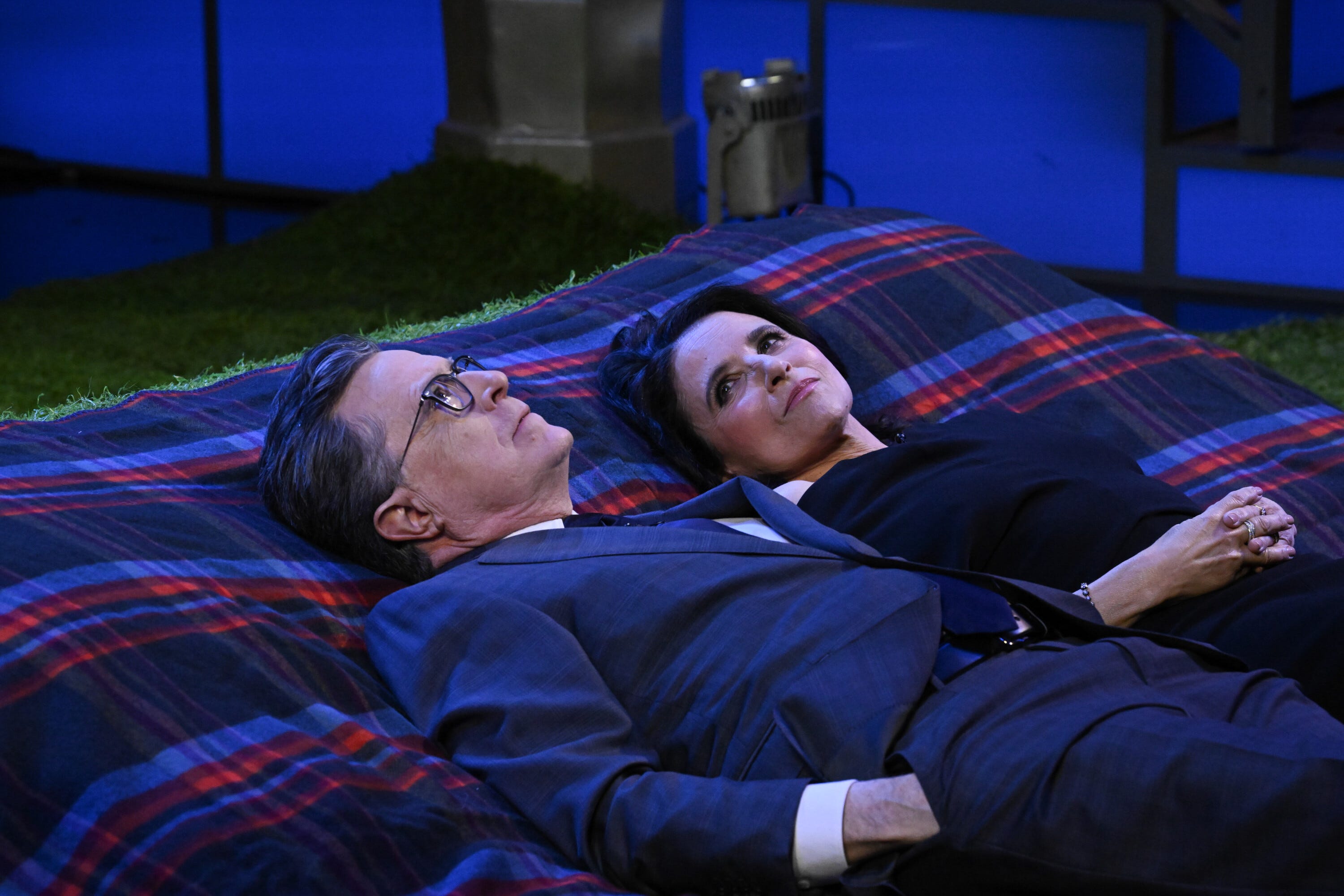
In a recurring segment called “Big Questions with Even Bigger Stars,” Colbert and his guests lie on a blanket and ask faux-profund questions while gazing at the sky. But In a genre increasingly dominated by silly games and canned interviews, The Late Show has become something like the Fresh Air of TV. It is a place where celebrities feel comfortable going a bit deeper, as when actor Andrew Garfield spoke about the death of his mother and musician Nick Cave discussed losing two of his sons,. In 2022, pop star Dua Lipa brilliantly flipped the script on Colbert by asking how his faith overlapped with his comedy, creating yet another viral moment.
A quick glance at the most popular videos on The Late Show’s YouTube reveal just how these moments resonate with the public: Among the most-watched clips is a debate over atheism with Ricky Gervais and a conversation with Jimmy Carter about why he prays for Donald Trump. In a recent interview, which CBS refused to air and subsequently went viral, Colbert chatted with Senate candidate James Talarico, a Presbyterian seminarian, about how the religious right has co-opted Christianity.
Crucially, Colbert doesn’t pretend that he has the answer for everyone, and he clearly delights in having lively, respectful debates with non-believers. Even when dealing with someone as smug and condescending as Bill Maher, he avoids being smug or condescending.
As The Late Show winds down this week, Colbert has booked some heavy-hitters, including David Byrne, Jon Stewart, Steven Spielberg, and Bruce Springsteen. Guests for Thursday’s finale have not been announced, Colbert has repeatedly expressed interest in having Pope Leo XIV on the show, and it doesn’t seem entirely impossible that the pontiff might make an appearance.
As of Friday, Colbert will no longer have a regular perch on the country’s most-watched broadcast network. Even as CBS insists the cancellation was a purely financial decision, we should be concerned that such an essential voice is being pushed off the airwaves.
Yet crestfallen fans should also remember what Colbert told Dua Lipa a few years back:
“No matter what happens, you are never defeated. You must understand and see this in the light of eternity, and find some way to love and laugh with each other.”
Meredith Blake is the culture columnist for The Contrarian
I hope he is given a larger, broader stage to continue to share his thoughts. His is an important voice, especially in the US and where, and how, it is right now. (And, as an aside, I would love to see Pope Leo XIV as his guest on Thursday - what a blessing that would be!)
"The end of 'The Late Show' is a loss for anyone who values thoughtful conversations about faith, spirituality, and belief"
Indeed, this, in combination with his humanity, in large part, what makes Colbert so important. He uses his plentiful basket of skills as an entertainer, his curiosity and search for both knowledge and the truth to communicate with both his guests and his audience. There have been many great comedians and humorists in history; Colbert is carrying on that tradition from Will Rogers who appeared nightly on network radio and was syndicated in newspapers nearly a century ago, and whose commentaries can be applied directly to the politics of today! I consider both among the greatest of Americans.